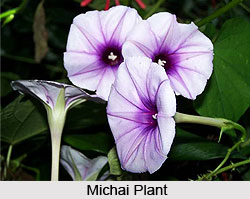
 Michai is the largest genus in the flowering plant family "Convolvulaceae", with over 500 species. The genus occurs throughout the tropical and subtropical regions of the world, and comprises annual and perennial herbaceous plants, lianas, shrubs and small trees; most of the species are twining climbing plants. Most species have spectacular, colourful flowers and are often grown as ornamentals. Michai plant is quite frequently cultivated in India. It has been naturalized in India and is commonly found from the upper Gangetic plain and the Himalayas up to 1500 m to West Bengal. The plant is also found southwards through the hills of central India to Karnataka.
Different Names of Michai
Michai is a medicinal plant commonly found in India, having several names in different native Indian languages. The botanical name of the plant is "Ipomoea Turbinata Lag" and "Michai" is actually its Hindi name. The plant is called in the same name in Bengali also and in Gujarati, it is known as "Garayo". While the Malayalam speaking people call the name as "Mukkattikay", it is known as "Kattutali" to the Tamil speaking people. It is a large and diverse group with common names including "Morning Glory", "Bindweed", "Moonflower" etc.
Characteristic Features of Michai
The leaves of Michai plant have a width of 6-13 cm and length of 7-18 cm and their shape is ovate to orbicular. The base of the glabrous leaves is cordate and the apex is acute to acuminate, with the margins entire. The petioles are 7.5-15 cm long. The flowering part of the plant is few-flowered, with 3-6 cm long muricate peduncles. The plant`s flowers are borne on 1-2 cm long pedicels, while the sepals are unequal and ovate to oblong. The corolla of the plant is nocturnal; having a shape like funnel and its colour is lavender to purplish. The corolla is 5-7.5 cm long and the tube is narrow and cylindrical, having a length of 3-6 cm. The tube is hairy within.
The fruits of Michai plant are capsular, ovoid and apiculate and they have a length of 1.8-2 cm and diameter of 1.3-1.7 cm. The plant`s seeds are ovoid, smooth, and shiny and their colour is black. The fruits` length is 1 cm and the plant usually flowers and fruits between the months of September and January, in central India.
Medicinal Values of Michai
Michai plant has a few useful medicinal properties and usages. The Indian people consider the bitter seeds of the plant to be purgative and they mainly use them as a substitute for those of "Ipomoea Nil" known commercially as "Kaladana". The Mundas of Chota Nagpur, Bihar, are reported to take the powdered seeds in small doses for getting relief from fevers. Apart from that, the juice of the plant"s leaves is used as an insecticide, as well.