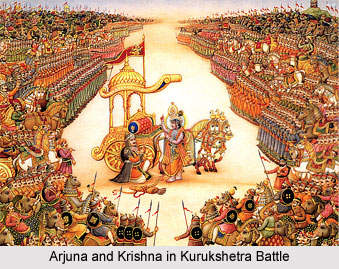
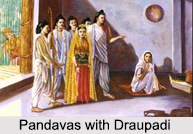
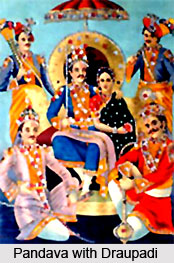
 Mahaprasthanika Parva is the seventeenth Parva or episode of the great Hindu epic of Mahabharata. It contains one sub-parva. It is one of the most essential concluding parts of the epic. In this Parva, the great journey of Yudhishtir and his brothers along with Draupadi across the whole country is described elaborately. This episode elucidates their final ascent to the great Himalayas where each of the Pandavas falls down except Yudhisthir. The total number of slokas composed by Vyasa in this Parva is three hundred and twenty. While journeying the entire country, Yudhisthir was accompanied by a dog which would not leave Yudhisthir.
In this episode, an apt description is given which speaks of the occasion when the Pandavas came across Lord Agni, while travelling on the shore of the sea of red waters. It is also narrated in this Parva that Agni asked Arjuna to give back his celestial bow or the Gandiva. This Episode commences with the introduction of the Pandavas who renounced their throne and prepared for their great journey along with Draupadi. After reigning with supremacy for several years and after the death of Lord Krishna, the Pandavas understood that the time had come for their departure from the mortal world. Thus the five brothers accompanied by Draupadi started for the Himalayas renouncing kingdom and all luxuries.
Journey of Pandavas to Heaven
While on their way to heaven, after travelling for quite sometime, Draupadi was the first to embrace death. Seeing Draupadi dead, Bhima asked Yudhisthir the reason behind the same. Then Yudhisthir told to Bhima that even if all of them loved her equally, Draupadi had more inclination towards Arjuna. Then Sahadeva fell down and Yudhisthir told that the son of Madri always thought that there was nobody in the earth who was equal to him in wisdom. Thus, Yudhisthir, along with Bhima, Arjuna, Nakula and the dog proceeded further. After some time, Nakula fell down and again Bhima enquired about the fall of his younger brother who was ever loyal and obedient to all of them. Then Yudhisthir replied that Nakula thought himself to be the most beautiful person in the earth and it was for that reason that he fell down. He also told that whatever was ordained for a person was required to be endured by the same person only. Thus, they moved further in their journey towards heaven. Then fell Arjuna, the great archer and again Bhima asked to his elder brother the reason behind the fall of Arjuna. Yudhisthir then replied that Arjuna was very much proud of his mastery in archery and also once uttered that he would consume all the foes in a single day which he was not able to accomplish. It was for that reason that Arjuna was not able to proceed any further towards the heaven. At last, Bhima fell down and at that time he asked his brother to explain him his fault. Yudhisthir then replied that Bhima was a voracious eater and he never cared for the wants of other while eating and thus suffered death before reaching heaven. Thus, Yudhisthir, accompanied by a dog, proceeded towards heaven.
After the fall of Draupadi, Sahadeva, Nakula, Arjuna and Bhima, Yudhisthir and the dog proceed alone towards heaven. Then a clap of thunder arrested their steps, and in between the mass of brightness they saw the god Indra, King of Heaven, who was standing in his chariot. He arrived there to carry Yudhisthir back with him to Heaven, and immediately requested the son of Kunti to enter the chariot. When Yudhisthir tried to enter the chariot along with the dog, Indra objected and asked Yudhisthir to abandon the dog and to enter the chariot alone. Dog is regarded unholy by the Hindus. It was impossible to contemplate the idea of a dog in Heaven. However, Yudhisthir refused to do so since, for him, the dog appeared as one who was devoted, loyal in time of loss and disaster, loving and faithful in the time of entire solitude. Thus, he was not able to think of happiness, even in Heaven, if the dog was not taken by him to heaven. Thus he told to Indra that he was not in a position to abandon the dog and then asked him either to admit him and the dog together to heaven or he would not require the safety and luxury of the place by leaving the dog. After Yudhisthir spoke in such a way, the dog changed himself in the form of Dharma itself and acknowledged the righteousness of Yudhisthir and expressed that people in future generations would praise and remember him as the most righteous person ever born. With this ends the Mahaprasthanika Parva of Mahabharata.