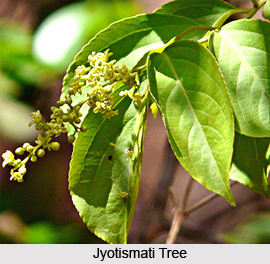
 Jyotismati is an Indian medicinal herb that is botanically named as Celastrus paniculatus Willd. This plant is commonly known for its medicinal usage in all over India. In Bengali this plant is called `Lataphataki`, in English `Black oil plant`, `Malkangana` in Gujarati, in Hindi `Malkamini` and in Kannada `Bhavanga beeja`. This plant is also preferred and well admired in other states of India like the people of Maharashtra call it by the name of `Kanguni`; the people of Odisha call this herb by the name of `Korsana`. The inhabitants of Tamil Nadu know this herb by the name of `Kaligam`.
Availability and cultivation of Jyotismati
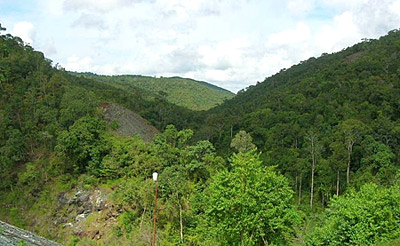
The herb Jyotismati occurs naturally from South Asia eastwards. This herb is found throughout most of India up to an altitude of 1800 metre, chiefly in deciduous forests. Not only in India, the herb is found in many places outside India.
Characteristic features of Jyotismati
Jyotismati plant is a large, woody, climbing shrub that is up to 10 metre tall. The bark of the plant is yellowish or pale brown in colour, corky, exfoliating in small and soft scales. The inner bark is pink, finely streaked with red or reddish brown. The twigs are smooth, tinted in reddish brown, are densely covered with small and elongate white lenticels. The leaves are broadly elliptic ovate or obovate, 4.5cm to 15cm long and 2.5cm to 8cm wide and the apex varies from acute to shortly acuminate. The base is cuneate, margins are crenate serrate. The lateral nerves vary from 5-8 pairs, midrib is elevated on both surfaces and the petioles are 0.8cm to1.5cm long.
Jyotismati flowers are unisexual, yellowish or greenish white in colour, 3.8 mm in diameter and are borne in pendulous terminal panicles that are 5cm to 20 cm long. This plant contains fruit that is a subglobose capsule 0.5cm to 1cm long and 0.5cm to 0.8 cm in diameter. The fruits get bright yellow when they mature, are three valved, and the fruits carry one to six seeds. The seeds of the fruit are ellipsoid or ovoid, transversally wrinkled, reddish brown in colour, are enclosed in a fleshy and scarlet aril. In central India flowering occurs between April and June and fruiting from October to December. The trees remain leafless for a short period between March to April and April to June.
Medicinal properties of Jyotismati
The seeds of Jyotismati tree are credited with emetic, diaphoretic, febrifugal and nervine properties. The seeds are also used in traditional Indian medicine for sharpening the memory and to cure sores, ulcers, rheumatism and gout. The seed oil acts as a powerful stimulant. Though the entire plant is considered to be of immense use but the root has massive medicinal properties. A drug combination that contains the seed oil has shown good results in the treatment of hysteria in clinical trials without any side effects. The practitioners of medicine consider the seeds useful as it is also used in the treatment of scabies, body and rheumatic pains, wounds, eczema, beri beri and paralysis. The tribal inhabitants of southern Bihar, the seeds are used to treat intestinal ulcers and tuberculosis. The practitioners` of Ayurveda use the seed and seed oil to treat epilepsy, stomach disorders, psychosis, oedema, diseases of the nervous system, and as a brain tonic.
In Siddha practice, the leaf and seed oil are used to treat diarrhoea, cough, constipation, menorrhagia and ulcers. The leaves and roots are used as a poultice to cure headache. An infusion of the leaves of Jyotismati tree mixed with the juice of Centella asiatica (Apiaceae) is reportedly taken as a nervine tonic among the Rabaris in the Barda Hills of Gujarat. The crushed root is used to treat pneumonia. To cure spermatorrhoea, leucorrhoea and piles, the inhabitants of the Gandhamardan Hills in Odisha make a paste of the root, rice water and black pepper and consume internally. Among the Gonds of Uttar Pradesh, the powdered root is considered useful for the treatment of cancerous tumours. The bark of the plant is used as an abortifacient. The practitioners of Ayurveda as well as practitioners of other medicinal institutions vastly use various part of the plant to treat sore throat, anaemia, colic, syphilis and carbuncles.