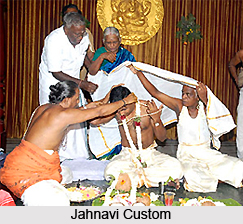
 A jahnavi is hand-woven cloth made of raw cotton with three strands of thread. The jahnavi is not made of wool or silk, since these materials have a different electrical potential. The three strands of thread in the jahnavi possess three peculiar knots. The jahnavi relates to the body`s three most important nadis and with the three principal knots, which has to be pierced if Kundalini is ever to be fully awakened.
The jahnavi is always worn from the left shoulder down to the right waist, except when certain rituals like Pitri Tarpana or the ancestral worship is performed. In these situations, the jahnavi is worn opposite, from right shoulder upto left waist. Great people like kings, princes and generals used to wear their swords, bandoliers or sashes left to right as well. A sash creates both a mental and physical sense of command; similarly a jahnavi creates a spiritual sense of command, which is necessary for the path of jnana or knowledge that deeply affects the mind.
A jahnavi has some significant effects on the physical body. The jahnavi makes the right, or masculine, side of the body predominant and by wearing it over the left shoulder, the jahnavi helps a man to accumulate and harness immense Shakti through the Kundalini Yoga. Whatsoever, a woman has no need to wear a jahnavi because she is the embodiment of Shakti. It is a custom that one should drape the jahnavi across his right ear, while going to any soiled area, for instance toilet. This is to avoid the downward-moving form of the body`s Shakti.
During the Vedic era the jahnavi happened to be an integral part of sadhana. Jahnavi was first introduced in a boy`s life, when he was ready to begin his education with a guru on an auspicious day, while the Upanayana ceremony. First he would be bathed and then have his head shaved. Finally, the boy has to appear before his guru, who would show him how to tie his loincloth, which was one long piece of cloth that is not the sewn thing that people use today. The true jahnavi has to be properly tied so that it would press on a certain vertebra, and thus stimulate some particular nadis. This signified the start of the period of the boy`s life during which he would be a celibate student.
Then the boy has to bow down in the posture of a full prostration to the guru, who would touch the boy`s head and thus bless him. While holding the boy`s head the guru would use phrenology to check out which parts of the brain were most fully developed, in order to determine which branch of knowledge the boy should pursue. A well-developed occipital would indicate a talent for mathematics, and so on.
This stage of Upanayana is an apt moment to test the boy`s other capabilities as well. Suppose the guru desired to know whether his student could succeed at alchemy. He would eventually pour mercury into the palm of the boy`s hand, and tell him to pour it back into the bottle without spilling a drop. If the boy succeeded in this, he was fit to be an alchemist. A person can only do this task if he had one long, straight line running across his palm, thus palmistry is again closely associated in this case.
When the guru had decided what the boy was fit to study he would commence him into that version of the Gayatri Mantra, which was most suitable for him, and would make him wear the jahnavi. Then the boy`s parents would ask him to return home. If the boy really wanted to succeed, he would ignore them and stay with the guru. The jahnavi has a strong power of retaining the power of a Brahman`s knowledge and hold him back to the spiritual world.
Today, jahnavi is hardly worn in its traditional manner and it has become merely a custom. The significance of wearing a jahnavi is closely associated with one`s self-realisation to choose the materialistic or spiritual world accordingly.