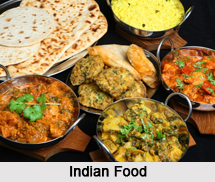
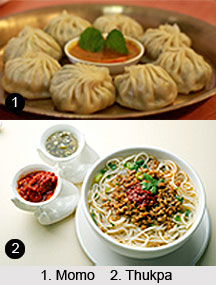
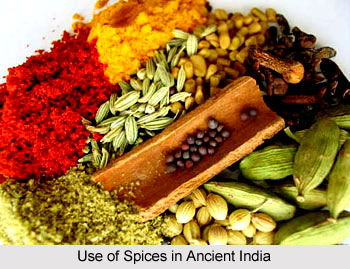
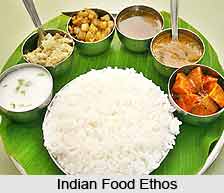
 Indian food ethos has originated from the beliefs of Aryan people which efficiently aimed at hygienic perfection of human civilization. There are several eating rituals in India, prevalent from the early ages. The ways of preparing, time for eating, fasting, and positions to sit and eat all are specific eating rituals in India. Eventually, with the passage of time many more Indian food ethos came into practice and the elders of the household initiated these practices into the coming generations.
Food in Aryan belief was not simply a means of bodily sustenance; it was part of a cosmic moral cycle. According to them, the eater, the food that the eater eats and the Universe must all be in harmony. All food on being digested was believed to give rise to three products. The densest of these is called the "Faeces", which gets excreted; the product of intermediate density is transmuted into "Flesh", and the third product, the finest and rarest, is called "Manas", which is thought or mind. Their main objective to follow the particular eating rituals was to manage the three final products. They believed in taking time to consume food properly and digest it at its best.
Ethics of Cooked Food
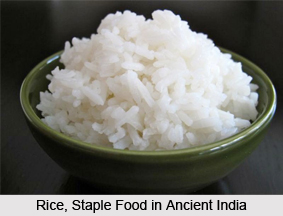
Kaccha (uncooked) foods are basically foods cooked in water like rice, khichdi and dal. These items of food are considered both exclusive and pure. The Indian food ethos also signifies that boiling food with water tends to render any "anna" or its flour pure. Once the cooking of a kaccha food starts, usually by setting the rice or dal to boil, the cook cannot leave the food area till the meal has been prepared, served and eaten following ritual rules.
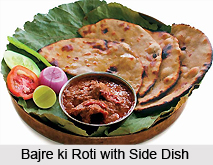
Wheat breads like roti and chapatti were not in vogue during the Vedic times, and therefore escaped the classification of Indian food ethos since they do not involve boiling. These items are strictly termed as kaccha foods, even though they are eaten at every meal. Kaccha food should be cooked afresh for every meal and leftover or stale food, termed as "basi" or "jutha" becomes polluted, according to the eating rituals in India.
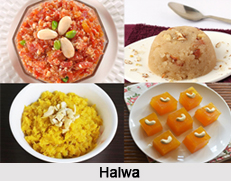
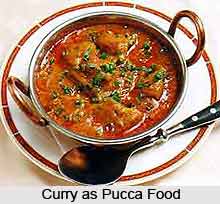
The Pucca or cooked foods are essentially those foods that are cooked with fat (course ghee). These foods are used outside the domestic cooking area. According to Indian food ethos, cooked foods are fundamentally those foods whose first contact is with ghee (fat). It is an ancient cooking ritual in India that while preparing halwa, the ghee must first be added to the pan and only then should the anna or phala follow. 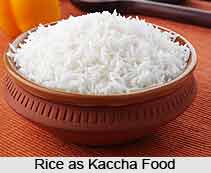 Sometimes, use of the same ingredients in a different sequence will determine the ritual classification. Thus to make kheer, a pucca food, the rice must first come into contact with ghee, before milk, fire and sugar come in its contact. If this sequence is not followed, and the rice is added to boiling milk, followed by ghee and sugar, the dish will be called "doodh bath", and is a restrictive kaccha food. Common daily dishes are most affected by such sequences. Pucca foods do not have much restriction and are less liable to pollution, and can be shared outside the family by those of either lower or higher levels of purity.
Concepts of pollution are intimately woven into the practices of eating and cooking. The cook should not taste the food while it is being prepared. Also, water should not be sipped from a tumbler, but must be poured into the mouth from above, since ones own saliva is polluting. Water used for rinsing the mouth must be cast out, never swallowed.
The domestic cooking practices also follow the Indian food ethos. The domestic hearth in a Hindu home was considered an auspicious area of high purity, even of sanctity. The domestic hearth had to be located far from waste disposal areas of all kinds and demarcated from sitting, sleeping and visitor receiving areas. The cook was obliged to take a bath and put on unstitched washed clothes.
Ethics of Eating Food
Prasad or the left over of food that has been offered to the Gods is thought to be pure "rasa" or essence that leaves no residue and maintains mans spirituality. Thus the Prasad is not supposed to be dropped on soil or stamped. If there is any residue left, it should be flowed in the river water. Prasad should not be taken after eating lunch or any non-vegetarian dish and after the intake of this holy food; one must drink water or wash his mouth.
The eating rituals and ceremonies have always been followed sternly in majority households. Food was never to be eaten standing up, lying down, and moving about or from the lap. One had to eat sitting on the ground, alone, facing east or north, and in total silence. Morsels of the meal were to be cast into the fire as an oblation, and prayers offered to various deities and ones ancestors. Portions of food reserved for Brahmins, serpents, dogs and insects, and laid outside for crows, who were believed to be messengers to the world of spirits.
 The householder was expected to see to the feeding of his guests and of any pregnant women, infants and aged persons in his household before he himself sat down to eat.
The Indian food ethos also includes a custom of respecting the forefathers and offering them food before one consumes it. Prior to eating, a few drops of water would be sprinkled on the leaf for purity, and, on the rice that had been served, a few drops of ghee. Every item placed on the leaf had its exact position and ritual eating order. Today these practices have become region specific. The higher male principle resided on the right, therefore, only the right hand was used for eating, reserving the left for baser functions outside the meal.
The Indian food ethos is still followed in contemporary generations, but much of the rigidity has faded away. The religious customs of food making merged into the regular food habits, however still these rituals and customs are significant in Indian homes.