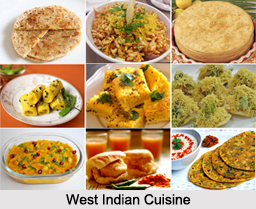
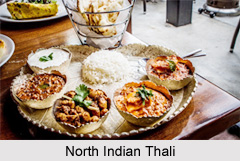
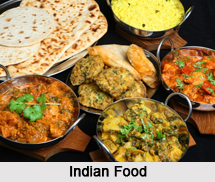
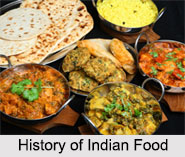
 History of Indian Food has experienced extensive immigration and intermingling through many descents. Influences on Indian food have been a 4000 year old history of several cultures interrelating with the country, leading to a vast assortment of flavours. This reflects not only huge variety of people who inhabit in India, but also the various forms of cuisine and delicacies of various communities. Along with this, history of Indian food also depicts the evolution of Indian food in different stages, which can be largely divided into food in ancient India, medieval India and contemporary India. Overall the popularity of various food items in India specifically describes India"s notion of unity in diversity.
Ancient History of Indian Food
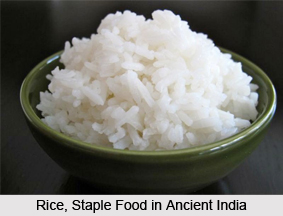
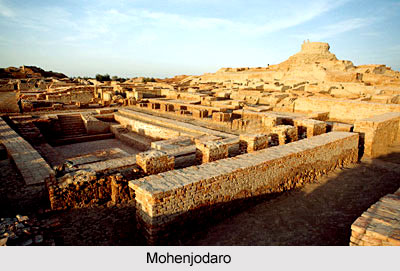
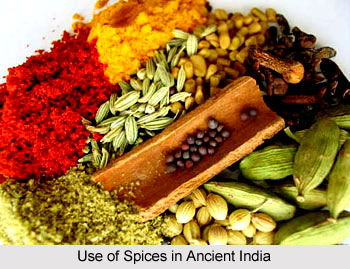
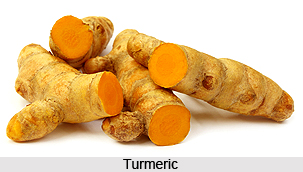
History of Indian food can be traced back to the prehistoric days when the culture of preparing food with proper preparation was introduced by the two earliest civilization of Indus valley Civilization. The Harappa and Mohenjo-Daro Civilisation for the first time introduced the science of cultivation that included a number of cereals and pulses. The Vedic period was defined as better forms of cuisines with new developed recipes. While the Indian society is predominantly agrarian, it cultivated large varieties of pulses, grains and vegetables that were complemented by hunting and forest produces. In Vedic times, a normal diet of an Indian consisted of fruit, vegetables, meat, grain, dairy products and honey. It also included beverages along with special kind of spices that was used by the Vedic people.
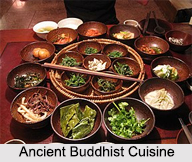
The Aryans who travelled from Central Asia introduced a number of food items which complemented the then existing Vedic culture. Along with this, food in ancient India also included food in Maurya Empire which was extensively discussed by Kautilya in Arthashastra. Kautilya lays down certain specifications regarding the structure of kitchen, the food items to be cooked and the purity to be maintained while cooking. Food in Ancient India further faced huge changes during the Gupta Empire which was greatly influenced by Buddhism and Jainism. During this period, consumption of meat was condemned as they considered some animals as sacred and considered food to be a part of religion. Though intake of sheep, goat and chicken was still prevalent, but under the influence of religion most of the people were vegetarian.  Overall the food in ancient India greatly contributed to the development of mind, body and spirit which reflected the growing changes within Indian food habits.
Medieval History of Indian Food
Food habits in Medieval India underwent changes with the advent of invaders from Central Asia. The Muslims introduced the most popular Mughal cuisine which forms a major part of Indian menu even today. Along with this, they brought different kinds of dry fruits and flat breads among the Indians. The Mughals were great patrons of cuisine. Lavish dishes were prepared during the rule of Jahangir and Shah Jahan. The Nizams of Hyderabad state, meanwhile, developed and mastered their own style of cooking with the most notable dish being the "Biryani". Next to this, the Portuguese introduced the Indians with "Vindaloo" and many other dishes. This was followed by the Chinese influence on Indian food that travelled along with the Mongoloid race from Central Asia. Along with this, food in medieval India was also influenced by the British and Anglo-Indian. The British introduced Western style of food in India which was gracefully accepted by the Indians along with their traditional past.
Contemporary History of Indian Food
History of Indian Food in Modern India mainly carried the traditional trends of Indian cuisines including the traditional Hindu vegetarian food as well as Mughal delicacies of Medieval India along with Chinese and other foreign delicacies. As such in the way of highlighting unity in diversity, India in modern days enjoys all kinds of delicacies. The trend of globalization has also revolutionized the food junction. Italian cuisines like pasta, pizzas, macaroni, Indianised version of Chinese, Mexican, and Thai etc is no more a far flung conceit, but within the physical and financial reach of middle class even.
Thus, the history of food Indian food has been an assimilation of all cultures that inhabit in India.