 Traditional Dress of Tamil Nadu portrays the cultural and traditional essence of the state. The men of Tamil Nadu wear traditional attires like Lungi or Dhoti, with Angavastra and a shirt. The women adorn themselves in traditional Saree and blouse. Poetic references indicate that during the Sangam Age in ancient Tamil Nadu, a single piece of clothing served as both lower garment and head covering, leaving the bosom and midriff completely uncovered. Traditional dress of Tamil Nadu possesses a certain aura within their dress materials with zari work predominating amongst women and white dhoti amongst men.
Traditional Dress of Tamil Nadu for Women
Women of this state are decked with the traditional sarees that mark them from rest of the communities. Even in ancient Tamil poetry Silappadhikaram (Cilappatikaram), people can get a clear image of women in sarees. The ageless charm of the traditional sarees is the identity of the women of Tamil Nadu. In Tamil Nadu, sarees are available in a variety of materials like cotton, chiffon, crepe silk, organza, silk, georgette, Pattola silk, micro silk, etc. Till a few years ago, the half-saree or Pavada besides serving as the traditional dress was also the most admired costume of young girls in Tamil Nadu. Full-length skirt, short blouses and a davani (shawl) successfully completed this dressing style.
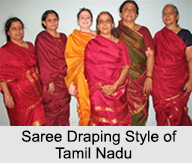 Tamil Nadu"s Kanchipuram silk sarees are the most famous traditional sarees and women mainly wear them on important occasions like wedding, religious ceremonies etc. This saree is woven from pure mulberry silk thread. It is produced in the Kanchipuram region of Tamil Nadu. Tamil women like to drape their heavy Kanchipuram sarees around themselves keeping the lower part of the calf exposed and the extra piece of pallu wrapped around her waist.
The features of the Kanchipuram sarees are wide contrast borders, temple borders, checks, stripes and floral designs. The patterns and designs in the kanchipuram sarees were inspired with images and scriptures in South Indian temples or natural features like leaves, birds and animals.
Traditional Dress of Tamil Nadu for Men
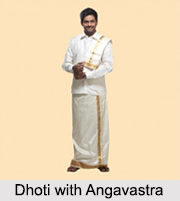
For men, traditional dress of Tamil Nadu is lungi, together with a shirt and Angavastra. The lungi is a rectangular cloth, normally manufactured from cotton, and worn around the thighs. A dhoti is a rather longer lungi, but with an additional length of material hauled up within the legs. The Angavastra is an elongated piece of cloth wrapped around the shoulders. In earlier times, it was donned instead of an upper garment, but nowadays men wear an Angavastra over a shirt.