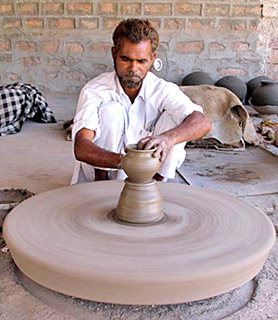
 Brahma satyam jagan mithya is translated, as Brahman is real; the world is unreal. This Mahavakya of Hinduism portrays that the absolute is real and the world is unreal or only relatively real. The saying Brahma satyam jagan mithya is a metaphor; the inner meaning of the Mahavakya is that like saying that the clay in a pot is real, or the gold in a bracelet is real. The idea that is depicted says earlier there was clay and gold, and when those changed form, there now appears to be a pot and a bracelet.
The world is unreal because finally, the pot is broken, or the bracelet is melted, there is once again only clay and gold. Thus, there is only the pot and the bracelet that are not real; they come and go from materialization. They are not as real as are the clay and the gold. It is also true that clay and gold also come and go, such as when planets are born and die from the nuclear fire of suns. It is also to be noted that the English words real and unreal for the Sanskrit words satyam and mithya, are not exact and accurate but they are the best synonyms.
The Mahavakya, Brahma satyam jagan mithya also indicates a denotation like something is more real than the temporary. In saying that the world is unreal, it is literally meant that everything experienced in the external world is, like the pot and the bracelet, in a process of coming, being, and going and the similar concept is applicable for all of the objects of the subtle realm. If this Mahavakya stopped there, this might appear to be a negative statement, or depressing remark. However, this Mahavakya also adds that this absolute reality is, in a sense, more real than the temporary appearances.
`Brahma satyam jagan mithya` reminds its believers two major things. It serves as a reminder of the temporary nature of the worldly commodities. It also serves as a reminder that there is an eternal nature that is not subject to change. In these reminders, the saying offers an invitation to come to know, in direct experience, the existence, consciousness, and bliss that is this eternal essence of human being.
When a Yogi practices contemplation with this and the other Mahavakyas, it is important to restrict the reflection that the world is unreal to stop him from doing his actions in the external world. He has to compulsorily think that the world is unreal. The realization of the unreality of the world and the reality of the essence behind the world brings freedom and not bondage or exhaustion.
The purpose of contemplation and yoga meditation following the `Brahma satyam jagan mithya` exercises is to attain Self-realization, or enlightenment, which is closely related with knowing or experiencing the deepest, eternal aspect of our own being. By working with this Mahavakya, one gradually sees the difference between what is temporary and what is eternal. One major way to work with this Mahavakya is to simply be aware of the world around. Gradually, gently, and lovingly one should observe the countless objects that are ever in a process of coming and going. One should remember the eternal nature that is always there, enjoying the beauty of how this process of ebbs and flows through that unchanging, eternal essence.
As the Yogi witness the external world in this way, he will eventually allow his attention to shift to his own physical, energetic, and mental makeup. Gradually he develops the insight that these superficial aspects are also temporary, and in a sense, is also unreal, or only relatively real. It steadily allows the mind of the Yogi to see that there is an eternal aspect of human being, and that this is actually the source of the mind itself. The mind comes to see that it must, itself, free itself, so as to experience the eternal that lies within.
By observing the world in this way, it is then easier to do the same kind of silent observation and contemplation while sitting in the stillness with the `Brahma satyam jagan mithya` Mahavakya. Over time, the depth of the insights increase, as an inner expansion comes.