Legends of Krishna in
Harivamsa Parva are found in the second section of this Khila of the
Mahabharata. It deals almost exclusively with Lord Krishna, the mortal avatar of Lord Vishnu. All the stories of the birth and childhood, the heroic deeds and love adventures of the all-too-human, cowherd-god, are related here at great length. It essentially describes the life of Lord Krishna after the end of the great battle at
Kurukshetra.
In the town of
Mathura there reigned the evil king Kansa. To him
Narada announced that he would meet his death at the hands of the eighth son of
Devaki, the sister of his father and the wife of Vasudeva. Kansa determines to kill all Devaki`s children. He has Devaki closely guarded by his servants, and six of her children are killed immediately after birth. The seventh child is rescued by Nidra the goddess of sleep. She transfers the boy (Balarama) before he is born from the womb of Devaki to that of Mohini, another wife of Vasudeva. The eighth son, Krishna, was exchanged by Vasudeva himself, immediately after birth, in order to rescue him from Kansa, with the daughter of the cowherd
Nanda and his wife
Yashoda, who was born at the same time. So the little daughter of the latter is dashed against a rock by Kansa, while Krishna is regarded as the son of a cowherd and grows up among the cowherds. Balarama, too, is entrusted to the protection of the cowherd family by Vasudeva, and the two boys grow up together in the cowherds` station.

Even as a toddler, Krishna performs wondrous miracles. One day, when his foster-mother Yashoda, after having laid the sleeping child under a wagon, lets him wait too long for food, he begins to struggle impatiently with hands and feet, and finally overthrows the heavy wagon with one foot. The boys Krishna and Rama later rush through forest and field, and make much trouble for the simple cowherd`s wife. On one occasion she hardly knows what to do, so she ties a rope round little Krishna`s body and fastens him tightly to a heavy mortar. But the boy not only drags away the mortar with him, but as the mortar gets caught between two gigantic trees, he tears out the mighty trees by their roots. Horrified, the cowherds and the foster-mother see the boy sitting laughing between the branches of the trees, but he himself is uninjured.
After seven years had elapsed, the boys grew tired of the cowherds` station. So Krishna caused innumerable wolves to issue from his body, which frightened the cowherds so much that they decided to wander further. They wandered with to the Vrinda forest. Here the boys now run happily through the forest. One day, while Krishna was strolling along the banks of the
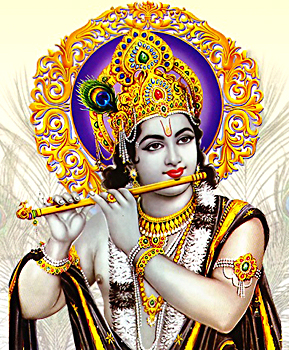
Yamuna River all alone, singing and playing his flute he reached the deep lake in which the snake king
Kaliya used to live along with his retinue. He used to poison the water of the river and make the entire neighbourhood safe. Krishna swiftly plunges into the lake, in order to overcome the frightful dragon. Soon the five-headed, fire-breathing monster appears, and a host of snakes rush furiously upon the youthful hero, surrounding and biting him. But he soon frees himself, presses the heads of the monster on the ground and jumps with force on to the middle head so that the dragon confesses himself conquered and retreats with the whole brood of snakes. Soon afterwards he also slays the demon
Dhenuka, who, in the form of an ass, guards the mountain Govardhana. Another demon, the giant Pralamba, does not venture to tackle Krishna but is slain by Balarama.

In the autumn the cowherds, according to their custom, wish to hold a great feast in honour of the rain god Indra. However, Krishna wanted none of this celebration of Indra. He told the men that since they were cowherds had to wander through the forest, it was the vows who were their deities. They lived by the wealth of the cows and it was the cows who were their deities along with the hills and forests. In such words he invites the cowherds to hold a mountain-sacrifice instead of the Indra celebration, which the cowherds do. At this Indra is so enraged that he sends down a frightful storm. But Krishna lifts up the mountain Govardhana and holds it like an umbrella over the cowherds and their flocks, so that they are entirely protected. After seven days the storm ceases, Krishna restores the mountain to its place and Indra humbly recognises in Krishna the exalted Lord Vishnu. Then the cowherds praise and worship him as a god, but he smilingly declares that he only desires to be their relative. The time will come later when they will recognise his true nature. And as a cowherd among cowherds he lives in youthful happiness.
He organises bull-fights and tournaments with the strongest among the cowherds. On the lovely autumn nights, however, his heart rejoiced in the round dances, which the beautiful cowherdesses, who are all enamoured of the hero-youth, perform in the moonlight, singing of his deeds and jestingly imitating his play, his gait, his dancing and his singing. Once when Krishna was enjoying himself with the cowherds, Arista, a demon in the form of a bullock, appeared. Krishna tears out one of his horns and slays him with it.

The fame of all the heroic deeds of Krishna reaches the ears of Kansa, and causes him anxiety. In order to get him out of the way, he sends for the two youthful heroes to come to Mathura, where, at a festival, they are to fight with his best wrestlers. But no sooner has he arrived than Krishna performs wonderful miracles and feats of strength. Thus he bends the king`s great bow which even the gods cannot bend with such strength that it breaks into two with a tremendous crash. Krishna pulls out the tusk of an elephant which Kansa lets loose upon the youths, and kills the elephant with it. The two powerful champion wrestlers with whom Kansa confronts the youths are also killed by them. Filled with rage, the king now commands that the cowherd-youths and all cowherds shall be driven out of his kingdom. Then Krishna springs like a lion upon Kansa, drags him by his hair into the centre of the arena and kills him.
After some time the two brothers go to
Ujjain, in order to learn the art of archery from a famous teacher there. A son of this teacher has perished in the sea, and as his fee, he demands that Krishna shall bring him back this son. Then Krishna descends into the underworld, overcomes the god of death,
Lord Yama, and brings the boy back to his father.

In order to avenge the death of Kansa, his father-in-law
Jarasandha goes forth with many allied princes to fight against the Yadavas, besieges Mathura, is repeatedly repulsed by Krishna, but always renews his attacks, until at last he is compelled to retreat. These battles with Jarasandha are described in a long series of narratives.
The tale of
Rukmini is similarly spun out. Bhismaka, King of Vidarbha has promised his daughter Rukmini in marriage to
Shishupala and the wedding was about to be celebrated. At this point Krishna comes with his brother Balarama to the marriage-feast and kidnaps the bride. The deeply-offended prince pursues him but is repulsed by Balarama.
Rukmin, the brother of the kidnapped girl, swears he will never return to his native town unless he has killed Krishna and brought his sister back. A fierce fight takes place in which Rukmin is defeated but in response to the entreaties of Rukmini Krishna grants him his life. In order not to break his oath, Rukmin founds a new town for himself. In Dwarka the marriage of Krishna with Rukmini takes place. With her he begets ten sons but later marries seven queens and sixteen thousand other wives with whom he begets thousands of sons. Pradyumna, the son of Krishna and Rukmini, later marries a daughter of Rukmin, and their son Aniruddba marries a grand-daughter of Rukmin. At the marriage of Aniruddha, Balarama and Rukmin quarrel over a game of dice and the latter is slain by Balarama. In connection with this there is a glorification of the deeds of Balarama. Then again there is the story of the slaying of Naraka. This Naraka is a demon, who has stolen the ear-rings of Aditi, and also otherwise gives the gods much trouble. At the request of Indra, Krishna fights against him and kills him.

The next narrative in the
Harivamsa Parva shows Krishna in a battle against Indra. The seer Narada once brought Krishna a blossom from the heavenly
Parijata tree, which Krishna gave to his beloved Rukmini. Then
Satyabhama, one of his other wives, grows terribly jealous, and sulks until Krishna promises to bring her the whole Parijata tree from heaven. But as Indra will not willingly surrender the tree, Krishna challenges him to fight. This leads to a long and violent battle between the two gods, which, however, is finally settled peaceably by Aditi, the mother of gods.

The next section again relates Krishna`s battles with the demons, Asuras, of the "six towns" (Satpwra) steal the daughters of the pious Brahmadatta. Krishna comes to his rescue and kills
Nikumbha, the king of the Asuras and restores the
Brahmi his daughters. The next section on Krishna relates the story of the killing of the Asura Nikumbha. The Yadavas, with Krishna and
Balarama at their head, undertake a pilgrimage to the sea to a sacred bathing-place in order to celebrate a great joyous festival there. Krishna with his sixteen thousand wives, Balarama with his only wife Revati, and youths of the Yadavas with thousands of courtesans give themselves up to playing and singing, feasting and drinking, and all kinds of enjoyments in the water and on the sea-shore. During these festivities the demon Nikumbha kidnaps Bhanumati, the daughter of the Yadava Bhanu. Krishna`s son Pradyumna pursues the Asura and brings the stolen one back while Krishna himself kills Nikumbha.
After a few shorter pieces, legends and speeches in praise of Krishna, the book concludes with the story of the "battle of
Bana" and the love affair of
Aniruddha, son of Pradyumna, with
Usha, the daughter of the Asura-king Bana. The latter is a favourite of
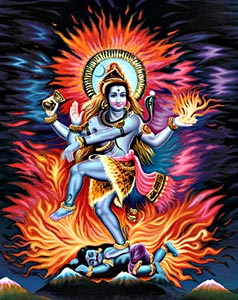
Lord Shiva. Krishna comes to the aid of Aniruddha who is hard pressed by Bana and the fighting with Bana leads to a violent battle between Shiva and Vishnu, by which the whole world is seriously menaced. But Brahma comes to the aid of the earth and creates peace between the two gods by declaring that Shiva and Vishnu are one. Here follows a hymn (stotra) glorifying these two as identical deities. With the marriage of Aniruddha and Usha, which is celebrated with great magnificence in Dvaravati, the book ends.

 Lord Krishna is the "Avatar" of Lord Vishnu whose influence on human lives far exceeds that of any other God incarnate. Krishna is also depicted as Govinda, who is the principal cause of all causes, the embodiment of wisdom and selfless action as well as a human liberal and practical philosopher with foresight.
 Vasudev, a descendent of Yadu and hailing from the Lunar Dynasty, married Rohini, the daughter of King Rohan and later again married the sister of King Kansa - Devaki. On the very moment of their marriage, a heavenly voice declared the future of this nuptial bond, saying that the eighth child of Vasudev and Devaki will be the reason of King Kansa`s death. Kansa was furious on hearing this and decided to slay down the groom of his only sister. However, somehow controlled, King Kansa went forward to slay each of the six sons born to Vasudev and Devaki. The couple was held in impenetrable prison within his kingdom.
 After the birth of Lord Krishna, his father Vasudeva brought him to Gokula. He was brought up in the safe and secured supervision of mother Yashoda and Nand. The maternal uncle of Lord Krishna, King Kansa was destined to die in his hands and thus the king wanted to kill Krishna right from his birth. During his childhood, Krishna faced several perilous situations that were designed by the notorious Kansa, however no one could slay him for his unsurpassed divine power.
 While this worshipping was executed in Brindavan, Lord Indra was enraged at the insult and loss of gifts. He called for the King of Clouds and decreed him to rain over Braj, until the entire land along with the Govardhan Parvat was swept over. An army of clouds covered the sky over Braj and poured torrential rain, as if the end of the world was at hand. Seeing this peril, all came running to Krishna and wanted an answer to this situation. They all asked Krishna to bring the Mount Govardhan and save their lives.
 Visit of Lord Krishna to Hastinapur was as an envoy of the Pandavas to persuade Dhritarashtra to restore Indraprastha peacefully to the Pandavas, and thus to avoid war. After the thirteen years` exile was over, the Pandavas once more, by their prowess in battle, revealed themselves to their friends. Dhritarashtra sent an ambassador charged with vague words of peace and friendship to the Pandavas, but he did not convey any definite proposal for giving them back their kingdom and property. After hearing everything from the envoy, all agreed with Yudhishthira that there was only one thing left to be conveyed to the Kauravas. They should be asked to give back Indraprasta or to be ready for a combat.
 Three great works in Hinduism enumerate Krishna`s Teachings, namely the Bhagavad Gita, Anugita and Udhavagita. Bhagwad Gita is the sacred Book depicting `Mahabharata` for Hindus. The advice Lord Krishna renders to discouraged Arjuna at
  Yashoda was the deity, who brought up Krishna, the son of Devaki and Vasudeva, a mythological king. The image of yashoda illustrates an incident of the birth of Krishna, some aspects.
 The
The  Death of Lord Krishna was destined to be in a desolate situation, by an ordinary man who was a hunter named "Jara". Lord Krishna is considered to be an incarnation or
  Lord Krishna saw his brother depart from the real world and he started to wander in the forest. Finally he sat on the ground, started to think about Gandhari"s curse, and realised that the time for his departure has already arrived. He self-possessed his senses and concentrated on his