Bhishma Parva is the sixth parva of the great epic of Mahabharata and it consists of five sub-parvas. Bhishma Parva is also known as the book of Bhishma, the grandsire of the Pandavas and the Kauravas and the commander of the Kaurava army in the great battle at Kurukshetra. This Parva deals with the introduction of Bhishma as the son of Santanu, the king of Hastinapur and it also narrates the tale of Bhishma`s great vow to remain celibate throughout his life. He stuck to his promise and remained unmarried till his death in the great battle. Bhishma was a great Yogi, and had the deftness of martial art and war tricks. He was the most respected person in the kingdom of Hastinapur. This Parva also gives an account of the marriage of Santanu with Satyavati, a fisher-maid. Bhishma vowed to lead a life of celibacy in order to enable his father to marry Satyavati. Thus, Bhishma was blessed to live as long as he would like and death would only come to him by getting his permission.
Swayamvara of Amba, Ambika and Ambalika
When Santanu died, Bhishma put his half brother Vichitravirya, the son of Satyavati, over the throne of Hastinapur. It was necessary that he should find a suitable marriage for his brother in order to smoothly carry on the royal succession. By that time, the raja of Kasi invited all the kings and princes in the earth, but he did not send any invitation to Hastinapur. When Bhishma heard about the swayamvara, he took it to be a suitable opportunity to get queens for his brother Vichitravirya. Accordingly, Bhishma set out for Kasi as a simple gentleman without any attendants and there he seized the three princess, Amba, Ambika and Ambalika, and brought them to Hastinapur. As the wedding-day of Vichitravirya drew near, Amba disclosed before Bhishma about her prior betrothal to the king of the Shalwas and thus she requested him to send her to the Shalwas. Then Bhishma, with the consent of Satyavati, send Amba to the capital of the king of the Shalwas.
King of Shalwa Rejects Amba
When Amba reached the court of the Shalwas and narrated everything that befell her, the king of Shalwas rejected her by saying that he would not accept someone as his wife who was carried off by Bhishma and intended for another`s bride. Rejected by the king of Shalwas, Amba`s heart was filled with anger and she turned, crying softly, and haughtily and went away from the city and took rest that night in one of the great forest-hermitages.
 Amba was deeply shocked and confused and did not know whom to blame for her misfortune. Amba sometimes blamed Bhishma, sometimes herself and sometimes her father for her misfortune. Once she cursed her father for announcing that prowess should be the dower of his daughters and then she would blame Bhishma. If Bhishma had not captured her, if he had not taken her to Hastinapur and if he had not arranged for her expedition to the king of the Shalwas, that trouble would not have come upon her. She thus blamed herself, her father, and Bhishma all by turns, but she never blamed the king of Shalwas for his lightness and vanity.
Amba`s Revenge
While staying in the hermitage, Amba grew calm and took the help and advice of the old sages of the ashrama and began to blame ultimately Bhishma as the source and root of her woes and the destruction of Bhishma became the motive of the rest of her life. There is also a description of a great battle in the Bhishma Parva between Bhishma and Parasurama, incarnation of Vishnu, in which Parasurama fought against his student on behalf of Amba. The battle ended without any decision with the intervention of the gods and Amba thanked the great Parasurama since he fought for her cause and went away. Amba undertook severe penance and deep meditation and at last Lord Shiva was pleased with her prayer and blessed her with a boon that she would reborn as a girl and later would attain perfect manhood. He also promised her that she would also form the cause of the defeat of Bhishma in a great battle. After blessed by Shiva, Amba prepared a sacrificial pyre and burned herself to ashes in order to be reborn.
Amba is Reborn as Shikhandi
After blessed by Shiva, Amba sacrificed herself in the sacrificial pyre and was reborn as the daughter of Drupada, and was named Shikhandi. Later on in life, Shikhandi attained perfect manhood with the blessing of a Yaksha in a forest and as per the blessings of Lord Shiva she remembered everything of her previous life and her resolve to defeat Bhishma. The desire of Shikhandi was fulfilled when he helped Arjuna defeat Bhishma in the great battle at Kurukshetra.
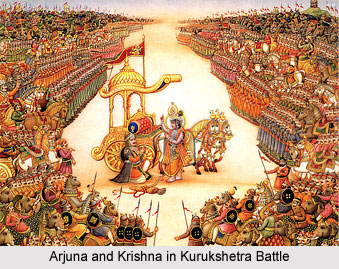
The Bhishma Parva of Mahabharata also narrates the incidents of the Great War at Kurukshetra in which Bhishma led the army of the Kauravas. Known to be invincible and a brave fighter, Bhishma killed thousands of soldiers and generals of the Pandavas everyday. The merciless slaughter of the Pandava forces and generals in the hands of Bhishma continued for the first nine days. On the night of the ninth day of the Great War, the Pandavas went to the camp of the Kuru general and got to know from him the way in which he could be defeated. Thus, on the tenth day, Arjuna was accompanied by Shikhandi, and with the sight of Shikhandi Bhishma stopped using his weapons, since he would not use arms against women or someone who was born as a woman and an unarmed person. Seizing the opportunity Arjuna showered several arrows over his grandsire and in a moment the great fighter and the commander of the Kaurava forces was laid on a bed of arrows in the battlefield. With this, ends the sixth episode of the great epic of Mahabharata, the Bhishma Parva.