Bark Type Spices - Informative & researched article on Bark Type Spices
 Indianetzone: Largest Free Encyclopedia of India with thousand of articlesIndian Food


in  
 Art & Culture|Entertainment|Health|Reference|Sports|Society|Travel
Forum  | Free E-magazine  | RSS Feeds  
Indian Food : Cooking Tips |Indian Street Food |indian Beverages |Indian State Recipes |Indian Desserts |Seasonal Foods |Indian Sherbets |Indian Spices |Indian Food |Sweets |Indian Vegetables |Food in Indian Culture |Culinary Terms |Rasa in Indian Food |Religious Influence on Indian Food |Indian Snacks |History of Indian Food |Indian Food Industry |Influences on Indian Food |Indian Chefs |Indian Festive Foods |Indian Regional Cuisines |Indian Culinary Influences by Indian Invasion |South Indian Cuisine |North Indian Cuisine |Western Indian Cuisine |Cooking Oils |Milk
Home > Society > Indian Food > Indian Spices > Types of spices > Bark Type Spices
Bark Type Spices
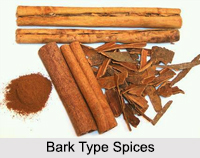
Bark type spices are made from the bark of a plant, like Cinnamon, Casia and many others.
More on Bark Type Spices
  Jangli Darchini   Cinnamon    

 Bark type spices constitute the bark of a plant. These Bark type spices are highly flavoured and impart taste to the food, it is mixed with. The two very common Bark type spices are Cinnamon and Casia.

Bark Type Spices Cinnamon Bark Cassia (Jangli Dalchini) and Cinnamon (Dalchini or Darchini) are very popular Bark type spices and commonly used in the Indian dietary. The term Darchini that has come to stay in Indian parlance is actually a derivation from the Arabian term Dar-al-chini, meaning the wood (or bark) of China, one of the oldest and largest producers of China Cassia so well known in commerce. Several reports indicate that cinnamon is one of the oldest spices known to mankind. Evidences show that Egyptians knew about it even 2000 years before Christ.

Trees growing at higher altitudes (180 to 300 meters) yield better quality bark with higher volatile oil content. Trees growing at lower altitudes (90 to 150 meters) yield a relatively thick, coarse bark, somewhat deficient in flavor, containing 1.0 to 1.2 % of volatile oil. The best bark of Batavia Casia comes from the trunk; the bigger the trunk the thicker and more valuable the bark. The dried quills are sorted and graded according to length, color, thickness and aroma and packed accordingly and then marketed.

Saigon Cassia is one of the important cassias in international trade and a distinguished Bark type spices in India. The best and the most expensive bark `Que-thanh` or Royal cinnamon comes from the province of Thanh-hoa in North Annam. Barking, that is removal of bark, is usually carried on the standing tree, starting with the main branches and working down the trunk, not by climbing but by erecting bamboo scaffolding around it. A string is tied round the trunk and main branches at intervals of 40 cm and the bark is cut through at these points with a sharp pointed knife. Then vertical cuts are made between the horizontal incisions at intervals of 25 to 35 cm and the slabs of barks are eased off with the aid of thin spatulas made of bamboo or buffalo horn. Each ring of bark is removed in this way until the bottom of the trunk is reached; the tree is then felled after which small branches and twigs are harvested.

Cinnamon is one of the most important tree spices of India that is classified under Bark type spices. Like its cousin cassia, cinnamon consists of layers of dried pieces of the inner bark of branches and young shoots from the evergreen tree Cinnamomum zeylanicum, which is obtained when the cork and the cortical parenchyma are removed from the whole bark. The thickness of the bark ranges from 0.2 to 1.0 mm. Pure cinnamon is free from any admixture with cassia, which is considered inferior to the former in appearance, flavor and odor. Bark type spices are quite popular in Indian kitchens for their flavouring qualities.

(Last Updated on : 23/02/2009)
 
 
Bark Type Spices Flower Type Spices Fruits Type Spices
Leave Type Spices Miscellaneous Spices Pepper Type Spices
Root type Spices Seed Type Spices  
Recently Updated Articles in Indian Food
Indian Sweets
Indian Sweets are usually known as Mithai. They diverge in tastes, aromas, shapes and colours. They are indispensable part of Indian culture during auspicious occasions.
North Indian Cuisine
North Indian consists of recipes of North Indian states like Delhi, Punjab, Rajasthan, Uttar Pradesh; Jammu & Kashmir, Haryana and Himachal Pradesh.
Religious Influence on Indian Food
Religious influence on Indian food and cuisine has been momentous and has shaped the current cuisine of India, which is popular throughout the globe.
Food in Gupta Period
Food in Gupta Period has been largely discussed in the writings of Mahakavi Kalidasa and Chinese travellers like Fahien, Yuan Chwang and Itsing who visited India during this period and described the culture of India.
Food in Mauryan Period
Food in Mauryan Period largely includes the food and drinks during 300BC to 75 AD which has been extensively discussed in Arthashastra, rock edicts of Ashoka and accounts of Greek historians.
E-mail this Article | Post a Comment
Forum
Forum on Indian Food
Free E-magazine
Subscribe to Free E-Magazine on Society
 
 
Bark Type Spices - Informative & researched article on Bark Type Spices
Sitemap
Contact Us   |   RSS Feeds
Copyright © 2008 Jupiter Infomedia Ltd. All rights reserved including the right to reproduce the contents in whole or in part in any form or medium without the express written permission of
Jupiter Infomedia Ltd.
