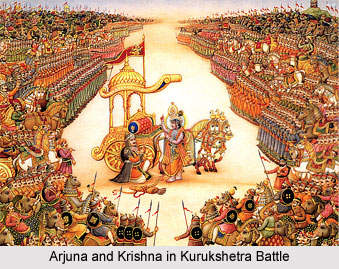
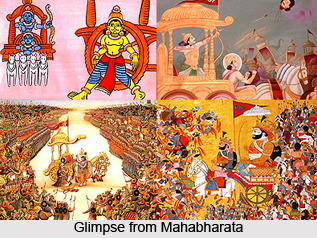
 Anushashana Parva is the thirteenth Parva of Mahabharata and it comprises of two sub-parvas. It consists of the final instructions or Anushashana from Bhishma to Yudhisthir. This episode is also a very long interval in the great epic of Mahabharata and it explains in detail the instructions given by Bhishma while he was in his death bed of arrows in the battle field. This Parva is considered to be a very large treasure-trove of Brahmanic lore which is a later story added to the great epic of Mahabharata. After Yudhisthir won the great battle at Kurukshetra after killing all the Kuaravas and their allies and at last Duryodhana, he was sworn in as the King of Hastinapur. When he came to know from his mother Kunti after the war that Karna was his own elder brother, Yudhisthir was deeply shocked since he was responsible for killing his elder brother and the Kauravas. The victory at Kurukshetra seemed to be useless to Yudhisthir when he recollected his loss in order to be victorious in the battle. He was surrounded by grief and counseled Krishna who told him to visit his grandsire Bhishma in the battle filed in order to get his advice.
After winning the great battle at Kurukshetra, Yudhisthir was made the king of Hastinapur. He ruled the kingdom very well under the direction of the Brahmanas. Once the coronation ceremony was over, King Yudhisthir approached Lord Krishna and expressed his sorrow with regard to the pain which he suffered due to the conditions of his grandsire Bhishma. Since he was responsible, as the elder Pandava, for the pitiable condition of Bhishma on the bed of arrows in the great battle, Yudhisthir was not able to get peace of mind. Lord Krishna thus asked Yudhisthir to visit the place in the battle field where Bhishma was on the bed of arrows and receive certain high principled instructions. In this Parva there is a narration of the condition of Maharaja Bhishma and his suffering. In the bed of arrows the son of Santanu and Ganda was surrounded by the sages and rishis including Vyasadeva and Narada. Some of the other great rishis and sages who were present there were Asita, Sumantu, Devala, Jaimini, Chyavana, Vashishta, Maitreya, Sanat Kumara, Valmiki, Kapila and Lomasa. When Yudhisthir appeared before his grandsire for the set of instructions, Bhishma expressed his dictums.
Anushasana Parva of Mahabharata gives an account of the instructions of Bhishma and how he told to Yudhisthir about the nine duties belong to all the four orders of society which include the suppression of anger, truthfulness, justice, and forgiveness, begetting children by one`s own wife, purity, avoidance of quarrel, simplicity, and maintenance of dependents. The great Bhishma also declared the duties which belonged to Brahmanas exclusively. Sense control was declared by Bhishma to be the first and foremost duty of a Brahmana. The second duty of the Brahminical order embraces the study of the Veda and performance of austerities. The worship of deity and teaching others how to worship the deity also formed a part of the various duties of the Brahmana as described by Bhishma.
Then Bhishma went on to explain it to Yudhisthir the duty of a Kshatriya. According to him, Kshatriyas should never beg, but should acquire wealth by taxing the citizens. They should study the Vedas, but not engage in the profession of teaching and should protect the citizens and should be ever ready to put forward his prowess on the battle field. To protect the citizens is a higher duty for a Kshatriya and the Parva also mentions that study of the Vedas and performance of sacrifice bring prosperity to a king. Bhishma told to Yudhisthir that a noble king should engage all the subjects in their occupational duties with regard to their order of life.
Anushasana Parva explains the fact that as per Bhishma Vaishya and Sudras should also carry on their respective duties. A Vaishya is required to perform service and give in charity, study the Vedas, carry out sacrifices and acquire wealth by fair means. One of the foremost intentions of the Vaishya should be to protect all animals particularly the cow and the bull since they are regarded as the parents of all mankind in order to attain lasting prosperity. A shudra is given the duty of serving the other three orders with regard to seniority. This Parva speaks that by such service the Shudra would get happiness. Thus, the Anushasana Parva narrates the Varnashrama system, acts of charity and also the practical duties of a king and activities of salvation as explained by Bhishma to Yudhisthir.