Akhukarni or Musakani is a prostrate, much-branched Indian medicinal plant, having the botanical name of Merremia gangetica (L.) Cufodont. The plant is called in different names in various native Indian languages. It is named as Bhuikamri, Indurkani and Undirakani-Pana in Bengali; as Undarakani in Gujarati, and Musakani is actually its Hindi name. The plant is called as Akhukarni in Sanskrit and also as Mushakarni, while its Marathi name is Underkani. The Tamil speaking people call the plant as Elikathu Kerrai and Perettaikirray, while its Telugu names are Elikajemedu, Perettaikkiray and Toinnuatali.
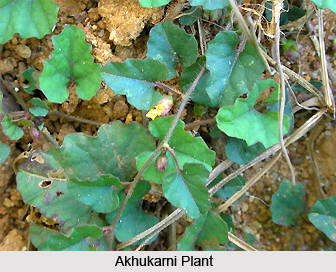 The glabrous plant named Akhukarni is a sparsely pubescent perennial vine that often roots at the nodes. The leaves of the plant are kidney-shaped to broadly ovate, and they have a length of 0.5-3 cm. The base of the leaves is cordate with a broadly rounded sinus and rounded basal lobes, which are obtuse to broadly rounded or emarginate at apex. The margins are coarsely crenate or entire, and glabrous or sparsely appressed pilose. The flowering part of the plant is axillary, solitary or in 2-3-flowered cymose groups. The flowers of the plant have very short or absent peduncles, while the sepals are obovate to orbicular. The outer sepals are 3 mm long and obtuse, having a distinctly mucronate apex and the inner ones are 3-4 mm long and deeply emarginate, with all pubescent on the back and ciliate.
The corolla of Akhukarni plant is of yellow (or pinkish) colour with a paler tube, having a shape like a bell or campana and the length of the tube is 5-9 mm. The plant`s fruits are capsular and sub-globose, having a length of 5-6 mm. They are longitudinally sulcate, glabrous and of brownish-black or black colour. The seeds of Akhukarni or Musakani have a greyish-brown colour and the glabrous seeds are dotted, with a length of 2.5 mm. The plant usually flowers and fruits from the month of August to December. The plant is commonly found in damp, grassy habitats in the upper Gangetic plain, Bihar and West Bengal, in India. It is also found southwards through peninsular India to Tamil Nadu up to 900 m elevation.
Akhukarni plant has a large number of medicinal properties and usages and it is being used in different Indian traditional treatment methods, for several years. In Ayurvedic practice, the plant is considered as cooling, anthelmintic, laxative and carminative. The Ayurvedic practitioners consider a decoction of the plant to act as deobstruent, diuretic and alterative, and they also use the decoction for treating rheumatism, neuralgia and headache. The decoction is used in the treatment of the diseases of kidneys, bladder, heart and lungs, fevers, strangury, urethral discharges, anaemia and leukoderma, and for resolving tumours, as well. The leaf juice of the plant is prescribed for migraine and as an eardrop to get relief from abscesses and ulcers.
In Unani medicine, the practitioners consider Akhukarni plant to be antipyretic and useful for treating headache, bronchitis, paralysis, inflammations, and fevers caused due to enlargement of the liver. The rose-flowered variety of the plant is used to treat diseases of the brain and nose, paralysis, wounds and inflammations, and the root of the yellow-flowered variety is also used to treat diseases of the eye and of the gums. The practitioners in Siddha use the whole plant for treating stomach disorders, diarrhoea, anaemia, worm infestations, fistula and leucorrhoea. They use a decoction of the whole plant in the treatment of cough, headache, neuralgia and rheumatism and they also use the powdered leaves as a snuff during epileptic seizures. The juice of the plant can act as a purgative and is commonly given internally to get relief from migraine headache. It is used as an eardrop to promote the healing of abscesses also. Apart from that, a mixture of the root and powdered leaves of Akhukarni or Musakani plant and flowers is applied externally to relieve swellings, as well.