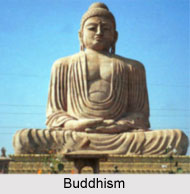
 Yogakara school of thought, developed in fourth century, is projection of Mahayana Madhyamika Buddhism. The Yogakara school of thought was also remembered as "conscious only" school. Aryasanga or Asanga and his younger brother Vasubandhu, the teacher of Dignaga, founded Vijnanavada or the idealist view of the Yogakara.
Yogakara, the Buddha school of thought, declares that the absolute truth or `bodhi` which is manifested in the Buddhas is achievable by the people who practice Yoga. Yogakara reveals the practical side of the philosophy and Vijnanavada tells about its speculative feature. According to their philosophy the belief of critical analysis is applied not only to the individual ego and the material objects, but also to the dharma, or the elements of things, and over all to an idealism which reduces all reality to thought.
The Yogakara believes in the subjectivism of matter. Matter is considered as an idea and things are supposed to be the clusters of sensations according to the Yogakara school of thought. Every dharmas or things and their qualities are constituents of consciousness. Human consciousness by its two functions of `khyati` or perception and `vastuprativikalpa` or interpretation develops the world of experience. The Yogakara traces the activity of consciousness to the beginningless instinctive tendencies working in it. The Yogakaras are supporters of Vijnanavada and renounce the real existence of all except `vijfiana` or consciousness. The internal experience cannot be denied though the existence of the natural world is taken as real. The Yogakaras do not accept the dependence of consciousness of external objects and believes that it is self-subsistent. The opinions of Yogakaras are termed as the `Niralambanavada`.
The Yogakaras denies the pattern of thought of the Madhyamikas. Since there is really no knowable, there is no existence of knowledge. According to the Yogakaras; the substratum for all illusionary entities which are not isolatory from thought is vijfiana` which is not an abstract, but a concrete reality. The Yogakaras are considered as candidly idealistic. The whole system of facts is directed within the individual consciousness. According to the Yogakara School of belief the thought is the outset and the end of all knowledge. The central thesis is the priority and productivity of thought. Thought is the only reality the human mind needs to reckon with. . The Yogakaras dissect things in the universe into the two categories of `sarhskrta` or composite, and `asarhskrta` or non-composite. The science of logic acquires a logical vision by the Yogakara theory. The theory points out the necessity of thought for all reality, it betrayed its weakness by its frequent denial of all non-mental reality and experience