


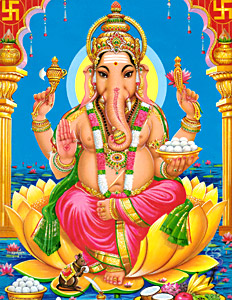
 Vigneswara is another name of Lord Ganesha or Vinayaka in Hindu mythology. This elephant headed Lord is one of the most popularly worshipped forms of divinity, considered as the remover of all obstacles who paves the way to success. Vigneswara is revered as the son of Shiva and Parvati, and represents the power of the Supreme Being. Vigneswara is also known as Ganesha, Ganapati, Gajamukha and Veenayaka. According to Indian belief and practices, he is the Patron of education, arts and sciences, and the God of knowledge and wisdom Vigneswara is also famous and worshipped among Jains and Buddhists.
Appearance of Lord Vigneswara The appearance of Lord Vigneswara is both unique and captivating. He is portrayed with a human body adorned with a potbelly, which symbolizes his ability to digest both the pleasant and unpleasant experiences of life. His appearance might seem similar to as that of Lord Ganesha but Lord Vigneswara has one tusk instead of two that is common seen. Apart from his single tusk, Lord Vigneswara’s most distinctive feature is his elephant head, representing wisdom, intelligence, and a deep connection with nature. His elephant head symbolizes wisdom, understanding, and a discriminating intellect to attain perfection in life. The one tusk figure of Vigneswara shows a wide variety and is portrayed as sitting down, dancing, standing, and other different poses. Lord Vigneswara is often depicted with large, floppy ears that signify his attentiveness to the prayers and concerns of his devotees. The wide mouth of Vigneswara represents the human desire to enjoy life. The trunk represents the power to face ups and downs of the external world. Sometimes Lord Vigneswara can be seen with two tusks, each represent two different aspects. His right tusk symbolizes wisdom and his left tusk symbolizes emotion. His broken left tusk represents the idea to human beings that to attain perfection one must triumph over emotions with wisdom. The number of Vigneswara's arms varies between two and sixteen arms. In most of the idols, Vigneswara feature four arms as a standard form and is often shown riding on a mouse. A beautiful amalgamation of human and animal traits, Lord Vigneswara stands as a reminder of the harmonious coexistence between humans and the natural world. His image exudes a sense of warmth, approachability, and friendliness, making him an instantly relatable deity for people of all ages and backgrounds. Myths associated with elephant head of Lord Vigneswara Different myths are present behind the elephant head of Vigneswara. According to few stories, he was born with the elephant head while in other stories he obtained it later. However, the most popular story depicts that God Vigneswara was born with a human head and Shiva beheaded him when as a child not recognizing Shiva as his father refused Him to enter. Later Shiva realised his mistake and replaced his head with that of an elephant. In another story, Parvati decided to show her new born baby to other Gods. But when God Shani looked at him, the head burned to ashes because God Shani is believed to have evil eyes. Then Lord Vishnu replaced the head with that of an elephant. Legend of Vignasura According to a legend, King Abhinandana had extraordinary ambitions who harbored a burning desire to ascend to the prestigious position of Indra, the ruler of the Gods. However, this audacious undertaking did not escape the notice of the vigilant Indra, who, perturbed by the king's audacity, took swift action. Indra dispatched Kaala, the embodiment of Time, in the formidable guise of Vignasura, a fearsome demon, with the sole purpose of obstructing the grand sacrifice orchestrated by King Abhinandana. Vignasura not only succeed in foiling the king's ambitious endeavor, but he also unleashed chaos upon the virtuous saints and disrupted their sacred rituals. A pall of despair descended upon the world as religious ceremonies ground to a halt. Witnessing this grim turn of events, the celestial deities beseeched the mighty Ganapati, the elephant-headed god, for intervention Responding to the fervent pleas of the Gods, Ganapati fearlessly plunged into a fierce battle with Vignasura, engaging in an epic clash that reverberated through the heavens and the earth. However, Vignasura, realizing the futility of resisting the indomitable Ganapati, surrendered to his might and implored him to assume the name Vignaharta—the remover of obstacles. This form of Lord Ganesha is worshipped as Vignasura. Vignasura, once an adversary of the divine forces, was graciously accepted into the celestial fold, becoming one of Ganapati's loyal attendants, known as the ganas. Thus, this legendary tale of sacrifice, confrontation, and ultimate redemption intertwines the destinies of gods and mortals, leaving an indelible mark on the tapestry of mythology. The battleground where this monumental conflict unfolded was forever consecrated, known henceforth as Ozar, serving as a testament to the triumph of Ganapati and the vanquishing of impediments. This place currently has a temple dedicated to Lord Vignasura. Worshipping Lord Vigneswara The worship of Lord Vigneswara holds immense importance in Hindu culture. Lord Vigneswara is worshipped before embarking on any new endeavor, for sidhhi (success) and budhhi (intelligence). Hindus invoke his blessings to seek his divine intervention in removing potential obstacles and ensuring a smooth path towards success. Lord Vigneswara's presence is considered auspicious at the beginning of any venture, be it the inauguration of a new business, the commencement of a wedding ceremony, or the initiation of a religious ritual The significance of Lord Vigneswara goes beyond just the removal of obstacles. His worshippers believe that he embodies the qualities of wisdom, intellect, and knowledge. He is regarded as the patron of learning and arts, and his blessings are sought by students, scholars, and artists alike. Lord Vigneswara is considered the ultimate guide and mentor, assisting individuals in their quest for knowledge and enlightenment. Lord Vigneswara's gentle and compassionate nature has endeared him to people seeking solace and comfort. His devotees often turn to him during difficult times, seeking his support and guidance to navigate life's challenges. With his divine presence, Lord Vigneswara offers solace, instills confidence, and empowers individuals to overcome adversity Devotees of Lord Vigneswara offer prayers and perform various rituals to seek his divine grace. India's one of the famous annual festivals is Ganesh Chaturthi, dedicated to God Vigneswara, a form of Lord Ganesha. This festival is celebrated with great fervor and enthusiasm across India and other parts of the world. During this festival, intricately crafted idols of Lord Vigneswara are installed in homes and public places, and devotees offer prayers, sing hymns, and perform elaborate rituals to honor the deity. Temples of Lord Vigneswara There are hundreds of famous temples present for Vigneswara in different locations of India such as Ujjain in Madhya Pradesh, in Jodhpur, Rajasthan, Baidyanath in Bihar, Wai in Maharashtra, Dhundiraj Temple in Varanasi, Uttar Pradesh. The most among these temples is the Vigneshwara Temple or Vighnahar Ganapati Temple of Ozar, Maharashtra. It is a Hindu temple dedicated to Ganesha, the elephant-headed god of wisdom. The temple is one of the Ashtavinayaka, the eight revered shrines of Ganesha in Maharashtra, India. It is the Vigneshwara form of Lord Ganesha worshipped here. This temple is associated with the legend of Ganesha defeating Vignasura, the demon of obstacles. |
| |||



Home > Society > Indian Religion > Types of Religion in India > Hinduism Religion > Hindu Gods > Lord Ganesha > Vigneswara
Vigneswara
| Lord Vigneswara is another form of Lord Ganesha or Vinayaka, prominently worshipped as the God of intelligence and good luck in the Indian subcontinent. Lord Vigneswara can be differentiated from Lord Ganesha by his distinct appearance. The elephant-headed Vigneswara is believed to be the remover of all obstacles in Hinduism. |
| ||||||||||||||||||||||||||||

