In Indian philosophy the theories of creation include the lead role of the Rig Veda. According to the Indian philosophy formerly nothing existed, neither heaven nor atmosphere nor the earth. This is the theory of creation according to the Indian philosophy which opines that desire is the seed of all existence. The desire of Prajapati is the sire of the living creatures of the cosmic world.
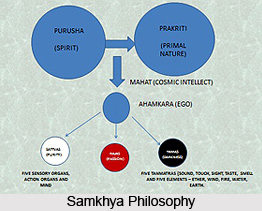
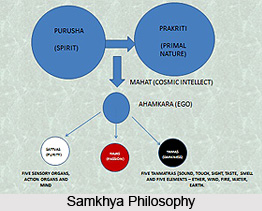
Indian philosophy believes that creation happened gradually. The universe in primitive form was made up of Ishwat Tattva, the Ishwar Tattva primarily spread homogeneously throughout the universe; this gradually and uniformly resulted into the creation. The theory of creation in Indian philosophy here ideally gels with the Hindu philosophy of creation. According to Indian philosophy Purusha and Prakriti identifies as energy and matter and is indeed the base of all creation. The theories of creation unfold the truth that mixing of these two in different ratios resulted in Sattva, Rajas and Tamas, the three pillars of creation. Sattva having great amount of energy and little matter, Tamas having less energy and big matter, Rajas being in between, are basic building blocks of our Universe. This theory of creation in Indian philosophy is indeed scientific as in the modern day, the presence of Sattva, Rajas and Tamas has been interpreted as Electron, Proton and Neutron. The theory of creation in Indian philosophy hence believes that these three basic Gunas in different ratio made five elements, named as Ether, Air, Fire, Water and Earth. These five elements present in the universe can be observed directly by our Ten Indriyas, five Gyanendriyans and five Karmendriyans.
The theory of creation in Indian philosophy asserts the fact that the multiplicity of the world is based on the one spirit. " Who indeed could live, who breathe, should not this ananda be in akasa ? " Here, it is the Omnipresence of the Omnipotent which has been credited for the creation of the universe. It is that supreme He, the formless, the intangible, the ever illumined energy who is reckoned as the beginning and the end of the world, the cause as well as the `effect, the root as well as the shoot of the universe. What existed originally was His wish to create and the creation followed. However, the course of development was basically a transition from the potential to the actual as the matter with which the process of evolution started; the creation initiated was not an independent entity. According to the theories of creation it was hidden in it the highest ananda
Quite ideally therefore matter which initiated the creation had more potential in it than "life". In the graduated scale of the types of existence, the later is the more evolved or the formed, and the earlier is the more potential or the unformed which ideally united to form the universe; to create the creation. To use the words of Aristotle, "the earlier is the matter and the later is the form"-this is the kernel of the theory of creation which made Indian philosophy to recognize the `matter` as the passive principle which was energized by the form to create. Here also comes the presence of God as the almighty. The theory of creation in Indian philosophy supports the presence of the God overlooking the matter whilst stirring it up into motion. This god is the eternally active self-conscious reason and is responsible for the whole realm of change