


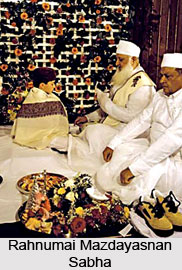
 Nowrozjee Furdoonjee and Dadabhai Naoroji founded the Rahnumai Mazdayasnan Sabha and did considerable efforts for the purification of Zoroastrian religion which was being prejudiced by Hindu elements like child marriages, polygamy, separate dining of men and women and use of nirang for sterilizing customs. In 1855 the Parsee Law Association was organized at a public meeting attended by 3,000 Parsis with Maneckji Nusserwanji Petit as chairman and Furdoonjee and Sorobjee as secretary. They were in charge later for the introduction of a uniform system of Parsi laws. All such important agenda was discussed in the Rahnumai Mazdayasnan Sabhas. Nowrozjee Furdoonjee and Dadabhai Naoroji founded the Rahnumai Mazdayasnan Sabha and did considerable efforts for the purification of Zoroastrian religion which was being prejudiced by Hindu elements like child marriages, polygamy, separate dining of men and women and use of nirang for sterilizing customs. In 1855 the Parsee Law Association was organized at a public meeting attended by 3,000 Parsis with Maneckji Nusserwanji Petit as chairman and Furdoonjee and Sorobjee as secretary. They were in charge later for the introduction of a uniform system of Parsi laws. All such important agenda was discussed in the Rahnumai Mazdayasnan Sabhas.
By the 1870s education was becoming increasingly important as a passport to achieve success in Bombay. This fact was obviously recognized among the Parsis. A lot of importance was paid to girls' education. The Parsee Girls School Association was started by Framji Nasserwanji Patel as the chairman and Furdoonjee as secretary. A number of Parsi schools were also opened in Bombay. Behramji Merwanji Malabari (1853-1912) was one of the most successful Parsi reformers who devoted his life to improve the lot of Indian women who were ruined by social traditions. The Parsis, refugee Zoroastrians from Iran who reached Gujarat in AD 936, spread along the western Gujarat coast and settled mainly in the ports and small towns of this area. Hereditary priests traveled also with them and came together as small groups of families. In the thirteenth century Gujarat was divided into five panths and each of the panth was governed by a council of priests and all five panths were tied together through links to Sanjan, the Iranian home of the Parsi migrants. Thus the Parsis discovered a system of socio-religious orders not unlike the caste system that widely existed among Gujarati Hindus. The Parsis were a closed community as well; they neither converted nor got intermarry with non-Parsis. Their temples and dokmas (towers of silence), where the dead were exposed, were closed for the non-Parsis. Access to their sacred literature was restricted to Parsi priests and discussed only within the community. In 1851, Naoroji Furdunji and a small group of educated Parsis hailing from Bombay founded the Rahnumai Mazdayasnan Sabha or the Parsis' Reform Society with funds provided by K. N. Kama. Furdunji presided the Sabha and was selected for the office he held until his death in 1885, and Sorabji Shapurji Bengali took over the position of secretary. Bengali was a passionate writer, whose main subjects were the brilliance of ancient Iran and popularizing the new western knowledge. In 1850, he published a monthly journal, Jagat Mitra (Friend of the World) that aimed to accept his ideas among literate Parsis. The Sabha also issued its own journal, Rast Goftar (The Truth Teller), as the main voice of their movement. In 1851, S. S. Bengali published another journal, Jagat Prem (Lover of the World) with the principle of disseminating knowledge of ancient Iran. The journal contained stories on Iran's cities, its sculpture and architecture, all as evidence of the greatness of the civilization that once existed in the Parsi homeland. The broad motives of the Sabha were to achieve the renewal of the social circumstance of the Parsees and the re-establishment of the Zoroastrian religion in its pristine purity. To achieve this, Furdunji felt it was necessary to stand against orthodoxy. The leaders of the Sabha criticized sophisticated ceremonies at betrothals, marriages, and funerals. They opposed both infant marriage and the use of astrology or palmistry. The Sabha made known its opposition to orthodox beliefs and customs using lectures, pamphlets and the pages of their journal as their medium. It soon acquired a number of opponents among the priests and laity, even within Bombay where many of the older merchants still followed the Parsi traditions. The search of the purified and proper Zoroastrianism led those associated with the Rahnumai Mazdayasnan Sabha to introduce western scholarship system into the training of Zoroastrian priests. In 1854, K. N. Kama established the Mulla Firoz Madrassah to teach the languages like Zend, Pahlevi, and Persian to young priests. During the 1850s, he established a translation fund so that the findings of modern research on his religion could be made available to his beneficiary Parsis. In 1863, following his lead, Jijibhai's son, Rastamji, formed a seminary, the Sir Jamshedji Jijibhai Jarthosti Madrassah, under the headship of S. S. Bengali. In 1864, Kharshedji Rastamji Kama, a cousin of K. N. Kama founded the Jarthosti Dim Khol Karnari Mandah to produce trustworthy editions of the Zoroastrian scriptures, rituals and doctrines. These labors to discover proper beliefs and interpretations among the Parsis unsettled many of the literate and concerned Parsis. A further shock was generated with the visit of the German scholar, Martin Haug during the 1860s. Haug declared that only the Gathas that is a collection of ancient poems could only be considered as the words of the Prophet Zoroaster and thus should take precedence over all other texts. The Rahnumai Mazdayasnan Sabha created a great impact on the colonial milieu and on the western scholarship to reinterpret Zoroastrianism. Western scholars studied the sacred texts; rituals and customs of the Parsis, and their knowledge became the basic brick of the religious change and for the instruction of a new generation of Parsi priests. The Sabha was the creation of an erudite and urban class of Parsis in Bombay City, who became a highly successful elite in the city and also in British India. This acculturative socio-religious movement reshaped heritage that almost anglicized Parsis and they could defend against Christian missionaries. This movement was compatible with their changed social, cultural, and economic environment. As a result, the Parsi community was divided between this urban group and those who remained in Gujarat still under the authority of the traditional Parsi priests. The Rahnumai Mazdayasnan Sabha was, as a result, highly successful in regulating the Parsi culture to the requirements of the new developed Parsi elite, who in time became models of behavior for younger Parsis. By 1947, the Parsi community had largely succeeded in adjusting to the majestic milieu with perhaps greater success than any other group in South Asia. |
| |||



Home > Reference > History of India > Modern History of India > Indian Renaissance > Advent of Indian Renaissance > Rahnumai Mazdayasnan Sabha
Rahnumai Mazdayasnan Sabha
| Nowrozjee Furdoonjee and Dadabhai Naoroji founded the Rahnumai Mazdayasnan Sabha for the purification of Zoroastrian. |
| ||||||||||||||||||||||||||||

