The battle between Maharaja Sawai Pratap Singh of Jaipur and Mahadaji Scindia of the Marathas was fought in the plains of Tunga - Madhogarh on 28th July 1787 and thus called the Battle of Tunga. The battle started at 9 am and lasted till about one hour after sunset. Although, the battle was a brief one, the combined Rajput army of Jaipur and Jodhpur was about 50,000 strong while the Maratha army was larger, with about 80,000 soldiers.
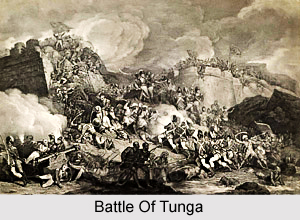 The battle of Tunga was a praise-winning event in the life of Sawai Pratap Singh of Jaipur as it was an important battle in the series of warfare with the Marathas. He could not win the battle without the help of Maharaja Bijay Singh of Jodhpur, hence he helped him by sending 20 thousand Rathore soldiers. The causalities in this battle are numbered in thousands
The greatest loss of Tunga battle was to the Rajput that came with the death of Muhammad Beg Hamadani, which broke the spine of the offensive power of the Marathas. Muhammad Beg Hamadani was the most famous Muslim warrior then living in North India and had sent on his troops to attack the Maratha right wing while he was sitting on an elephant in the shade of a tree watching them from behind. A cannon ball suddenly came and struck the tree above and rebounding knocked him down to the ground, tearing one side of his body open. Eventually, the branch, broken by the shot, fell down crushing him from below. His advancing troops, unaware of his fate, attacked the Maratha right wing and penetrated to their baggage, but were revolted by the Deccan horse hurried up from the reserve by Rana Khan.
The Marathas during the rest of the battle made three or four advances as if to fall upon the Maratha guns again, but found no opportunity of carrying out their design. The Mughals are deprived of their chief and did not stir again. After repelling the first two enemy attacks, Mahadaji Scindia`s army stood on the self-protective. There was no further advance on the Maratha side, partly due to Hamadani`s death was not known to them till after nightfall, and mainly because it began to rain in the afternoon thus making that sandy plain difficult for arms movement. The Marathas were afraid of the ravines in front, the oncoming darkness and the lack of water in that tract. So, each side fell back to its camp and resorted to random firing till an hour after sunset in order to guard against any surprise in the darkness.
The Rajputs unanimously declared the battle of Tunga as `an entire victory`. The Rajputs delivered successive charges on the Maratha forces in the field and failed to displaced them; all their attacks were repulsed, and at the end of the day each side returned to its camp in the rear, as was then the usual practice. The day after the battle the Maratha army came back on the same field and advanced, within gunshot distance of the Jaipur camp, but no troops were on the opposite side tried to stir out. That is not the conduct of a triumphant army. Their Rajah even begged for a two days` treaty for burying and burning his dead. The Rajputs could not even take a single Maratha gun; moreover their own casualty list was much heavier than that of the Marathas. Neither did the Sindhias could actually enjoy their victory, since Mahadaji Scindia had failed to crush the enemy in the field, or to rout them out of their camp, he also could not capture any enemy gun.