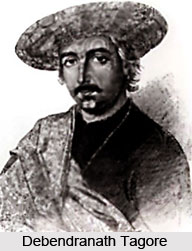
 Tattvabodhini Sabha was a particular reform movement organization, aiming to popularize Brahmodharma or Brahmo faith. When Brahmo Samaj became weak after the death of its founder Ram Mohan Roy, Debendranath Tagore took every possible initiative and established the `Tattvaranjini Sabha` on 6 October 1839. This Sabha was later renamed as `Tattvabodhini Sabha`. Its prime objective was to propagate the spirit of Hindu Scriptures, including the Vedas. In 1842, Tattvabodhini Sabha and Brahmo Samaj came together and Tattvabodhini Sabha took over the duty of running the Brahmo Samaj and popularizing the Brahmo faith all across the nation. The Sabha then built up a widespread movement against conversion of Indians to Christianity.
The family of Debendranath Tagore was strictly Brahmans who had worked for the Muslim rulers of Bengal, and became associated with the British, and other wealthy landowners due to the Permanent Settlement. Tagore experienced a spiritual crisis in 1838 and the following year the Tattvabodhini Sabha (Truth-Teaching Association) was formed. This Sabha was a society that held weekly religious discussions and monthly worship programmes. Debendranath Tagore initiated Vedanta in his new organization, but in contrast accentuated the superiority of Hinduism. Tagore struggled with missionaries in general and Alexander Duff particularly. In 1840, the Tattvabodhini School was established to oppose Duff`s own institution. Debendranath Tagore began publish the Tattvabodhini Patrikd in 1843 - a newspaper that within a short period became a forum for religious discussions and an outspoken critic of the missionaries. As a result Tagore acquired a major voice in the spread of theistic Hinduism. In spite of his success with the Tattvabodhini Sabha, he went forward to revive the Brahmo Samaj.
 Tattvabodhini Sabha took upon three strategies to spread the message of the Brahmo faith. Firstly, they started to set up the Tattvabodhini schools, publishing journals and books, and encouraged young scholars to study and assemble religious books like the Vedas. At the initial stage, a primary school was established in the village of Bangshabati. Here arrangements were made to study languages like Bangla, Sanskrit and English as well as religious books on various aspects of the society. In 1843 the school was moved to Banshberia in Hoogli. On 16 August 1843 the second phase of the Sabha`s activities began Tattvabodhini Sabha`s mouthpiece, tattvabodhini patrika, was published with Akshay Kumar Datta as the editor. Henceforth Brahmo faith began taking its firm structure slowly but steadily. The third stages of the Sabha`s activities started in 1845 when four students, including Anandachandra Vidyavagish, were send off to Benaras to study the Chaturvedas.
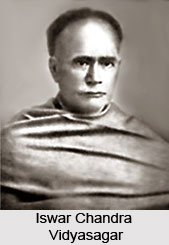
The Tattvabodhini Sabha encouraged a balanced attitude towards religion, a feature that attracted both the groups conservative like Ishwar Chandra Gupta as well as an individual with a modern outlook like Iswar Chandra Vidyasagar. Debendranath Tagore, however, modified his philosophy and conflict with many of the views of the members of the Sabha. Thus came a split in the Sabha in May 1859 and subsequently, the liability of publishing the journal and books for the circulation of the faith fell on Calcutta Brahmo Samaj.