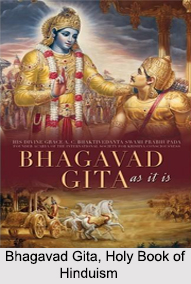
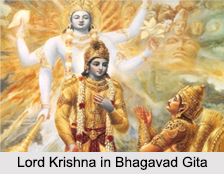
 Lord Krishna`s memorable and invaluable lectures and preachings to Arjuna while on field of the climactic battle of Kurukshetra, comprises the Bhagavad Gita. The Gita is a colossal religious sermon text, governing and administering men towards a sublime and refreshed life, free from earthly restrictions. Arjuna`s dejection and depression prior to the battle of first-bloods, led Lord Krishna to make him understand the truth about life and immortality, with benediction from the Almighty. The Supreme Spirit is the only being that perhaps is capable to perform any act of governing the universe. Hence, Arjuna`s volley of uncertainties and questions were summed up by Krishna in the Supreme Spirit in Bhagavad Gita teachings. Arjuna enquired from his Lord of Lords "what is that which men call the Supreme Spirit, what is man`s Spiritual Nature, and what is the Law? What is Matter and what is Divinity?" Arjuna was also not satisfied with just these questions. His curiosity also was channelled towards that Divine who rules the spirit of sacrifice in man; including enquiry about that self-disciplined individual, who during the time of death may arrive at the knowledge of the Lord.
Lord Shri Krishna answered that the Supreme Spirit is the Highest Imperishable Self and Its Nature is spiritual consciousness. "The worlds have been created and are supported by an emanation from the Spirit which is called the Law." Matter is composed of the forms that perish; Divinity is the Supreme Self in Bhagavad Gita; He who inspires the spirit of sacrifice in man, is in truth Krishna Himself, who had stood before Arjuna in human form. Whosoever at the time of death thinks only about Him and thinking thus, leaves the body and goes away, assuredly will he recognise Him. Before leaving his physical body for the last time before death, on whatever sphere of being his mind rests and of any intention, he is bound to be transferred to that place. Therefore, Krishna advises, that one should meditate always on Him and fight; if one`s mind and reason is fixed on Him, that enlightened being is sure to reach Him. He whose mind does not ramble off and who is absorbed in constant meditation attains the Supreme Spirit. When he meditates on the Omniscient, he reaches that stage from where he can perceive the Ancient, more Minute than the atom, yet the Ruler and Upholder of all, Unimaginable, Brilliant like the Sun, beyond the reach of-darkness; he who leaves the body with an impassive mind, filled with devotion by the power of his meditation, gathering his whole vital energy between his eyebrows, attains the Supreme Spirit.
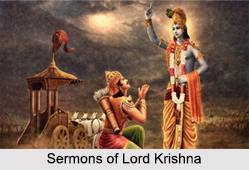 Krishna at this point of time, in continuation of describing to Arjuna the vitality of life and life-fore, embarks to speak briefly of the imperishable goal, "proclaimed by those versed in the scriptures, which the mystic attains when free from passion, and for which he is content to undergo the vow of continence." Krishna advocated that in order to reach that Supreme Spirit of Bhagavad Gita while leaving the physical body and travel forth, one must close the gates of the body, draw the forces of his mind within the heart and by the power of meditation concentrating his vital energy in the brain, he needs to repeat Om, the Symbol of Eternity, holding Him always in remembrance. Krishna is ever accessible to him who thinks constantly about Him and of nothing else; he is bound to be an ever-faithful devotee. Reach thus unto Him, these great souls are no more entangled within the misery and death of earthly life, for they have gained perfection. The worlds, with the whole realm of creation come and go and are transient; but there is no rebirth for him, who strives to reach the Lord. Those who understand the cosmic day and cosmic night cognise that one day of creation is composed of a thousand cycles and that the night is of equal length. At the dawning of a day all objects in manifestation stream forth from the Unmanifest and when evening falls they are dissolved into It again.
The same multitude of beings, who have dwelled on earth so often, all are dissolved as the night of the universe comes near, to issue forth anew when morning dawns. Thus everything is always pre-ordained. In truth, therefore, there exists the Eternal Unmanifest, which is beyond and above the Unmanifest Spirit of Creation, which is never destroyed when all these beings pass away. The wise speak that the Unmanifest and Indestructible is the highest goal of all; when That is once reached, there is no returning back. "That is My Blessed Home." This comprises the kernel of Supreme Spirit of Bhagavad Gita. That Highest God, in Whom all beings abide and Who permeates the entire universe, is reached only by unconditional devotion. Krishna went ahead to describe to Arjuna further about the additional manifestations of the Supreme Spirit. Krishna states of the specific times at which, if the mystics travel forth, do never return and there exists times in which they go forth only to return. If knowing the Supreme Spirit the sage goes forth with fire and light, during the daytime, in the fortnight of the waxing moon and in six months before the Northern summer solstice, he is sure to attain the Supreme. However, if the sage departs in sombreness at night, during the fortnight of the waning moon and in the six months prior the Southern solstice, then he reaches but lunar light and he will be born again. These bright and dark paths out of the world have existed since time immemorial. Those who take the former never come back; those who choose the latter, return back. The saint, who is knowledgeable about these paths, is not confused. Therefore Krishna advises only to meditate perpetually. The sage who is aware that this passes beyond all merit and comes from the study of the scriptures, from sacrifice, from austerities and charity, reaches the Supreme Primeval Abode.