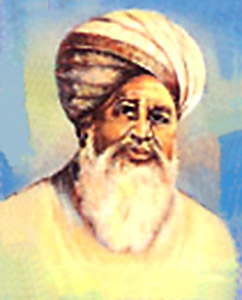
 Shari`at `Ullah was born in 1781 in the village of Shmail in eastern Bengal. The founder of the Fara`izis, Shari`at `Ullah received his primary education in Calcutta and Hooghly. In 1799, when he was eighteen years, Shari`at `Ullah traveled to Mecca. The first two years he took training under a migrant Bengali, Maulana Murad, and for the next fourteen years learned more about the Maulana religion being the student of the Hanafi scholar, Tahir Sombal. Shari`at `Ullah was also initiated into the Qadiriyah order of Sufism during this period. Moreover, he spent two years at al-Azhar University in Cairo. After Shari`at `Ullah returned to Bengal in 1818 as a scholar of Islamic law and philosophy, he began to preach, but soon returned to Mecca, where he took the formal consent of his teacher to preach his own religious campaign. After returning to Bengal, probably in 1820 or early 1821, Shari`at `Ullah very soon attracted the aspired individuals among the peasants of eastern Bengal.
Shari`at `Ullah`s message was one of the religious purification and he was deeply shocked by unacceptable beliefs and behavior well liked among Bengali Muslims. Shari`at `Ullah called for a return to farcflz that was the obligatory duties of Islam, particularly the profession of faith known as kalimah, fasting in Ramadan (sawm or rozah), attending daily prayers (salat or namaz), paying the poor tax (zakat) and pilgrimage to Mecca (hajj)`. Along with these rites Shari`at `Ullah focused on the principle of tawhid (monotheism). Variations from the original message of Muhammad were the products of either shirk (polytheistic religious beliefs) or bid`ah (sinful innovations). In practical terms Shari`at `Ullah prohibited the worship conducted at the shrines of a variety of Islamic saints, the rituals that are connected with the birth of a child or with circumcision, and the intense wailing at ceremonies to honor the Shari`at `Ullah`s heroes, al-Hasan and al-Husain. Uneducated Muslims who copied customs from the non-Muslim community held some of these rituals responsible on Hindu influence that either preserved by converting to Islam, or simply accepted.
The scriptural fundamentalism of Shari`at` Ullah was widely accepted primarily among peasants in eastern Bengal. In order to successfully reach this audience the Fara`izi leaders preached in Bengali language and used that language in their initiation ceremony rather than Persian, Arabic or Urdu. They introduced a distinctive pattern of dress that made the members of their movement stand out from the rest of their community. Militant, unified, and composed mainly of illiterate peasants and artisans, the Fara`izis soon faced opponents as they came within the eastern Bengali districts of Dacca, Faridpur, Jessore, and Badkarganj.
Firstly, Fara`izis directly challenged the orthodox or Sadiqi Muslims who were determined to maintain the practice of Islam as it was then. The Sadiqis were mainly descendants of the Muslims who had entered Bengal immediately after the conquest. Many of them were members of the landlord class, which was thought to be a group by the Fara`izis as economic and ideological enemies. Hinduism was also an opponent, a fountain of polytheism and evil innovations.
Once more religious tensions came up solely due to economics reasons, since the majority of landlords in eastern Bengal were Hindus. In 1831, Barasat had become the center of Fara`izi that led to disturbances against the power of local landlords. Indigo factories were burnt and peasants refused to pay rents to Hindu landlords because they often insisted illegal payments. Muslim peasants opposed for religious as well as economic reasons. Hindu landlords collected money for ceremonies like Durga Puja, the annual celebration of a Hindu goddess.
Shari`at `Ullah asked his followers to refuse such demands and they did. Throughout the 1830s conflict started between the Fara`izis and their landlords with each side blaming the other, as the religious movement slowly became entangled in economic and political issues. This drifted toward rural conflict and continued after the death of Shari`at `Ullah in 1840 when his son, Dudu Miyan, succeeded him as leader of the community.