


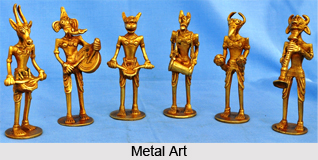
 Metal art products have been unearthed at various parts of India, as per the records of the archaeological research and excavations conducted at numerous regions of India. Copperware, brassware, sheet-metal work and bell metal or 'kansa' are the different types of metal art existent in the country. Archaeologists had discovered several metal objects which include a copper statuette of a dancing figure and assumed as the craft of 2000BC. Specific regions of India specialise in certain forms of metal art. Metal art products have been unearthed at various parts of India, as per the records of the archaeological research and excavations conducted at numerous regions of India. Copperware, brassware, sheet-metal work and bell metal or 'kansa' are the different types of metal art existent in the country. Archaeologists had discovered several metal objects which include a copper statuette of a dancing figure and assumed as the craft of 2000BC. Specific regions of India specialise in certain forms of metal art.
History of Metal Art The ruins of Indus Valley Civilisation prove that the Indian metal art is quite ancient, dating back to 3000 B.C. to 1700 B.C. Excavations at Kalibangan in Rajasthan made possible the discovery of bangles, weapons and copper beads. Copper and tin were considered to be the earliest metals used by human beings. As the civilization advanced, the alloy of tin and copper in the form of bronze was introduced and was heavily employed in Indian metal art. 'Matsya Purana' contains references of some bronze images, which bear testimony to the fact that they are quite ancient. The smelting process of zinc and copper was introduced by the European during 1720s. Small rimmed pots and large water pots which are named as 'lotas', are similar to the pots excavated from early centuries A.D and are still in demand in several parts of India. In 11th century, copper and bronze vessels were exported and Punjab was the place where the Iranian metal wares were made. Excavations at Zawar in Southern Rajasthan have proved the presence of zinc, along with metal art which was existent during 14th century. During the 19th century, Nasik became the centre of copper and brass beating. It was believed that metals originated from meteorites and therefore mankind started to create various objects from metals, which were considered sacred. According to a popular belief by the ancient Indians, metals were obtained from meteorites and were considered sacred. Therefore, various objects were manufactured from metals. Much later, people started to believe that metals were capable of alleviating the evil effects of planets and accentuating planetary influences. Gradually, metal art evolved and several types of metal objects were crafted in numerous designs. A Sankrit term 'patra' or leaf has given birth to the word 'patram', which means vessels. The designs of metal vessels are inspired by nature. Brass or copper pitchers meant for carrying water were some of the earliest metal vessels in India. The shapes of the metal containers vary between different regions of the nation. Reservoirs, plates, cups, glasses, tumblers and many other utilitarian items for domestic purposes started to be used by Indians, with the passage of time. 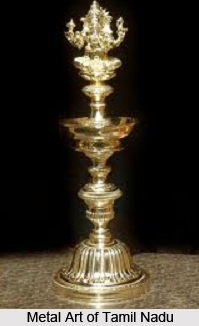 Concentration of Metal Art Concentration of Metal Art
The Qutub Minar of South Delhi represents the Indian metal art of the fifth century A.D. The iron pillar of Mehrauli in Delhi is exemplary of the great artisanship at the Mauryan epoch. Tamil Nadu produced some of the world's well praised figurative bronzes during the Chola period and made Indian metal art to stand apart. Following the bronze metal art tradition, the gods of the temples for worship were being started to be made of 'astadhatu' which was considered to be sacred and consisted of gold, silver, mercury, copper, zinc, tin, lead and brass or 'pancha loha', which is an amalgamation of copper, lead, brass, silver and gold. This added a remarkable diction to Indian metal art. Pahaldar and Jaipuri lamps are exemplary of the great artisanship of North India. The fish shaped handles cast in brass is a speciality of Rampur in Northern Uttar Pradesh. Varanasi and Srinagar near Mahoba, Uttar Pradesh, the Bastar region of Chhattisgarh, several parts of West Bengal and Orissa are the places where the figurative metal works are still well practiced and admired. In the Southern sect of India Swamimalai, near Thanjavur (Tamil Nadu) are the places important for figurative art. Bastar and Madhya Pradesh follow the traditional way of lost wax which is to leave the entire body apart from the arm and head of the figure hollow and is built up on a core. The technique of making the deities and decorating them is called 'Dokra' which is used by the tribes of west Bengal and Orissa. Kashmir is famous for its floral embellishments and calligraphy on copper vessels. In Jaipur the incising of the metal art employs three different styles that are 'Marori', 'Chicken' and 'Bichi'. 'Badlas' which are a kind of zinc pot are the distinct art of Marwar in Rajasthan. Moradabad is acclaimed for 'Khudai' or metal engraving work which is done in 'naqashi' style. 'Barik kam' of Moradabad is praised for its elegance of style and efficiency. The repertoire includes eagles, lions, 16th century Europeans in ornate armour and even galleons. Madhya Pradesh, Southern Uttar Pradesh, Orissa and West Bengal are the centres where the metal art of 'bell metal' is practiced. Certain ritual pieces, traditional cooking pots such as 'urale', large vessels, and oil lamps are made of bell metals. 'Mohra' is a unique metal art of Himachal Pradesh. Mohra denotes the metal plaques. The metal plaques exemplify deities like Lord Shiva and other gods and goddesses. 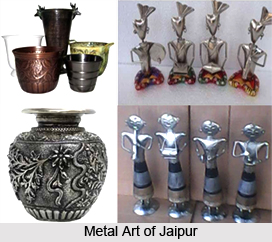 In several sects of India, the handmade production of small cigarette boxes, bowls and 'paan daan' (boxes made to contain the spices, leaves and tools associated with betel chewing), 'ugal daan' (spittoon), 'ataar daan' (perfume box) are immensely popular. Among the varieties of metal art and craft of modern India, various ritual articles and water pots are noticeable like 'panchapatra', 'tamrapatra', 'sinhasan', lotus and 'kanchanthal'. Pahaldar and Jaipuri lamps are exemplary of the great artisanship of North India. Some of the vastly used metal objects are 'surabi' which is a kind of flask, 'Sarota' which is used to cut the areca nuts, axe, spear, handmade cutlery, pen knives etc. In several sects of India, the handmade production of small cigarette boxes, bowls and 'paan daan' (boxes made to contain the spices, leaves and tools associated with betel chewing), 'ugal daan' (spittoon), 'ataar daan' (perfume box) are immensely popular. Among the varieties of metal art and craft of modern India, various ritual articles and water pots are noticeable like 'panchapatra', 'tamrapatra', 'sinhasan', lotus and 'kanchanthal'. Pahaldar and Jaipuri lamps are exemplary of the great artisanship of North India. Some of the vastly used metal objects are 'surabi' which is a kind of flask, 'Sarota' which is used to cut the areca nuts, axe, spear, handmade cutlery, pen knives etc.
'Bidriware' is a speciality of Indian metal art. The term Bidri (silver inlay work against dark metal backgrounds) is derived from Bidar in Karnataka which was once a capital of a Muslim ruled state. 'Meenakari' or enamel work on gold, is an art which is well admired in Delhi and Jaipur. This added a whole new facet to Indian jewellery art. The meenakari work was supposed to be initiated by Maharaja Man Singh I at the end of 17th century. 'Tarkashi' is an amalgamated style of Rajput and Mughal. This is an art of laying fine brass or copper wire carefully into incised grooves in a wooden surface. Silver and brass inlays are done in various other ways like 'tainishan' or inlay of sheet, 'zarnishan' or low relief, 'aftabi' or cut out designs on overlaid metal sheet and 'zarbuland' or high relief. ' A remarkable development in Indian metal art happened with the introduction of 'Black Metal'. Black metal figures came into existence because of the white aluminium from which figures of deities and dancers were being made. One of the well-known craft of Kerala is the manufacturing of big church bells and urale which are made for temple use. Metal art has improved its style and technique through ages. Following the trend and considering the demand of the metals, the design of the metal art has still been ameliorating, keeping in mind the budget and demand of the common people. |
| |||



Metal Art
| Metal art, an ancient art of Indian heritage, is still practiced by the Indian craftsmen. |
| ||||||||||||||||||||||||||||

