


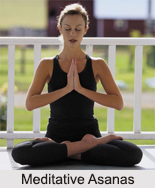
 Meditative Asanas are the postures one assumes in order to sit or stand comfortably for extended durations, enabling one to concentrate and meditate without interference from muscle proprioceptors. The idea behind Meditative Asanas is merely to position oneself in such a way so that one’s limbs cease to send stimuli to the mind, allowing the practitioner to concentrate on meditation. Meditative Asanas are the postures one assumes in order to sit or stand comfortably for extended durations, enabling one to concentrate and meditate without interference from muscle proprioceptors. The idea behind Meditative Asanas is merely to position oneself in such a way so that one’s limbs cease to send stimuli to the mind, allowing the practitioner to concentrate on meditation.
History of Meditative Asanas Meditative Asanas have been consistently mentioned in various Indian Text on Yoga over the ages, including the Puranas and the Vedas, and have formed the core around which a comprehensive physical culture of asana practice was developed. The "Hatha Yoga Pradipika" (1400 AD) claims that Lord Shiva taught 84 Classic Asanas, with 4 paramount amongst them: the Siddha, Padma, Simha and Bhadrasanas, and singles out Siddhasana as the ‘Chief of all Asanas’. It attaches nearly as much importance to the latter three. Apart from that, many ancient texts in Hinduism like Patanjali yoga sutras, Upanishads, and even Indian epics mentioned different forms of meditation asanas performed by saints and yogis. Some archaeologists date meditation back to as early as 5,000 BCE. Postures of Meditative Asanas According to the Patanjali Yoga Sutras, asana is a posture involving eight limbs and emphasize the choice of meditation seat or sitting position. Yoga sutras do not name any asana in particular but specifies the characteristics of a good asana, as “sthira sukham asanam.” It means “the seat of asana or meditation should be steady and comfortable.” All the meditative Asanas are similar, and invariably involve keeping the neck and body erect to let the blood flow freely along the spine and to avoid pressure on the visceral organs. The legs are rooted to the ground to maintain a steady posture. Meditative Asanas are also performed with either of two gazes; the nasal gaze and the frontal gaze (focusing on the nose or directly in front) and also involve the three Bandhas: the chin lock, abdominal compression and anal contraction. Some hand and finger symbolisms known as ‘Mudras’, are also performed in some meditative Asanas. Seat and Sitting Position in Yoga Asana Cross-legged positions are considered as a stable base for meditation. This sitting position has been practiced in Buddhism and Hinduism. Asanas in this position include Padmasana, Ardha Padmasana, Siddhasana or Muktasana, and Sukhasana. Other reliable sitting positions are kneeling posture, seen in Virasana and Vajrasana. Another stable sitting posture is found in Baddha Konasana which is sitting with the feet together and both knees on the ground. The cross-legged postures are simple and stable, restful for the muscles, but active enough to keep the practitioner awake. The spinal column needs to be erect and in balance; this poise lets the muscles of the back relax, and allows to focus more on the breath. For people who cannot sit in cross-legged posture can take help of meditation tools to find a stable sitting posture. The zafu cushion is a traditional support for sitting meditation which elevates the hips above the knees, keep the hips stiff and the spine straight and upright. Types of Meditative Asanas Asanas classified as meditative are considered highly important in the canonical Yoga texts. There are 12 meditative postures listed in various Hatha Yoga manuals, and variations on the same have been devised over the years, of which 16 are known, resulting in a total of 28 Meditative Asanas. Only 19 of these, however, can be considered real Meditative Asanas, since the others are corrective or cultural.  Swastikasana: In this sitting posture, the legs are folded and crossed over one another. The head and back are kept straight and the hands are placed on the knees. It is helpful for people suffering from varicose veins and pain in the leg muscles. Swastikasana: In this sitting posture, the legs are folded and crossed over one another. The head and back are kept straight and the hands are placed on the knees. It is helpful for people suffering from varicose veins and pain in the leg muscles.
Vajrasana: As the name suggests, this asana resembles a thunderbolt and is beneficial for relieving stomach disorder, strengthens nervous system and improves blood circulation. This posture is achieved by sitting with both legs folded backward and the hip resting on the feet. the back and head will be straight while the hands will rest on the knees. Samasana: In this posture, body remains in a symmetrical position and, therefore, it is named Samasana. The external organs of the body are kept in such a way that they stand divided in to two, achieving equilibrium. It strengthens back and improves concentration. Bhadrasana: In this asana, the legs are folded close to the body while the knees bend outward and the soles of the feet touch each other. This firm pose helps to increase blood flow in the pelvic and relieves fatigue from the inner thighs and legs. Padmasana: Translated as “Lotus pose,” is a cross-legged sitting meditation pose from ancient India, in which each foot is placed on the opposite thigh. This asana is good for overall posture and strengthens joints and bones. Siddhasana: It is described as a meditation seat in the early Hatha Yoga text. In this posture, the legs are folded with knees outward and each feet is placed over the ankle of the other leg while the spine remains straight. Siddhasana can improve your posture, lengthen your spine, and open your hips, chest, and shoulders. Virasana: It is a kneeling asana where the each foot is placed beside the hip and the hip is touching the floor. This asana stretches the ankles, knees, and thighs to relieve muscle pain and stiffness. Goraksasana: This kneeling position is achieved by bending knees outward on each side while soles of the feet touch in other. The heels will be placed upward while the toes will touch the floor. The arms will rest on heels. This position is great to relieve sciatica and hernia and tones up the reproductive organs. Hathasiddhasana: This meditative sitting posture is achieved by folding the legs in the form of padamasana and then placing one heel on the root of the generating system while the other heel will act as a support below it. This asana can improve posture, lengthen spine, and strengthen hips, chest, and shoulders Sukhasana: In this meditative pose, the person has to sit in a cross-legged position on the floor with the back and neck straight. This pose relieves back pain, aligns the spine and the hips. Guptasana: It is a sitting position where the knee is folded outwards and the feet are placed at the front over one another. The hands usually rest on the knees. Guptasana stimulates all the visceral organs, controls heart rate, blood pressure and corrects sexual and emotional problems. Muktasana: It is a basic yoga posture, achieved by sitting with folded legs and knees facng outwards. The feet should be close to the body resting over one another or resting in front of one another. Muktasana is called liberation pose as it relaxes the muscles and improves concentration. Tristhitasana: It is a variation of Vajrasana where both legs are folded under the thighs with knees facing forward. The ankle is placed horizontally touching the floor and the toes are facing each other. The weight of the body will rest on the ankles. This asana is great for strengthening calf muscles and regulates blood pressure. Pavana Muktasana: This meditative asana is effective in treating gastritis and improves digestion. This posture is achieved by lying supine with legs folded, knees close to the chest. The hands should be holding the knees while the body and head rests on the floor. Vrisasana: It is a comparatively new meditation posture that has been mentioned in Gheranda Samhita. Vrisasana is performed by sitting with both knees folded forward and both feet uner the buttocks. the left knee should be below the right knee and the left foot should be under the right buttocks. the right foot should be under the left buttons and the hand should rest over the right knee. This is effective strengthening leg muscles and correcting posture. Sthitaprarthanasana: It is a simple standing meditative asana where the feet are rooted firmly on the ground and the hands are folded in the form of namaskar, close to the chest. Sthitaprarthanasana relaxes body muscles and improves posture. Ksemasana: This position is achieved by sitting in cross legged posture with knees bending outwards and spine straight while the hands are resting on the knees. It is great of relaxation and also strengthens the spine. Sthirasana: This is also a cross-legged posture and knees are bending outwards. The portion of the leg from calf to feet will be resting over one another while the hands are placed over the knees. This posture calms the mind, improves concentration, and strengthens the lower spine. Dhirasana: In this posture, the person sits on the floor with one leg placed straight forward and the other folded with knee facing forward. The heel of the folded leg will touching the anus. This asana improves physical and mental strength. Effects of Meditative Asanas Meditative Asanas are devised essentially as it aids in meditation and concentration. These Asanas are not generally expected to cure ailments, and do not have cultural or therapeutic qualities, although some do prove effective as exercises. The meditative Asanas offer absolute peace of mind and relaxation throughout the body if done regularly. Meditative Asanas are highly significant in the history of yoga, and are often the only Asanas described in the ancient texts. Ancient, yet still relevant, meditative Asanas are a pivotal part of Yoga practice and Indian culture. |
| |||



Meditative Asanas
| Meditative Asanas are essentially designed to aid one’s meditation and concentration, and formed the basis for several other Asanas in creating a complete physical culture. |
| ||||||||||||||||||||||||||||

