Jogen Chowdhury
|
Jogen Chowdhury possesses the pulse and rhythm of art that comes from a filial resemblance to nature and milieu.
|
|
|
 Jogen Chowdhury was born in Daharpara Village, Faridpur in Bangladesh. During the partition in 1948, the whole family shifted to Kolkata. Jogen Chowdhury was educated at the Government College of Art & Craft, Kolkata and next at Ecole Nationale Superieure des Beaux Arts, Paris. Till the year 1951, Jogen Chowdhury and his family stayed at the police department quarter of his uncle, where on the walls he painted his first painting in Kolkata. He had painted several mythological scenes from the village theatres and also sculpted various Hindu deities. Jogen Chowdhury was later employed as Designer in the Handloom Board, Kolkata. Jogen Chowdhury was born in Daharpara Village, Faridpur in Bangladesh. During the partition in 1948, the whole family shifted to Kolkata. Jogen Chowdhury was educated at the Government College of Art & Craft, Kolkata and next at Ecole Nationale Superieure des Beaux Arts, Paris. Till the year 1951, Jogen Chowdhury and his family stayed at the police department quarter of his uncle, where on the walls he painted his first painting in Kolkata. He had painted several mythological scenes from the village theatres and also sculpted various Hindu deities. Jogen Chowdhury was later employed as Designer in the Handloom Board, Kolkata.
In 1967, Jogen Chowdhury went to London for five months. In 1970, Jogen Chowdhury joined 'Calcutta Painters' group. From1973-87, Jogen Chowdhury was appointed as a Curator in the Art Gallery, Rashtrapati Bhavan. Jogen Chowdhury became the founder member of 'Gallery 26, Artists' Forum', New Delhi in 1975. Jogen Chowdhury was one of the jury members at the International Exhibition, Bharat Bhavan in Bhopal at 1990.
Jogen Chowdhury is one painter who has inspired young artists of modern India, in a significant way. In his recent works the sensory experiences of cloth, bolsters, sofas and the human body are cross-projected to create a mysterious world of semi-substantiated. Personal associations add to the emblematic ambivalence of his motifs, making his images come closer to unfathomable experiences. His art is rich in suggestions.
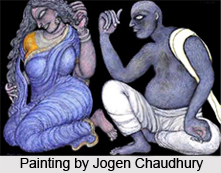 He is widely known as the master of the unbroken line. He has been stimulated by the linear Kalighat pat tradition and his lines are emotive and used to express and propose the character of a person. This is done by disfiguring the form without breaking the line. Distortion has been Jogen Chowdhury's most significant impact. By carefully distorting the form he imparts air of caricature in figures of men and women. He uses colour to provide matter into the form. Jogen Chowdhury's art feels familiar to the viewer but it is far more individualized though the consciousness or characteristics are real. The figure is always in the foreground being primary and communicating. He is widely known as the master of the unbroken line. He has been stimulated by the linear Kalighat pat tradition and his lines are emotive and used to express and propose the character of a person. This is done by disfiguring the form without breaking the line. Distortion has been Jogen Chowdhury's most significant impact. By carefully distorting the form he imparts air of caricature in figures of men and women. He uses colour to provide matter into the form. Jogen Chowdhury's art feels familiar to the viewer but it is far more individualized though the consciousness or characteristics are real. The figure is always in the foreground being primary and communicating.
His ability to juxtapose contrary emotions makes his art a form of self expression and a reflection of a collective and subjective consciousness. His famous paintings are in ink, water colour and pastels however he has painted in oil medium as well. Jogen Chowdhury joined Kala Bhavan, Shantiniketan as professor of painting in 1987. He has written on contemporary art extensively. He was appointed as Juror in several exhibitions.
|
|
|
|





