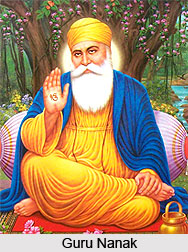
 Japji is the Morning Prayer that the followers of Sikh religion recite everyday. The Japji or the prayer lines are actually the seminal composition of Guru Nanak and they are more popularly known as Mulmantra. However, this name is not there in the Guru Granth Sahib. Japji is considered as the creedal or the formal statement of religious belief of Sikhism and also as the essence of Sikh thought. According to some of the scholars, the whole of Guru Granth Sahib is actually a further interpretation of Japji.
The Japji is actually a terse, concise composition of thirty-eight stanzas or pawns (literally steps) and it contains two slokas, one at the beginning, named Alulmantra, and the other at the end. Guru Nanak has classically composed it by using terms from the languages like Western Punjabi, Braj Bhasha, Sanskrit, Arabic and Persian. The Japji demonstrates a remarkable economy of expression and thought. Although the language used may be classical, the message is contemporary. Guru Nanak begins the composition by using the numerical 1 and by doing so, he has actually stressed on the oneness of God, on unity. According to him, beyond nothingness is one. God is one and He is indivisible.
According to the Meharban`s Janamsakhi, Guru Nanak compiled the Japji at Kartarpur and he sought assistance from Bhai Lehna in compiling the Japji. The Guru and Bhai Lehna then worked hard for days and eventually selected the thirty-eight pauris from the corpus of the Guru`s compositions. After that they arranged them in the presently available order. It is also believed that the grasp that Bhai Lehna showed of what Guru Nanak said and wrote, during this period impressed the Guru a lot. That also helped Bhai Lehna to become the successor of Guru Nanak.
The first pauri oijapji begins with the injunction Jap (to recite) and then, Guru Nanak says that God is the originator of Time and Space. According to Guru Nanak, He has always been there in the past and will be there in the future. God is everywhere - on this planet, in the solar system and also in distant galaxies. Guru Nanak has actually described the main aspects of his philosophy in the Japji and also described his view about the oneness of God. Guru Nanak has also stressed the role of Guru in the Japji and described the Guru as the Dispeller of Darkness. According to Guru Nanak, Guru is the God-conscious guide, the enlightened preceptor and a vital link between man and God. However, he also said that this should not be taken to mean a personal Guru.
Guru Nanak said in the last pauri of Japji that let purity be the forge and have the patience of a goldsmith, in order to purge oneself to the dross of ego and to shape oneself to the God wills. He also said to let Faith be the anvil and Knowledge the hammer and let meditation fan the flame. Guru Nanak also asked his followers to let Love act as the crucible and the Lord`s name the catalyst. The last sloka of Japji, is written by the second Sikh Guru, Guru Angad Dev and he said in this sloka that the Guru`s word is as vital to the human soul as air is to the very being of Man. He said Water is the father (source of life) and the Earth the mother (sustainer), Day and Nights are the nurses in whose lap mankind plays. Guru Nanak was deeply concerned with the ordinary man and as a result, he laid down guiding principles for his followers on matters spiritual as well as social, even in a composition as metaphysical as Japji.