





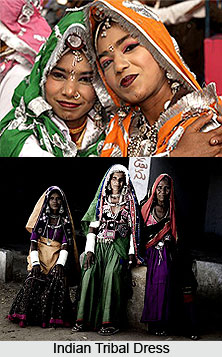
 Indian tribal fashion has existed since the primordial existence of tribals who had first laid their footsteps in the subcontinent. With time, several instances and excavations by historians and archaeologists have exhibited the unusual yet exceptional qualities in making fashion happen during times when man had just started to grasp the meaning of 'progression of humanity'. Today, however tribal fashion in India has taken on a fresh meaning, looking towards the Western culture, with much broader and pan-Indian aspects to be proud about. People of the Indian metropolitans, with swanky shops established in every corner of streets, house tribal jewellery or tribal attires, making the rather archaic communities going great guns. Whatever is the stance of cities today, the fact remains as it is, that Indian tribal fashion has descended from the tribal ancestors, who still maintain a progeny. The hinterlands in which they perhaps reside, stay witness to umpteen innovative tribal fashion, successfully blending the ancient and the modern. Indian tribal fashion has existed since the primordial existence of tribals who had first laid their footsteps in the subcontinent. With time, several instances and excavations by historians and archaeologists have exhibited the unusual yet exceptional qualities in making fashion happen during times when man had just started to grasp the meaning of 'progression of humanity'. Today, however tribal fashion in India has taken on a fresh meaning, looking towards the Western culture, with much broader and pan-Indian aspects to be proud about. People of the Indian metropolitans, with swanky shops established in every corner of streets, house tribal jewellery or tribal attires, making the rather archaic communities going great guns. Whatever is the stance of cities today, the fact remains as it is, that Indian tribal fashion has descended from the tribal ancestors, who still maintain a progeny. The hinterlands in which they perhaps reside, stay witness to umpteen innovative tribal fashion, successfully blending the ancient and the modern.
Indian tribal fashion can be zeroed down on the two primary aspects of costumes and jewellery. Indian history bears evidence that the primeval tribal jewelleries were sometimes chiselled out from animal bones, carved into extraordinary angles. These jewelleries possessed a sharp and jagged edge, which were almost always worn everyday, with specialties reserved for occasions. With time and advancement of civilisation, Indian tribal fashion took on a fresh turn, with the surging advent of gold jewellery. Depending on one's capacity to afford the expensive metal, throughout the ages gold has been utilised in every kind of jewellery, from necklace, armlet, headgear, wristlet, ornament for the waist, or even anklets. Gold ornaments were also and still is at times utilised in appeasing the Almighty in ceremonial occasions. Emerging in almost every hue and brightness, gold jewellery in Indian tribal fashion can be witnessed from the east to west and north to south.  Flowering one's body, empowered with rich patterns of fragrant flowers amongst many tribes of North-East India are in vogue, however with certain restrictions. Indian tribal fashion also finds proud passage in the diversified class of costumes and attires from the states and union territories that the country is dotted with. For example, men in Arunachal Pradesh, believe in keeping it simple, hence they wear lungis woven in red and black yarn, a jacket and a turban. Women from Arunachal deck themselves in a piece of cloth that wraps the body from the shoulders to the knees. This is then done again with a full-sleeved coat and a striking sash, called muhkak, tied around the waist. A Khasi man from Meghalaya is known by his dhoti (an unstitched garment for the lower part of the body), jacket and a turban. Khasi women from Meghalaya deck them with a two-piece cloth pinned on each shoulder and a shawl, called jainsem and tapmoh locally. A Garo tribes woman dons a blouse and tie and a long unstitched cloth called dakmanda, round the waist. The cloth is hand-woven, with a 6-10 inch borderline, bearing floral motifs. A Jaintia tribes woman from Meghalaya deck up in a similar manner as Garo women, with the blouse, a striped sarong, called thoh khyrwang.
Indian tribal fashion is also reflected exceedingly well in the costumes of tribes in Mizoram. Men folk from Mizoram deck them with a piece of cloth, early 7 feet in length, wrapped round the body. In winter, men adorn them with a long white coat, fastened at the throat and going down up to thighs. The coats are ornately patterned near the sleeves with bands of red and white. The tribes men also wear a particular kind of headgear, wrapping a cloth around the head, paying attention that the ends fall over the ears. Women from Mizoram don a single cloth wrapped around the waist and descending to the knees. A short white jacket with hand-woven patterns on top completes the look of the attire. Tribal fashion in Manipur consists of women donning a blouse and a three-piece hand woven phanek, closely resembling a wrap-around skirt. Men generally wear a single piece of cloth, resembling a lungi. Turbans are a must attire for Manipuri men. Indian tribal fashion finds a pride position in Nagaland, with sixteen tribes donning different costumes. Within the men, attires primarily comprises a short wrap-around skirt and a feathered headgear. Women from Nagaland possess various fashions of donning a skirt, named mekhla, varying according to tribes. Whatever, is the form amongst the tribes, wearing of mekhla follows the basic of less is more. Tribal fashion in Tripura consists of men wearing a narrow piece of cloth as a garment for the lower section of the body, without a shirt. The headdress is a turban, with the Tripura women donning two separate pieces of cloth, draped round the body both for lower and upper section of the body. The most astonishing feature of the attire is the upper part of the garment, embroidered with ornate designs. Indian tribal fashion amongst the Bhil community in Rajasthan consists of the men getting comfortable in a loincloth, embroidered waistcoats, turbans and traditional Rajasthani shoes. The Bhil tribeswomen don a single cloth, tucked round the waist, while the rest is used to cover the head. Diversified jewellery, ranging from beaded chokers, colourful bangles, nose-rings and an ornament hanging from the hair to the forehead, is a requisite for Bhil women. The Warli tribe from Western Ghats, rather popular as ghatis, don minimal clothing, with men wearing short dhotis and embroidered waistcoats. Warli women wear saris, short in length, with a half-sleeved embellished choli that is tied in a knot in the front. The Toda tribe from Nilgiri Hills have men wearing long, loose-flowing garment, covering the whole body. The colours are normally red, white and blue borders. Toda women also wear the same woven garment, except in the fashion of a sari. The jewellery is limited to silver, beads and shells. Indian tribal fashion exists to quite a massive height in West Bengal, Bihar and parts of Orissa, with the presence of the Santhal tribe. Santhal attire basically redefines minimalism, with men donning lungi and women donning short sari without a blouse, however worn to fit their body neatly, without even going loose at any trying circumstances. |
| ||||||||||||||||||||||||||||

