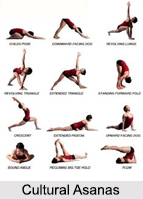
Cultural asanas are more akin to daily physical exercise postures that one practices in day-to-day life. Some of the cultural asanas include sun salutation, triangle postures, sarvangasana, sirshasana and so on. The names of different cultural asana postures with their values have been mentioned in classical yoga texts like Gheranda Samhita, Hatha Yoga Pradipika and Siva Samhita and in a number of Upanishadic works. These Yoga Asanas are named as cultural asanas because of their capacity to culture or refine the body in advanced stages.
In the world of yoga and asanas, yogic practices are basically divided into two kinds of broad spectrums, cultural yoga postures and meditative yoga postures. Cultural yoga postures or Yoga Asanas are meant for physical movements in order to keep the body flexible, agile, fit and sound. Cultural asanas are also aimed at reconditioning the body and mind, to bring about stability, peace and sense of well-being. Most of the Cultural asanas work on the abdominal part of the body. Cultural asanas require static stretching, which brings about an appropriate toning of muscles. They aid in bringing flexibility of the spine and render the back and spinal muscles stronger. Cultural asanas also motivate proper working of the vital organs in the thoracic and abdominal cavities. There are countless varieties of cultural asanas, performed generally in sitting, lying and standing positions.
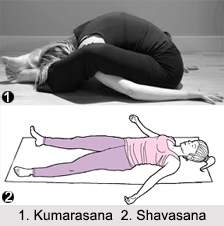
Cultural asanas are further sub-divided into physical asanas and relaxative asanas. Physical asanas greatly assist in attaining perfection in Hatha Yoga; while Relaxative asanas work on the chitta (the understated aspect of consciousness) level, eliminating every physical and mental tension. They are practiced in supine and prostrate positions of the body. Shavasana and Makarasana are two foremost Relaxative asanas. Makarasana generates heat within the body and is named after the shape of a crocodile that a body takes. Relaxative asanas are though few in numbers. They are executed in the lying position and are aimed to provide rest to the body and mind.
There are three important phases while practicing cultural asanas, each of them are equally important and should be conducted with proper attention. The phases include getting into the position, holding the position and getting out of the position. Each of the phases requires considerable amount of time and should never be done in a hurry that may result in negative effects. The section of cultural asanas contains by far the largest amount of asanas. It is said that there are 84 lakhs (8.4 million) of yoga postures that are titled as cultural asanas. Of these, 84 are more important and 12 of them constitute the composition of the Rishikesh sequence sometimes called Sivananda series or Yoga Vidya series.
The cultural asanas can be divided in seven groups as follows -
Dynamic sequences, such as the `surya pranam`
Backward bending postures, such as the cobra, locust, or bow poses
Inverted postures, such as the headstand or the shoulder stand
Sideward bending postures, such as the triangle pose
Forward bending postures, such as the sitting forward bend aka Paschimottanasana
Twisting postures, such as the half spinal twist
Standing postures including balancing poses, such as the tree pose
The cultural asanas are primarily meant for culturing the body and mind. They are mainly aimed to physical culture and thus maintain the health of the body. Most of the asanas come under the category of the cultural postures. The organs of human body are made up of tissues and the health of the body depends on the health of the tissues. The circulatory system can be kept in the best condition through cultural postures, which guarantee steady supply of proper nourishment and of the internal secretions of the endocrine glands and elements necessary for nourishment of tissues.
Thyroid, pituitary and the pineal glands are best taken care of by the cultural asanas like Sirasasana and Sarvangasana. The smooth functioning of the digestive system requires the gentle and automatic massage of the digestive organs that is provided by these kinds of asanas. Cultural postures like Bhujangasana, Salabhasana and Ardha Matsyendrasana are superb in keeping the abdominal organs in good health and efficient removal of waste products. Inverted asanas like Sirasasana and Sarvangasana brings about better blood supply to the brain and ensure its health and the health of the cranial nerves serving the different organs of senses as well. Cultural asanas are postures that are excellent for keeping the spine healthy. These postures greatly preserve the health of the nerves.

On the basis of refined position and movements, the cultural asanas can be further classified as backward bending asanas, forward bending asanas, spinal twisting asanas, inverted asanas and balancing asanas. The backward bending asanas stretch the abdominal muscles, tone and strengthen the muscles that control the spine, help prevent slipped disc and other back settings. The spinal nerves, which appear from between the adjacent vertebrae, are also toned. This has positive effects throughout the body since these nerves provide energy to all the other nerves, organs and muscles in the entire body. Forward bending asanas loosen up the back, thus maintaining good health and increase vitality. During a forward bending asana, each of the vertebras is estranged, the nerves are stirred, blood circulation around the spine is increased and the spinal cord is nourished. The cultural asanas are very important for making the back muscles supple and strong, thus compressing and massaging the abdominal organs, including the liver, kidneys, pancreas and intestines and stretching the leg muscles and tendons as well.
The spinal twist asanas improve the `pranic flow` in the `samana` area, around the naval. These asanas also nourishes the organs such as the pancreas, stomach, kidneys, small intestines, liver and gall bladder, thus relieves the associated disorders and rejuvenates the tissues in general. Inverted asanas overturn the action of gravity on the body, instead of everything being pulled towards the feet, the direction shifts towards the head. These practices improve health, increase self confidence and reduce anxiety and stress. They also increase mental power, concentration and the capacity to sustain large workloads without strain. These kind of inverted asanas encourage a proper supply of blood to \ to the brain, thus, nourishing the neurons and flushing out toxins. Blood and lymph, accumulated in the lower limbs and abdomen, are drained back to the heart then again circulated to the lungs, purified and re-circulated to the parts of body. This process nourishes the cells of the practitioners. An improved blood flow allows the pituitary gland to operate more competently turning the entire endocrine system. This has a positive effect on the metabolic procedures and even on ways of thinking.
People suffering from high blood pressure and severe back conditions, especially slipped disc should not practice these inverted asanas. Those with illnesses that make the blood impure should not perform inverted asanas until the blood is purified. Women should not practice inverted postures during pregnancy or menstruation. Balancing asanas improve the function of cerebellum, the brain centre that controls the body in the work of motion. These asanas induce physical balance, stilling cataleptic movement. As the moving body attains balance it becomes more and more free to rely on other forces, such as gravity, to support and drive it. This group of practice develops a reasonable mind and is especially noted for balancing the nervous system and removing stress and anxiety.
Padmasana or the lotus-pose is one of the important cultural asanas. This is an essential exercise in postural training both for the purpose of yoga meditation and also for preserving normal elasticity of the muscles connected with the pelvis and lower extremities. `Padma` means lotus in Sanskrit and in this asana position of the legs look like blooming lotus. This asana has been given a great importance in the Yogashastra as it is best suited for Pranayama, meditation and concentration. If practised daily, this beautiful, contemplative asana steadies the body and calms the mind, taking a person to the higher realms of realisation.
Suptapadmasana, Urdhvapadmasan, Samanasana, Apanasana, Vrsasana, Tarkasana and Dyanasana are some of the main cultural asanas.