


 Clay Crafts of India is an ancient art form dating back to more than 1000 years. The remnants of clay pottery that is found in the sites of Indus Valley Civilisation points to the highly skilled potters who were present even in ancient India. Red Ware was the most popular clay craft in the late Vedic Age. According to myths and traditions clay art was originated by the Potter. Potter the synonym of Prajapati is also revered as Lord Brahma, the creator, created human beings from clay. According to mythology, when Lord Shiva came to marry Sati, the need of an earthen pot was required. So Lord Shiva took two beads from his necklace and gave birth to a male and female forms who are the first moulder of "Kumbha". So the potter is also known as kumhaar. Clay as a material is difficult to control at all stages and the potter has to be constantly diligent from beginning to end, in order to avoid damage or breakage. The culminating fire which will turn plastic clay into permanent terracotta is the most hazardous operation of all. Clay Crafts of India is an ancient art form dating back to more than 1000 years. The remnants of clay pottery that is found in the sites of Indus Valley Civilisation points to the highly skilled potters who were present even in ancient India. Red Ware was the most popular clay craft in the late Vedic Age. According to myths and traditions clay art was originated by the Potter. Potter the synonym of Prajapati is also revered as Lord Brahma, the creator, created human beings from clay. According to mythology, when Lord Shiva came to marry Sati, the need of an earthen pot was required. So Lord Shiva took two beads from his necklace and gave birth to a male and female forms who are the first moulder of "Kumbha". So the potter is also known as kumhaar. Clay as a material is difficult to control at all stages and the potter has to be constantly diligent from beginning to end, in order to avoid damage or breakage. The culminating fire which will turn plastic clay into permanent terracotta is the most hazardous operation of all.
Types of clay crafts Jhuker pottery a famous clay art in India has its roots deeply associated with Harappan civilization. The clay art which developed in the Harappa civilization gained quite a chic form during the Vedic era. According to the archaeological discovery in western Uttar Pradesh, the most acclaimed clay art in the late Vedic period was the "Red Ware". Another notable form of clay art of the Vedic period was "Painted Grey Ware" which comprises dishes, bowls which were used during the rituals and ceremonies for meal. Another form of clay art came into existence was Northern Black Polished Ware. Northern Black Polished Ware was a kind of pottery where a very glossy and lustrous kind of fabric was used. 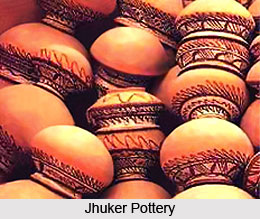 As the clay art developed, black pottery as another form of clay art became popular in India. The blackening involves the firing in a closed hearth and the smoke arises from the hearth colours the terracotta. The process of Black Pottery is more luxurious in Nizamabad (Uttar Pradesh). The process indulges the carving of the designs on the dry surface then they are fired and after firing the carvings are filled with paint made from a mixture of mercury and zinc. Some pots, when they are hot are painted with raw lacquer and a black, glossy, non- porous surface is produced.
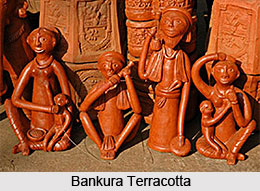
Clay art also involves the making of clay beads, "jbanvan" for cleaning the feet, "hookahs" and "chillums" for smoking tobacco. Even clay art in India associates the making of some of the architectural elements such as "Jali" (trellised screens) and tiles. Miniature toys, utensils, animals and human figures of various casts and occupation are available in bright colours and fabulous designs and are often used as an element of decoration. Varanasi and Krishnanagar in West Bengal are famous for producing umpteen amount and variety of miniature idols. Even the religious festivals demand the clay images of the deity which are hugely manufactured in Kumartully and Patuapara of Kolkata. Terracotta is an important form of pottery. In fact terracotta is the most common form of pottery in India. Various figures are made in terracotta. Terracotta figures serve as show pieces in many of the Indian households. In India clay images made as votive offerings for tribal shrines are sold at fairs organised by government departments, and end up as decorative pieces in city homes, shorn of their basic ritual association. Centres of Clay Crafts in India There are a wide variety of clay crafts in India. For instance the Bengali Surai or the common jug, the Kagzi or paper pottery of Alwar, the painted pottery of Bikaner, the colourful Khurja pottery of Uttar Pradesh, the variety of clay ware in Himachal Pradeshlike gidya, patri and narale, the beautiful pottery of Saurashtra, the earthen ware of Srinagar. 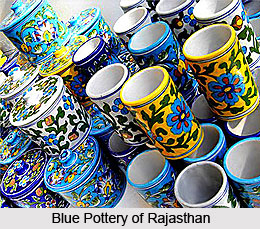 The unique Karigari pottery of south Arcot also enriches the clay craft of India. Some other popular potteries of India are the Blue Pottery of Jaipur, Pokran Pottery and a lot more. In the present age Pottery has diversified into a number of branches. Clay figures of Lucknow represent characters of different races and tribes of Oudh. Wall brackets, vases, clock-cases, and other articles are manufactured out of clay. They are in a decadent style that is modelled after the Italian work which is found all over Lucknow. Clay figures painted and dressed up in muslins, silks and sequins are modelled at Kolkata, Lucknow and Pune. The unique Karigari pottery of south Arcot also enriches the clay craft of India. Some other popular potteries of India are the Blue Pottery of Jaipur, Pokran Pottery and a lot more. In the present age Pottery has diversified into a number of branches. Clay figures of Lucknow represent characters of different races and tribes of Oudh. Wall brackets, vases, clock-cases, and other articles are manufactured out of clay. They are in a decadent style that is modelled after the Italian work which is found all over Lucknow. Clay figures painted and dressed up in muslins, silks and sequins are modelled at Kolkata, Lucknow and Pune.
Modernization of clay art in India happened with the introduction of the Chinese and Persian porcelain art which was brought in India by the Mughals. The porcelain tableware came into demand. During the Sultanate period in Delhi and Uttar Pradesh, India proceeded with its own manufactory of blue pottery. Ram Singh, an innovative ruler was the person who fetched the craft from Delhi to Jaipur and then onwards the craft preceded its growth and now proved to be the principle manufacturer. |
| |||



Clay Crafts of India
| Clay Crafts of India is an important art form of the country. There is a wide variety of clay potteries in India. In fact clay crafts in date back to the time of Indus Valley Civilisation. |
| ||||||||||||||||||||||||||||

