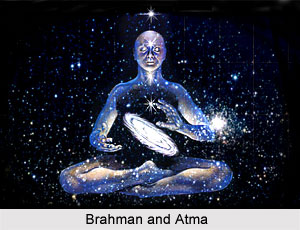
 In Indian philosophy the Brahman and Atma are regarded as the objective and the subjective. Brahman and Atma reckoned as the cosmic and the psychical principles are acknowledged as identical in Indian philosophy. The relation of the Brahman and Atman is depicted in the Rig Veda. Brahman is the Atman. The transcendent conception of God depicted in the Rig Veda got the transformation of subjective entity. The infinite is the connotation of not beyond the finite but within the limitation of the finite.
Indian Philosophy supports that Atma is the inmost individual being, and the Brahman is the inmost being of universal nature and of all her phenomena. This is the necessary implication of all relevant thinking, feeling and willing and this specific identity of subject and object is not a vague hypothesis. Indian Philosophy asserts that nature is considered as the sole creator who led the human mind towards the spiritual reality. This is where the concept of Brahman and Atman are interrelated.
The conceptions of Brahman in Indian philosophy are illuminated by the stages of waking, dreaming, sleeping, and the conception of ecstasy of the self, are clearly discriminated in the later Vedanta writings and answer to the different conceptions of Brahman. `Ananda`, the highest Brahman that is `Atman`, is realised in the fourth or the `turiya` state. This state is the union of the object and subject. The observer, the observing eye and the object are merged together in one whole. The identification of Atman with the self-conscious individual implies the Brahman as the self-conscious `Isvara` with a force opposed to him. As the self-conscious individual will be a mere abstraction apart from some content or object from which he derives his being, even so the `Isvara` requires an element opposing him. The conception of `Isvara` encompasses the highest object of the religious consciousness.
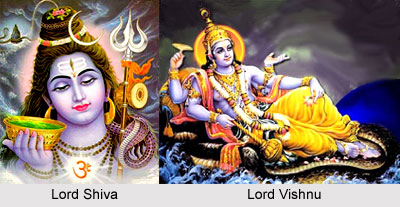
Brahman in Indian philosophy is reduced to the `Hiranyagarbha` or the cosmic soul, which comes between the Isvara and the soul of man when the Atman is identified with the mental and vital self of man that are `manas and `prana.` This is considered as related to the entire cosmos in the same way as the individual soul is related to its body where the influence of the Rig Veda is perceived here. It is supposed that the world is composition of a consciousness and a will. The mind of the world is defined as `Hiranyagarbha`. Upanishads based on Indian philosophy also interpret this conception of world soul under various names and forms. The connotations are `Karya Brahma`, or the effect God, the Brahma of `Natura Naturata`, as distinguished from the Karana Brahma or the Causal God of Isvara, or the `natura naturans`. The entire cosmos is based on this effect; on this relation of Atman and Brahma. The Brahman of the Upanishad is regarded as no metaphysical abstraction, no indeterminate identity, and no void of silence but as the most real being with an entirety. Indian philosophy says that it is the utterance "AUM," generally employed to represent the nature of Brahman and throws light to the real entity of its concrete character, symbol of concreteness as well as completeness. In Indian philosophy the Brahman and Atman epitomizes the supreme spirit, the "emblem of the most high." It connotes the three principal qualities of the supreme trio personified as Brahma, Vishnu and Siva. "A" denotes Brahma the creator, "U" is Vishnu the preserver, and "M" is Siva the destroyer.
In a broader sense again Indian philosophy recognizes `Brahman` as infinite because it is the ground of all finites, eternal and that it is the timeless reality of all things in time. Brahman delineates the growth, and is suggestive of life, motion and progress, and not death, stillness or stagnation. The ultimate reality is detailed as `sat`, `cit` and `ananda` which are the implication of existence, consciousness, and bliss. According to Brahman, `Taittiriya` is the reflection of existence, consciousness and infinity and refers to positive reality. The highest and the ultimate reality never denotes to thought, force, or being exclusively, but associates the living unity of essence and existence, of the ideal and real, of knowledge, love and beauty.