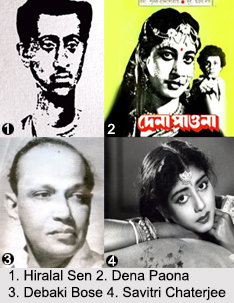
From the very beginning it was the Bengali filmmakers, cameramen, musicians and other technicians who had valuable contribution towards the Indian film industry. During the Silent Era several impressive films were made like Bhramar, Hariraj and Buddhadev. These films were produced by Hiralal Sen. His longest film was titled Alibaba and the Forty Thieves. While speaking of the talkie era the first name that occurs to one`s mind is Pramathesh Chandra Barua and Debaki Bose. Both of them have made several Bengali films. Debaki Bose`s most memorable film till date remains to be Chandidas that was made in the year 1932. This was one of the landmark films because of its sound recording. PC Barua created a cult with his Devdas, an adaptation of Sarat Chandra Chatterjee`s novel.
The inter-action between the literary culture and film culture was also beneficial. Mahatma Gandhi is reported to have said that what Bengal thinks today, the rest of India thinks tomorrow. In much the same way, Bengali cinema has led in subject matter from the 1920s till the middle of the 1940s. And the way
Rabindranath Tagore`s work has been creatively used by
Satyajit Ray and others enhances the film culture. In a situation where much of Indian cinema is homogenized, the regional film has given it an identity and a sense of purpose. It has also revealed the variety of people and cultures in India with their richly diverse languages, legends, stories, clothes, climate, music and dance.
Bilet Pherat (1921) or The England Returned: Directed by N.C. Laharry, the film starred Dhirendranath Ganguly, Manmatha Pal, Kunjalal Chakraborty, and Sushilabala. The first Bengali film, this was a satire on the predicament of an Indian (Laharry) who returns home from England after a long spell. So impressed with himself and his sojourn abroad, he is almost an alien in his parental home. The film shows were accompanied by a live band.
Andhare Alo (1922): Directed by Sisir Bhaduri, the film starred Sisir Bhaduri, Naresh Mitra, Jogesh Choudhury, and Durga Rani. Based on Saratchandra`s story, the film recounts the life of an upper crust youth - family and bride on the one hand and a caring courtesan on the other. The performances were acclaimed by many.
Chandidas (1932): Directed by Debaki Bose, the film starred Durgadas Bannerjee, K.C. Dey, Amar Mullick, Umasashi, and Sunila. On the love between the fifteenth century poet Chandidas and a washer woman - the poet rejects conventional norms and prefers to abide with his love. As a Vaishnavite, his own beliefs were liberated and democratic. The real-life saint Chandidas could have been one of three - Badu Chandidas, Dwija Chandidas or Deena Chandidas.
Natir Puja: Directed by Rabindranath Tagore, the film starred students of Shantiniketan. The film was, as a matter of fact, the recording of a dance drama composed by Tagore in 1926.
Rajrani Meera (1933): Directed by
Debaki Bose, the film starred
Pahadi Sanyal,
Molina Devi, Durgadas Bannerjee, Amar Mullick, Chandrabati Devi and Nibhanani Devi The film was on the life of the legendary Rajput princess Meerabai who suffers at the hands of her in-laws because of her single-minded worship of
Lord Krishna. Chandrabati Devi became a major star with this film.
Dhoop Chhaon/Bhagya Chakra: Directed by Nitin Bose, the film starred Biswanath Bhaduri, Durgadas Bannerjee, K.C. Dey, Ajmat Bibi, Kedar Sharma, Pahadi Sanyal, Umasashi, Sardar Akhtar, and Amar Mullick. A story of greed and the omniscience of fate - a child is kidnapped by his father`s brother, is reared by a blind singer, falls in love but finds that life has other twists and turns in store for him. K.C. Dey as the singer rendered a fine performance and his singing overshadowed much of the story and performances. This was the first systematic use of playback singing, claimed by Nitin Bose to be among the first films in the world to employ the technique.
Manmoyee Girls` School: Directed by Jyotish Bannerjee, the film starred Tulsi Chakraborty, Radharani, Jahar Ganguly, Kanan Devi and Jyotsna Gupta. This hit comedy based on a stage play concerned itself with the stipulation that only a married couple would be employed at the school in question. The main characters pretend to be married and there are many incidents, following which they do fall in love and get married. The pedestrian charm of the film, and good performances, particularly by
Kanan Devi, led to many remakes - in Hindi (Miss Mary), Marathi (Jhakli Mooth), Bengali, Tamil (Missiamma) and Telugu (Missamma).
In 1949 `42` or Byalis was released. It was directed by
Hemen Gupta and starred Bikash Roy, Manju Dey,
Sombhu Mitra, Suruchi Sengupta, and
Pradeep Kumar. The most famous of Gupta`s film, this was based on a true incident in Midnapore, Bengal. A village revolts against colonial rule following an incident of unparalleled cruelty. The uprising leads to further violence and unrest, in turn causing more damage. The finale depicts the soldiers refusing to fire on the villagers (too much innocent blood has already been shed) and joining in raising the national flag (the tri-colour). The film was banned in many states (it did however release in Bombay) and was allowed exhibition in 1951 after many changes had been incorporated.
Kavi was directed by Debaki Bose, the film starred Nilima Das, Anubha Gupta, Robin Majumdar, Tulsi Chakraborty and Nitish Mukherjee. A railway porter discovers the poet in himself - two women fall in love with him and his poetry, but with tragic consequences. The picturization, and the performances of the two heroines were commanding, and many songs, particularly `Kalo jodi manda tobe` and `Ei khed mor mone mone` became popular.

After the 1930s and 1940s Bengali films took another step forward in the arena of filmmaking with the help of
Satyajit Ray,
Bimal Roy,
Ritwik Ghatak and others.
Chinnamul (1950) was directed by Nemai Ghosh. This Bengali film starred Prematosh Roy, Gangapada Basu, Sova Sen, Shanta Devi, Shanti Mitra, Bijon Bhattacharya, and Ritwik Ghatak. Set during the Partition of India, the film depicts the suffering and struggles of the farmers forced to leave East Bengal and arrive in Calcutta. The elderly woman refusing to let go of her home`s door post, the crowded train journey are merely two examples of this film that sought realism. There was no makeup and no professional actors in the film. Satyajit Ray is believed to have been partly involved in the development of the screenplay. Censorship and police interference accompanied the film.
One film that changed the face of the Indian cinema is
Pather Panchali (1955) by Satyajit Ray. It took three years to complete the film. It was a landmark film in the history of Bengali films because of its subject and its treatment. The film deals with a poor family in rural Bengal but the film also explores the journey of life induced with a myriad of emotions. The film has two sequels:
Aporajito (1956) and
Apur Sansar (1959). The latter introduced the two most outstanding actors of Indian cinema-Soumitra Chatterjee and Sharmila Tagore.
Sharey Chuattar (1953) was directed by Nirmal Dey. The star cast of this film included Uttam Kumar, Suchitra Sen, Tulsi Chakraborty, Molina Devi, Bhanu Bannerjee, Jahar Roy and Nabadwip Haldar. This delightful comedy was the launch vehicle of Uttam Kumar and Suchitra Sen - among the finest actors and biggest stars of
Indian cinema.
Kabuliwala: Directed by Tapan Sinha, the film starred Chhabi Biswas, Tinku Thakur, Radhamohan Bhattacharya, and Manju Dey. - Based on Rabindranath Tagore`s short story about an Afghan spice-seller who is imprisoned for murder. Upon release, he realizes that the Indian girl who reminded him of his daughter is now an adult - and that his daughter back home would have forgotten him. Tinku Thakur as the Indian child gave a spontaneous performance. This was her sole film appearance.
Moreover movies, such as, Teen Kanya, Devi, Aranyer Din Ratri, Charulata, Goopy Gyne Bagha Byne, Hirok Rajar Deshe, Neel Akasher Nichey, Chorus, Anatreen, Mrigoya (the first film of Mithun Chakrborty), Akaler Sandhane, etc are also worth watching.
Another landmark film in the history of Bengali film is Meghe Dhaka Tara by Ritwik Ghatak. The film witnessed superb performances by Anil Chatterjee and Supriya Devi. Along the commercial vein films like Shaapmochon, Harano Sur, Jiban Mrityu, Dui Bhai, Jhinder Bandi, Shaptapadi, Deep Jwele Jayi, Saat Paake Bandha, Sonar Kella, Kinu Goalar Goli, Parash Paathar, Dhonnyi Meye, Ogo Bodhu Sundari and a host of films were being simultaneously produced. These films were quite popular with the audience.

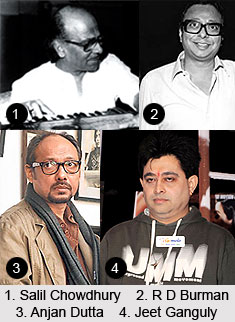
During this era the commercial films comprised all the necessary ingredients of entertaining the audience. The songs of such films were very popular with the Bengalis. The music composed by
Pankaj Mallick,
Hemanta Mukherjee, Salil Choudhury, Nachiketa Ghosh, Sudhin Dasgupta and Himangshu Dutta was a rage with the audience.
Around 1980s the Bengali film industry went through crises but the films of
Gautam Ghose, Sandip Ray,
Rituporno Ghosh,
Aparna Sen and other contemporary
Bengali directors revived the industry. Besides the hardcore commercial films innovative movies were welcomed open heartedly by the Bengali cine-goers. The contemporary filmmakers explore all kinds of themes-- from political issues to emotional subject matters.
Films, such as, Damu, Atmiyo Swajan, Grihajudhha, Uttara, Mondo Meyer Upakhyan, Unishe April, Paromitar Ek Din, Paroma, Titli, Baksha Rahoshyo, Nishijapon, Bombaier Bombete, Anuranon, Dahan, Utsav, Shubho Mahurat, Chokher Bali, Dosar and others have made niches for themselves.
A list of Bengali films will include the following:
| Bengali films of 1931 |
Bengali films of 1947 |
Bengali films of 1963 |
Bengali films of 1979 |
Bengali films of 1995 |
| Bengali films of 1932 |
Bengali films of 1948 |
Bengali films of 1964 |
Bengali films of 1980 |
Bengali films of 1996 |
| Bengali films of 1933 |
Bengali films of 1949 |
Bengali films of 1965 |
Bengali films of 1981 |
Bengali films of 1997 |
| Bengali films of 1934 |
Bengali films of 1950 |
Bengali films of 1966 |
Bengali films of 1982 |
Bengali films of 1998 |
| Bengali films of 1935 |
Bengali films of 1951 |
Bengali films of 1967 |
Bengali films of 1983 |
Bengali films of 1999 |
| Bengali films of 1936 |
Bengali films of 1952 |
Bengali films of 1968 |
Bengali films of 1984 |
Bengali films of 2000 |
| Bengali films of 1937 |
Bengali films of 1953 |
Bengali films of 1969 |
Bengali films of 1985 |
Bengali films of 2001 |
| Bengali films of 1938 |
Bengali films of 1954 |
Bengali films of 1970 |
Bengali films of 1986 |
Bengali films of 2002 |
| Bengali films of 1939 |
Bengali films of 1955 |
Bengali films of 1971 |
Bengali films of 1987 |
Bengali films of 2003 |
| Bengali films of 1940 |
Bengali films of 1956 |
Bengali films of 1972 |
Bengali films of 1988 |
Bengali films of 2004 |
| Bengali films of 1941 |
Bengali films of 1957 |
Bengali films of 1973 |
Bengali films of 1989 |
Bengali films of 2005 |
| Bengali films of 1942 |
Bengali films of 1958 |
Bengali films of 1974 |
Bengali films of 1990 |
Bengali films of 2006 |
| Bengali films of 1943 |
Bengali films of 1959 |
Bengali films of 1975 |
Bengali films of 1991 |
Bengali films of 2007 |
| Bengali films of 1944 |
Bengali films of 1960 |
Bengali films of 1976 |
Bengali films of 1992 |
Bengali films of 2008 |
| Bengali films of 1945 |
Bengali films of 1961 |
Bengali films of 1977 |
Bengali films of 1993 |
|
| Bengali films of 1946 |
Bengali films of 1962 |
Bengali films of 1978 |
Bengali films of 1994 |
|