Syamantaka Mani, Mythical Jewel, Indian Mythology - Informative & researched article on Syamantaka Mani, Mythical Jewel, Indian Mythology
  Indianetzone: Largest Free Encyclopedia of India with thousand of articles Indian Religion


in  
Art & Culture | Entertainment | Health | Reference | Sports | Society | Travel
Forum  | RSS Feeds  | Free E-magazine
Indian Religion : Vastu Shastra l Indian Religions l Indian Myths l Indian Mythology l Gods of India l Goddesses Of India l Religious Thinkers of India l Types of Religion in India l History of Indian Religion l Indian Yogis l Ajivikas l Sacred Scriptures in Indian Religion l Tantra l Shaivism l Indian Communities l Sacred Animals in India l Roman Impact on South Indian Art and Society l Bhattacharyas l Indian Classical Terms
Home > Society > Indian Religion > Indian Mythology > Syamantaka Mani
Syamantaka Mani, Mythical Jewel, Indian Mythology
Syamantaka Mani or Jewel is the most renowned jewel in Indian Mythology, endowed with supernatural powers.

In the Puranas it is mentioned that Syamantaka Mani, or the Syamantaka Jewel or Gem is a mythical jewel endowed with magical and enchanting powers.

The Vishnu Purana and the Bhagavata describes the story of Syamantaka Mani. The precious stone or the Syamantaka Mani originally belonged to the Sun god or Surya who wore it around his neck. It was said that whoever possessed this jewel would never come across any mishaps in the form of natural disasters like in the form of droughts, floods, earthquakes or famines, and would always be in prosperity and opulence. It is also said that wherever the Syamantaka Mani is kept, it would produce almost nine mounds of pure gold daily for the keeper. This gem is also the basis of the stunning light and rays of the Sun god.
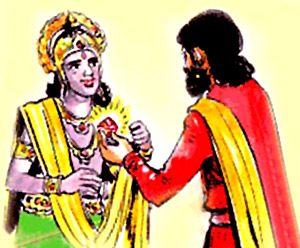
Syamantaka Mani, Mythical Jewel, Indian Mythology There was a king of the name Satrajit, a Yadava nobleman. He was a great devotee of the Sun-god or Surya. Satrajit while walking along the sea shore was praying ardently to Sun-god. Sun-god pleased with Satrajit`s devotion himself appeared and stood before him. Seeing the god in an indistinct and dazzling fiery shape, Satrajit asked him to appear in a less blinding form, so that he could see the God clearly. On this the Sun god took the Syamantaka jewel off his neck, and Satrajit saw the Sun God who is of a dwarfish stature, with a body like burnished copper, and with slightly reddish eyes.

Sun-god awarded Satrajit as a blessing, the precious gemstone Syamantaka Mani. As a consequence of this Syamantaka jewel, when Satrajit returned to Dwaraka with the jewel, people mistook him for the Sun God himself, such was his dazzling glory.

Satrajit later presented Syamantaka Mani to his brother Prasena, who was also the ruler of the Yadava region. Prasena used to wear the gem often, and once while walking in the woods with it, he was attacked by a lion, which killed him and fled with the jewel. Then the lion was attacked by Jambavan, described as a `bear`, killed it after a fierce fight and took the Syamantaka jewel. Jambavan was in Rama`s army of monkeys to Lanka.

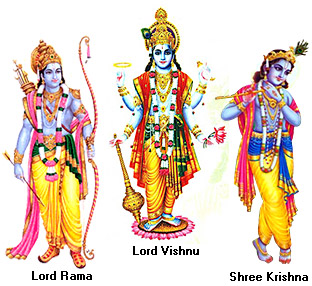
It was rumoured that Lord Krishna wanted to possess Syamantaka Mani or jewel. Thus when Prasena did not return, people started to accuse Krishna for the murder of Prasena and for the theft of the precious stone. With the purpose to prove his innocence, Krishna wanted to find out the true offender and recover the Syamantaka Mani. As he followed on the search of the dead Prasena, Krishna came to the place were he found the dead body of Prasena and his horse. He also found the pieces of teeth and nails of a lion. Krishna then followed the footsteps of the lion, which led him to the spot of the second struggle, were the corpse of the lion was lying. From there, he followed the tracks of a bear, which finally led him to the entrance of Jambavan`s cave. In that cave Jambavan`s children were playing with the Syamantaka Mani. Jambavan entered the cave and found Krishna; he thought him to be an intruder and wanted to kill Krishna. There was a combat between Krishna and Jambavan that lasted for twenty-one days, defeated him, got back the Syamantaka Mani, and returned to Dwaraka. Krishna later married Jambavati, Jambavan`s daughter.

In the meantime Krishna`s family members and friends waited for twelve days outside the cave but Krishna did not came out and they thought that he was dead. All of Krishna`s friends and family members became extremely grief-stricken and started worshiping Goddess Durga to assure the Lord`s safe return. As they performed this worship, Krishna entered the Dwarka with his bride Jambavati.

Krishna then called Satrajit to the royal assembly and, after recounting to him the entire story of the Syamantaka jewel`s recovery, gave the gemstone back to him. Satrajit did not want to take the jewel but Krishna forced him to take. Satrajit accepted the jewel, but with great shame and remorse. He went back to his home, and there he decided to offer Lord Krishna not only the jewel but also his daughter, Satyabhama. Sri Krishna accepted the hand of Satrajit`s daughter, Satyabhama, who was endowed with all divine qualities. But Krishna refused to take the jewel and returned it to King Satrajit.

Some days later, Krishna and Balarama were going towards Hastinapur after hearing the rumours that the Pandavas have been burnt to their deaths in a fire. In the mean time Kritavarma, Akrura and Satadhanwa, wanted to steal the Syamantaka Mani from Satrajit. Thus in Krishna`s absence from Dwaraka Satadhanva at one night entered the house of Satrajit and murdered him to death and stole the jewel.

Satyabhama was mournful and rushed to Hastinapur to inform Krishna about the horrifying death of her father Satrajit. Krishna and Balarama immediately started for Dwaraka to avenge Satrajit`s death, hearing of which Satadhanwa fled on his horse, keeping the jewel with Akrura. Satadhanwa was chased down by Krishna and Balarama and finally killed by Krishna near Mithila. Later Krishna returned to Dwaraka, and upon realizing that Akrura had already fled to Kashi with the Syamantaka jewel, summoned him up, and asked him to admit his guilt. When Akrura obeyed what Krishna had said then He let him keep it, on the clause that Akrura had to stay in the city of Dwaraka.
(Last Updated on : 29/01/2009)
  More on Indian Mythology...
 
Avatara Nagas Naginis
Apsaras Kaparddin, Indian Mythology Kapila, Indian Mythology
Kapila, Mythology Character Krauncha Krikana
Krisasva Kritanjaya, Indian Mythology Sataydhriti, Indian Mythology
Arundhati Kaliya Radha
Position of the Eighth child Yaja Swarga
Syamantaka Mani Srutayus Suchi
Satajit Sarpa Savibhasa
Tridev Sumantu Satadyumna
Sweta Swayambhuva Swamabhak
Swayamprabha Sruta Srinjaya
Sunaka Syala Sweta-Dwipa
Manwantara Swaraj Krodhavasa
Suvira Suvela Suvarna
Suvala Susuma Suchandra
Subhasa Srutanjaya Sudhanwan
Srutadeva Srijavana Sudyumna
Srideva Somasushmapana Somadatta
Pushpavat Pururavas Satanika, King Of Indraprastha
Soma, Hindu Mythology Skambha Shishunaga
Shiksha Sikhandini Sisumara
Siddhis Saryatas Sarama
Sumati Sankha Nikumbha
Evil and Demon Spirits in Hindu Mythology Anaranya Mahajwala
Mahanila Mahendra Mahikas
Mahishmati Mainaka Mayodaya
Mainaka Makara Malaya
Malina Mallas Manas
Manaswini Mandahara Mandehas
Romapada Marttikavatas Marshti and Marshtimat
Marutta Marutwati Maya
Medhavin Mena Menaka
Meru-Savarnis Misrakesi Mitra
Narishyanta Mrigavati Mrigi and Mrigamanda
Mangala Chitraka Mrigasiras
Muda Nalini Naras
Narikavacha Navala Takshaka
Tala Tamrapakshi Tapa-Loka
Nischara Nisitha Nisunda
Nipa Nirmali Niruta
Nirvritti Jyamagha Nirmalas
Dharbaga Dharmanetra Divaratha
Ekachakra Upakosa Upayaja
Urana Urddhabahus Urja
Urjaswati Urjjavaha Urvasi
Usanas Ushas Hidimba
Karna Kuntal Ekapadakas Dhrishtasarman
Dhruyu Dhumrakesa Param
Parameshthin Paras Pariplava
Dhi Krishna, Son Of Havirdhana Dhishana
Niyama Niyati Niyat
Richa Nriga Nyagrodha
Padmavati Paka Paksha
Palita Pancha-Lakshana Panchapsaras
Panchavati Khatwanga Dirghamukha
Dirghatamas Dishta Divaspati
Divya Dhumraswa Dhundu
Ansuman Parna Parshata
Parvathi Pauras Pavitras
Dosha Dravina Dridhasona
Dukha Dyumatsena Dyutimat
Pransu Prasada Prasenajit
Prasraya Prastutas Pratah
Pratikshatra Pratishthana Pradarsanas
Pradosha Pradyota Prajani
Punjakasthali Punyajanas Punyasloka
Purujanu Purumidha Purvachitti
Purvashada Rajni Pushya
Pushya-Shanti Putra Raivata
Rajarshis Rajas Rambha
Ramyaka Ratnavali Ratri
Revali Rina Lokaloka
Ritadhaman Ritu Ritudhaman
Rohini Rohini Rohitaswa
Ruchiradhi Rupavahikas Swahi
Jantu Jhajhara Jimutaketu
Jogi Kachhapa Kaitabha
Kakavarna Kakubha Kala
Kalanara Kalayavana Kalika Purana
Kalmashapada Kampilya Lomapada
Kapali Kapila, Indian Mountain Kapotoroman
Karambhi Kashtha Kaumara Creation
Kavi, Son Of Manu Chakshusha Kavyas Kavyas
Kavya-Darsa Kavya Prakasa Kesini, Mythological Character
Kevala Khandikya Kimpurusha Kingdom
Kirtaratha Kolaria Kotavi
Kotikasya Kratha, Son Of Vidarbha Kratusthala
Krauncha, Mythical Character Krikana Krisasva, Ruler Of Visala
Ketumta Kritaka, Son Of Vasudeva Kritaka, King Of Magadha
Kritanta Kritaratha Krittika
Kritwi Krodhaghara Kshatranjas
Kshema, Son of Dharma Kshema, Queen Of King Bimbisara Kuntibhoja
Kshemadhanwan Kshemaka Kshetrajna
Kuhu Kukkura Kukshi, Mythical Character
Kuru, Son Of King Samvarna Kuruvatsa Kusamba, Son Of Kasu
Kusika Lakshmana Lasya
Lekhas Lesa Lingam
Sachi Sadnova Sagarika
Sahajanya Saivy Sakuni, Son of Demon Hiranyaksha
Sahya Sainhikeyas Shishunaga
Samaradana Sakra, Hindu Mythology Salisuka
Samaravira Sambara, Asura, Demon Sambhuta
Samika Sampadvasa Sampati
Sandipani Sanda Sanjna
Sankara Acharya Samudra, Ocean, King Of Rivers Samudra
Samvara Samvatsara Samyati
Sandhyansa Sankalpa Sannyasi
Santati Santosha Sarmishta
Savarna, Wife Of Sun Savarni Saryati
Shatadru Skanda Sata Sankhyas
Smaya Somadatta, King Of Vaisali Sringavera
Sravasta Srigadita Srutavat
Sutanu Garuda Regions of hell
Adrisyanti Agneyastram Agnibahu
Agnishtoma Ahikshetra Aja
Ajaka Ajapashya Ajitas
Ajavithi Aindrajalika Ahavaniya
Akasavani Akshohini Alaka
Alankara Alloo Amaravathi
Amavasu Ambhansi Amogavarsha
Amogha Siddha Anabhitra Anadichitta Parameshti
Anagundi Ananata Anargharaghava
Araga Andakataha Andhra Dipaca
Angirasas Anima Animisha
Anjaka Anjana Ankalamma
Anugrahasarga Anuvatsara Anyadesya
Apamurtti Apana Aparagodana
Apaspati Apastamba Apava
Archish Argha Ahrat
Arshabhu Arugan Aryaka
Avantyas Avarant Avasthanas
Ayana Ayomukha Babhravya
Badagas Badari Balavatsa
Banddhas Bandhayanas Basava
Bhajina Bhalandana Bhanus
Bhanumat Bharatavarsha Bharga
Bhat Bhuri Chandrahasa
Danta Vaktra Chitrabaha Riksha
Kshana Shakuntala Kambala, Indian Mythological Character
Katyayana Kameri Kamya
Bharata Bhurloka Devayani
Kalapa Kalpa, Vedic Time Measurement Manasarovara
Himapandura Emush Rishabha
Dappleskin Omkara Sannatimat
Recently Updated Articles in Indian Religion
  • Dhammapada
    Dhammapada, the core of Buddhist teaching in Pali language, is considered the gospel of Buddhism even today
  •  
  • Brahma Nirvana
    Brahma Nirvana is the ultimate communion with the eternal Reality of life that is the Brahma.
  •  
  • Ahmadiyya Sect,
    Ahmadiyya Sect is an Islamic sect founded in India by Mirza Ghulam Ahmad of Qadian.
  •  
  • Arahant
    Arhant according to the philosophy of Dhammapada is an individual who has attained the highest degree.
  •  
E-mail this Article | Post a Comment
Free E-magazine
Subscribe to Free
E-Magazine on Indian Religion

 
Syamantaka Mani, Mythical Jewel, Indian Mythology - Informative & researched article on Syamantaka Mani, Mythical Jewel, Indian Mythology
Sitemap
Contact Us   |   RSS Feeds
Copyright © 2008 Jupiter Infomedia Pvt. Ltd. All rights reserved including the right to reproduce the contents in whole or in part in any form or medium without the express written permission of Jupiter Infomedia Pvt. Ltd.