


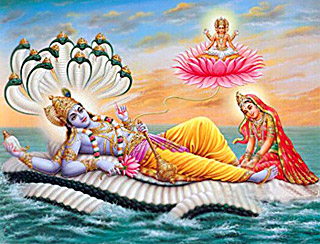
 In Hinduism Sesha or Shesha is stated to be the king of all Nagas. He is one of the primal beings of creation and an avatar or incarnation of the Supreme God. Sesha is also known as Sankarshan. Sesha is mostly connected with Lord Vishnu. His name means 'that which remains'. In Hinduism Sesha or Shesha is stated to be the king of all Nagas. He is one of the primal beings of creation and an avatar or incarnation of the Supreme God. Sesha is also known as Sankarshan. Sesha is mostly connected with Lord Vishnu. His name means 'that which remains'.
The Puranas considers that Sesha hold all the planets of the Universe on his hoods. He continuously sings the glories of Lord Vishnu from all his mouths. He is sometimes referred to as 'Ananta-Sesha' which means 'Endless Sesha.' Sesha is represented as a huge snake, forming by its many coils floats in the space or on the universal ocean. It forms a bed on which Vishnu sleeps. Sesha is portrayed with its thousand heads erect, to form a canopy over Vishnu's head. Sesha's this figure presents the idea of defense against any invasion of the sleeper's repose. Sesha is also said to support the eight elephants which support the world. In the Hindu mythology it is considered Balarama, Lakshmana, and Nityananda Prabhu to be the incarnations or Avataras of Sesha. Patanjali is also considered as an incarnation of Sesha and is represented in Naga form with Naga canopy. In legends it is specified that Sesha loosens Mount Mandara, to enable it to be used in the churning of the ocean by the devatas and asuras. In the epic Mahabharata, Sesha's father was Kashyapa and his mother, Kadru. In the Puranas there is an account of a dispute between Sesha and Vayu, regent of the wind. Vayu blew with all his strength against the thousand peaks of Mount Meru, and Sesha covered each of the peak by one of his thousand heads. The sanctity of Tripiti, a hill in the north of Mysore is derived from a tradition version of this legend. The legend goes like this. To trick Sesha Vayu once ceased blowing for a time. Sesha then lifted up one head to ascertain the cause. It is then, Vayu suddenly blew off the exposed peak, which was carried through the air and fell at Tripiti, conferring on the place the sanctity of Mount Meru. At the Mabalipuram, Land Of Seven Pagodas near Madras, there is a good sculpture of Sesha in one of the hill caves. The subject is a favourite one with the Vaishnavas. Among the images carved in relief in the surface of the rock, is one of Hari (a title of Vishnu). This sculpture is of gigantic dimensions, recumbent upon a coiled serpent, whose heads, which are numerous, the artists have contrived to spread into a kind of canopy over the sleeping god. The image is finely imagined and is executed with great skill. The Hindus believe that at the end of every Kalpa (creation) all things are absorbed in the Lord Vishnu, and that in the interval of another creation he repose himself upon the serpent Sesha (duration), who is thus called Ananta or endless. The city of Thiruvananthapuram is also named after Sesha as the 'City of Lord Ananta'. |
| |||



Home > Society > Indian Religion > Indian Mythology > Nagas in Hindu Mythology > Sesha Thousand Headed Snake
Sesha Thousand Headed Snake
| Sesha is the king of all Nagas and the thousand-headed snake god. |
| ||||||||||||||||||||||||||||

