Sculpture of Kadasiddheswara Temple
|
Kadasiddheswara Temple is an example of one of the earliest experiments the Chalukya clans did in the temple sculpture and architecture.
|
|
|
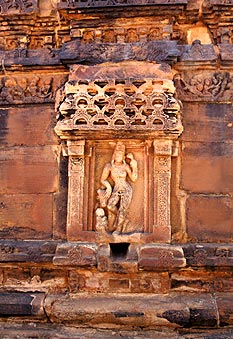 Sculpture of Kadasiddheswara Temple compared to other temples of Pattadakal is less ornamented. Sukanasa depicts dancing Siva and Parvati in a shallow trefoil chaitya-arch. The niches on the outer walls of the sanctum have the images of Ardhanarishwara (north), Harihara (west) and Siva (south). The doorway of the sanctum has pilasters set among decorated bands (sakhas) with Siva and Goddess Parvati seated at the centre of the lintel and Brahma and Vishnu on either side. River goddesses and attendants are carved at either side below the bands. Kadasiddheswara Temple is one of the monuments in Pattadakal that dates back to the 7th century. Sculpture of Kadasiddheswara Temple compared to other temples of Pattadakal is less ornamented. Sukanasa depicts dancing Siva and Parvati in a shallow trefoil chaitya-arch. The niches on the outer walls of the sanctum have the images of Ardhanarishwara (north), Harihara (west) and Siva (south). The doorway of the sanctum has pilasters set among decorated bands (sakhas) with Siva and Goddess Parvati seated at the centre of the lintel and Brahma and Vishnu on either side. River goddesses and attendants are carved at either side below the bands. Kadasiddheswara Temple is one of the monuments in Pattadakal that dates back to the 7th century.
Sculpted images of dwarapalas are to be found beside the mandapa doorway. These are decorated with five worn out bands or sakha. The wall surfaces are completely plain except for the friezes bearing the sculpted images of the ganas. The stone sculpted ganas are seen here with garlands in their hands.
It is the outer walls of the sanctum where one will come across few sculptures that include the carved figures of Ardhanariswara, Lord Shiva and Harihara. The doorframe of the sanctum has pilasters that have been set amidst the ornamental sculptures of bands where Shiva and Parvati are shown seated at the center of the lintel. They are flanked by Lord Vishnu and Brahma on either side. The figures of river goddesses and attendants are also found below the sakhas.
This article is a stub. You can enrich by adding more information to it. Send your Write Up to content@indianetzone.com
|
|
|
|





