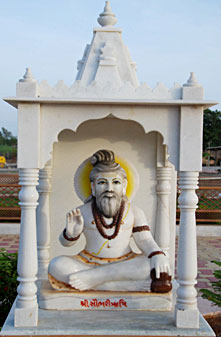
 Saubhari was a pious sage and his legend is narrated in the Puranas. Saubhari spent twelve years immersed in a lake of fish. The monarch of the lake was Sammada who had many progenies. Sammada used to live with his children and grandchildren and lived amongst them happily, playing with them night and day. Saubhari, the sage was disturbed in performing his meditation by their sports. Saubhari got distracted from his meditation and thought to have his own family and children. Having thus decided the Muni Saubhari came up, hastily, from the water and inspired with a desire of offspring. Saubhari then went to King Mandhatri, and demanded one of his fifty daughters to be his wife.
As soon as King Mandhatri was informed of the arrival of the sage, the king rose up from his throne. He welcomed Saubhari and treated him with the most profound respect. After taking a seat, Saubhari said to the emperor that he wanted to marry one of the daughters of the King Mandhatri and have offspring.
Afraid to refuse, and yet unwilling to bestow a daughter upon such a suitor, the king Mandhatri sat silently for sometime. Saubhari saw the King contemplating and asked him why he was agonized. The king Mandhatri apprehensive of his displeasure answered and replied to sage Saubhari that it was customary and ritual of the family of the king to wed their daughters or the princesses to the persons selected by the girls. The daughters of the royal lineage selected suitors of fitting rank by their own choice. The reason for King Mandhatri`s bewilderment is that his daughters are unknown of this fact of sudden marriage proposal and that he is unknown whether they will agree to the proposals. The sage Saubhari understood the problem of the king but was determined to marry.
It was settled that, if any one of the daughters accept Saubhari as a bridegroom, then Mandhatri would give his consent to the marriage. Mandhatri then commanded the eunuch to lead the sage into the inner chambers. As Saubhari entered the apartments he assumed the stature of a fair and handsome man. He assumed a handsome form so that all the girls were captivated, and contended with each other as to who should become his wife. When the daughters of King Mandhatri looked upon the person of the Rishi, they were equally inspired with passion and desire. Like a troop of female elephants disputing the favours of the master of the herd, they all wanted to marry the Rishi in handsome form. To get married to the Rishi, a violent quarrel arose amongst the daughters of the king, each insisting upon the exclusive election of the Rishi. The Rishi came to the king and informed what had happened inside. King Mandhatri was puzzled to hear this news from the sage Saubhari and decided to marry all his daughters to the Rishi. Thus in the end pious sage married all the fifty daughters of Mandhatri.
Saubhari had fifty wives and then he took them home to his habitation. He employed the chief of architects, Viswakarma to construct separate palaces for each of his wives. Saubhari ordered Viswakarma to provide each building with elegant couches, and seats, and furniture. Further he ordered to attach to the palaces gardens and groves, with reservoirs of water, where the wild-duck and the swan should sport amidst beds of lotus flowers. The divine artist Viswakarma obeyed Saubhari`s command, and constructed splendid apartments for the wives of the Rishi. In each palace by command of sage Saubhari, the inexhaustible and divine treasure called Nanda took up his permanent abode. There the princesses entertained all their guests and dependants with abundant food and pleasure of every description and of the choicest quality.
After some years had passed, king Mandhatri yearned to visit his daughters. He felt anxious to know whether they were happily circumstanced. Therefore he set off to visit the hermitage of Saubhari. When Mandhatri arrived he was amazed to see a row of beautiful crystal palaces, shining as brilliantly as the rays of the sun. He was surprised to see those lovely gardens and reservoirs of pellucid water. Mandhatri entered into one of these magnificent palaces and found his daughter and embraced them. He asked to each of them whether they were happy living with the Sage and does Saubhari treat them with tenderness or do they long to go back to their father`s palace. But to these questions each daughter of Mandhatri answered that they live a beautiful palace, wear costly ornaments and live luxuriously and happily. The only cause of anxiety of each daughter of Mandhatri is that the husband sage Saubhari is never absent from their dwelling, solely attached to each of them. Each of the sisters thought that sage Saubhari is wholly devoted to her, and paid no attention to her sisters.
In every palace, Mandhatri heard the same story, from each of his daughters, in reply to his questions. With a heart overflowing with wonder and delight, Mandhatri met the wise sage Saubhari, whom he found alone. After paying homage to Mandhatri addressed the sage to be a holy person with amazing power which no other human being possess. King Mandhatri then resided with him for some time, partaking of the pleasures of the place, and then returned to his capital.
In the course of time, the daughters of Mandhatri bore to Saubhari a hundred and fifty sons. As the day passed Saubhari`s affection for his children became more intense, and his heart was wholly occupied with the sentiment of self. Saubhari`s desires and wishes doubled as days passed. He thought to spent life blissfully with his children and grandchildren. By these and similar reflections Saubhari perceived that his anticipations every day outstripped the course of time; and, at last, he exclaimed that there is no end to his desires. He thought that when one of his desires is matured then he longs for another one and this way his desires are never-ending. Thus Saubhari resolved to devote himself wholly and solely to penance and to the worship of Vishnu. Saubhari realized that separation from the world is the only path of the sage to final liberation. Consequently, Saubhari, the pious sage abandoned his children and retired with his wives to the forest.