


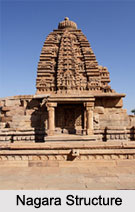
 North Indian temple architecture produced all over northern India and as far south as Bijapur district in considered by its individual shikhara, a superstructure, tower, or spire above the Garbhagriha, a tiny shelter housing the main image or symbol of the temple goddesses. North Indian temple architecture produced all over northern India and as far south as Bijapur district in considered by its individual shikhara, a superstructure, tower, or spire above the Garbhagriha, a tiny shelter housing the main image or symbol of the temple goddesses.
The style is sometimes referred to as Nagara, a kind of temple mentioned in the Shilpa Shastras but correct association of the Shilpa Shastra terms with existing architecture has not yet been recognized. Different Temple Sculptures of North India The different types of temple sculptures of North India are as follows; Nagara - Nagara is the manner of temple architecture which became popular in Northern India. Unlike in south India, North Indian temples do not generally have complicated boundary walls or gateways. Earliest temples of North India had simply one shikhara (tower), but in the later periods, numerous shikharas came. The garbhagriha is always located directly under the tallest tower. Latina - Latina is the easy and most ordinary type of shikhara. Latina types are mostly used for lodging the garbhagriha. Later on, the Latina buildings grew compound and in its place of appearing like a single tower, the temple began to support many little towers, which were clustered jointly like rising ton type with the tallest one being in the middle. Phamsana - Phamsana are broader and shorter than Latina form. Their roof is composed of some slabs that quietly rise to a single point over the centre of the building, unlike the Latina ones which look like roughly rising towers. Phamsana roofs do not bend inwards; in its place, they incline rising on a straight incline. In many north Indian temples, the phamsana type is used for mandapas while the chief garbhagriha is housed in a Latina construction. Valabhi - Valabhi are rectangular buildings with a roof that rises into a vaulted hall. The border of the vaulted hall is round, like the bamboo or wooden wagons that would have been drawn by bullocks in very old times. The shape of this temple is influenced by very old building forms that were already in survival. This article is a stub. You can enrich by adding more information to it. Send your Write Up to content@indianetzone.com |
| |||



Home > Art & Culture > Indian Sculpture > Indian Temple Sculptures > Temple Sculpture of North India
Temple Sculpture of North India
| Temple sculpture of North India has been highly influenced by the Mauryas, Guptas and Rajputs. |
| ||||||||||||||||||||||||||||

