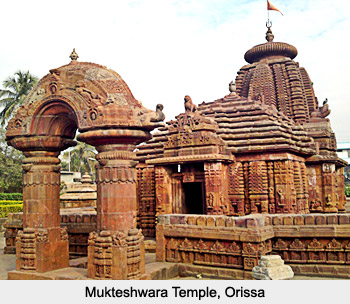
Introduction
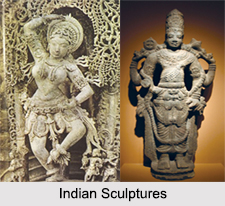 Indian Sculpture was the favoured medium of artistic expression on the Indian subcontinent. Indian buildings were profusely adorned with it and indeed are often inseparable from it. Indian Sculptures and its associated zone lay bare the fact that sculpture is essentially a public art. It is indeed amazing how even day to day affairs have been portrayed with the help of sculptures in India from political economy to the cultural hedonism the plethora is immense and extensive. Mankind have had used sculpture as the basic means of artistic expression. The art of sculpture requires the sculptors to breathe life to the cold and lifeless stones and rocks. The Indian artisans have been successfully rendering life to these listless blocks.
History of Indian Sculptures
History of Indian sculpture dates back to the Indus Valley Civilization of 2500 to 1800 BCE, during which time small terracotta figurines were produced. While stone, metal, ceramics and wood have taken a back seat; the sculpture zone has been swept off by the horizons of light and sound. Environmental art and sculpture has hogged the limelight and the contemporary age has manifested the nuances of the same. There was a constant influence of foreign art and culture that enriched Indian sculpture and architecture. The grandeur that the Islamic art brought to India has been embossed in marbles and red sandstones. When the British reigned over India, the sculptures were of the European Gothic style. A wide range of styles and traditions subsequently flourished in different parts of India over the succeeding centuries. Indian sculpture had reached a form that has lasted with little change up to the present day.
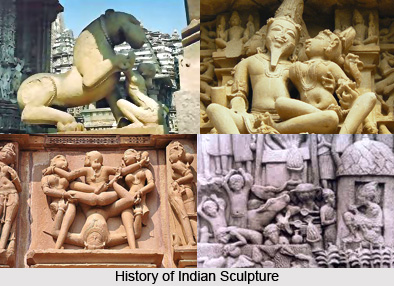 India witnessed development in sculpture during the rule of the Mauryan Empire. Sculptors begin to carve characters and scenes from mythology. Brick constructions and the terracotta works were slowly replaced by the new found religious faith, Buddhism. Beautiful monuments dedicated to this faith came into existence.
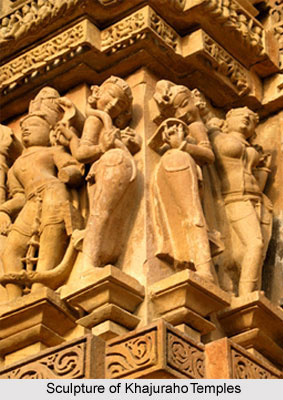
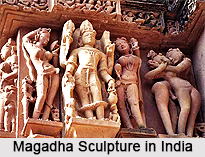
The presentation tends to be frontal. Among other themes, there are examples of Hindu art`s most abiding image - magnificent young women, nude, full-breasted, and often some strikingly athletic pose. For example sculpture of Khajuraho temples of 11th century AD. Buddhist sculpture acquires a character of its own when the religion moves outwards from India to northwest.
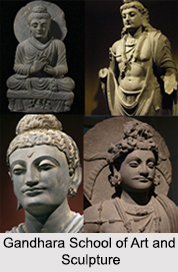
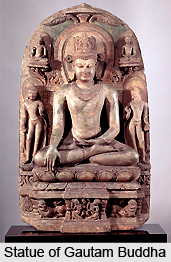
From the 1st century AD there is a strong school of Buddhist sculpture known by the ancient name of Gandhara. In Gandhara sculpture realism is subtly combined with the local traditions of India to produce Buddhist images. The sculptures of Buddhist structures were simple yet these appeal to the senses.
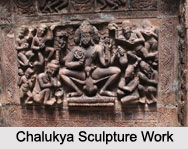
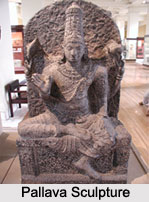
Down south several kingdoms sprang up and with their emergence Hinduism was revived. In an attempt to bolster this faith the South kingdoms, such as, Cheras, Cholas, Chaulkyas, Pandyas, Nayakas, Pallavas and others provided royal patronage to the Indian temple sculpture. The scenario was similar in North India as well. However, there was a basic difference between the two styles. While the North Indian temples have bee-hive shaped towers, the South Indian temples follow the idioms of Dravidian art and sculpture. The ancient Indian sculptures, thus, primarily consisted of religious buildings. Another reason for this concentration was that temples in ancient India were the centre for art, culture and knowledge. Hence art and sculpture flourished here.
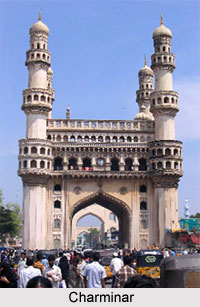
Muslim rulers introduced India to an entirely different mode of sculpture and architecture. Medieval Indian sculpture, thus, witnessed the constructions of dome shaped buildings. Other architectural elements that enhanced the beauty of the religious places include the jharokhas, chajjas, chhatris and others. The modern Indian sculptures completely drifted away from the Muslim sculptures. The history of Indian sculpture has, thus, witnessed numerous changes over the ages. While some of the Indian sculpture has survived the test of time, others remain only in forms of ancient ruins. The contemporary Indian sculpture follows a more international vocabulary but its sources are deeply rooted in the history of Indian sculpture and art.
Types of Indian Sculptures
The various types of Indian Sculptures depend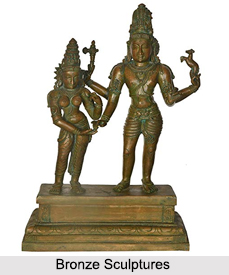 on the materials of which the sculptures have been composed. They are as follows:
Some date back to the pre-historic era some have evolved with the changing empires in India. Indian sculptures offers a varied range starting from carving to sand sculptures; the range that the Indian sculpture offers is truly varied. Besides the ancient and medieval sculptures a number of modern sculptures have come into being.
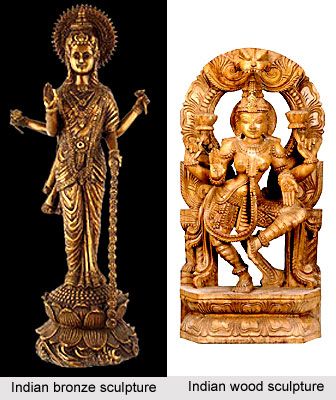 While tracing the history of Indian sculpture one would find out that carving in India has done for centuries with using varied materials such as stone or rock, wood, bronze metal, bone, and marbles also. The purpose of creating sculpture has been to create a piece of art that should be permanent hence, durable and frequently expensive materials, like bronze and stone such as marble are used. But, the most preferred and less expensive materials that were used for producing sculpture on wider scale are stone, metal & wood including such as oak, box and terracotta. Materials for sculpture can be just stone, bronze, clay and durable wood in case of India. Most of these materials are long lasting materials.
•Wooden Sculptures - Wooden Sculptures are made almost all over India. The southern states of Karnataka, Kerala and Tamil Nadu have an exceptionally grand tradition of wood sculpting. Every region of India had developed its own unique style of wooden structures, marked with a distinct type of carving, strongly influenced by local traditions and the materials that were locally available. From the southern parts of India, the wooden sculptures and toys are very much popular for their intricate carving works and meticulous finishing. In Indian wood sculpture, Idols of god, goddesses and demigods are the most preferred themes through this presentation.
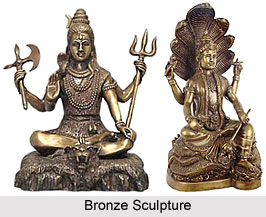
•Bronze Sculptures - Bronze Sculptures have been discovered from many regions of India. These were used for ritual worship and are characterised by exquisite beauty and aesthetic appeal. From the 17th century & onwards, south India has images that are made of various gods and goddesses, of saints and deified mortals from the Bronze metal. The sculpture of Bronzes immensely radiates a sense of immortality and powerfully reflects the fascination and mystery about the ancient cultures of Buddhism, Jainism and Hinduism. These art works are a visual interpretations of celestial beings, illustrate about the human condition of transcendence through which he led to spiritual enlightenment.
•Marble Sculptures - Marble has been one of the most popular choices of material for crafting statues since ancient times. Marble sculptures are sturdy, durable, elegant and classy. Marble sculptures are marked with a unique place in the world art, as the art of stone sculpting is very much common in every state of India. A large percentage of marble sculpture is employed for a sacred purpose in India, in preparing various statues, idols of Gods & Goddesses & carvings in architecture. The entire artwork of marble sculptures bears the excellent style and patterns of finest craftsmanship that are achieved with quality.
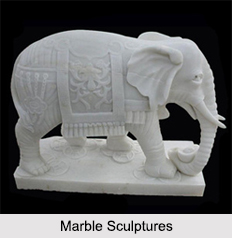 •Stone Sculptures - The classical tradition of Stone Sculptures in India was closely linked with architecture. All major temples of India illustrate the rich tradition of Stone Sculptures. The temples and Madhis in the Himachal area are full of stone statues of deities. The tribal areas have their own kind of statues which reflect the religious beliefs of the tribals. The Shiva temple at Baijnath and the Krishna temples at Masroor are carved out of a single rock. The temples at Chamba, Mandi, Kulu and Bilaspur areas display feats of architectural skill by local artisans much before the advancement of science. The stone masons are known as `Batai Hadai.` Large buildings and small articles of daily use in the houses like pounding stones, moohras, pots and basins also display the skill of local masons amply. The pink sandstone sculptures of Mathura evolved during the Gupta Empire period. Gupta period art would later influence Chinese styles during the Sui dynasty and the artistic styles across the rest of East Asia.
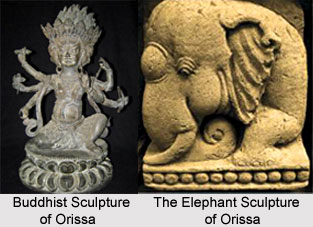
•Sand Sculptures - Sand Sculptures are popular among the booming tourist industry in Puri. The sculptures are created solely with sand, water and a small amount of glue. Sand sculpture, like any other kind of sculptures can be of any shape, size or form. It can include the above things- a castle, or created in a human, animal, plant or a fantasy form. In India, sand sculptures originated in Orissa, but later on became familiar in all parts of country.
Themes of Indian Sculptures
Indian craftsmen have always been fascinated by figures from mythology and religion. Sculptures of Hindu Gods and Goddesses, of other Hindu figures, of Buddha, and figures from Christianity and other religions have hence dominated their work. The nude was used both to represent the body as a symbol of spirit and to reveal the imagined shapes of the Gods. The multiple heads and arms of sculptured Hindu divinities were thought necessary to display the manifold attributes of these Gods" power. In addition, they have also carved beautiful statues and sculptures inspired by everyday life, as well as court life. India boasts of sculptures of animals, birds and human figures. Indian artists also experiment with abstract sculpture and sculpture in other media.
Features Of Indian Sculpture
A characteristic of Indian sculpture is that it is primarily realistic in nature and that human forms appear in it are closely related to the surroundings. Intricate designs and sculptural artefacts mark the archetypal feature of the lost history of the classic Indian Sculpture.
Elements of Indian Sculpture
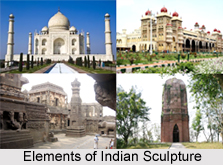 A cluster of architectural and sculptural elements lead to the formation of a single sculpture. Indian sculptures, too, have several such elements that are employed to carve out amazing pieces of art. These architectural and sculptural elements have been assembled from different schools of Indian art and architecture. While some of the sculptural elements are widely found engraved on the walls of places of worship others have been utilized to decorate the palaces and forts.
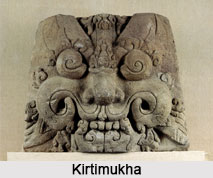
Architectural attributes like garbhagrihas, mandapas and gopurams represent the key features of a particular style. For instance the aforementioned elements will take one back to the South Indian temples. Sculptural attributes like the kirtimukhas helped to decorate the outer walls of these temples alongwith the animal and plant motifs. Such architectural and sculptural elements are parts of ancient India. With changing times several other kingdoms cropped up. Invaders became rulers and with them they brought new architectural and sculptural elements. One of the most prominent features is the dome. This was introduced by the Delhi sultanate and is considered a Persian influence.
Alongside the architectural and sculptural elements original methods of in lay works also evolved. Pietra Dure is one such method. From times immemorial several alien styles of art and architecture have influenced Indian art. Hence there are certain attributes which are not native yet they have been consistently used in the Indian monuments. Arabesque, jharokhas, chhatris and others belong to Islamic art and architecture.
Besides these the other architectural and sculptural elements of Indian art are as follows:
| Vestibules | Minarets | Charbagh |
| Tombs | Domes | Reliefs |
| Haveli | Miniature towers | Friezes |
| Stepwell | Calligraphy | Eaves |
| Vimana | Jaali | Pradakshinapatha |
| Shikhara | Chhajja | Cenotaphs |
Muslim Indian Sculptures
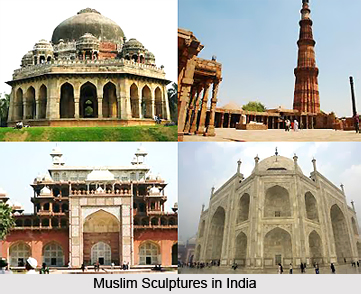 Muslim Indian sculptures played an important role in the development of Indian art and architecture. Historical facts have often pointed out that Muslim invaders have plundered ancient Indian temples. Simultaneously it is also true that the Muslim rulers of India have constructed beautiful monuments and enriched the art and culture of India. Throughout the Muslim rule in India wonderful monuments have been constructed that are famous even today. These monuments still stand as logo of creativity while displaying the finesse of the Muslim Indian sculpture. Taj Mahal is one such glaring example of Muslim sculpture; built in white marble it been recognized as one of the Seven Wonders of the World.
The Muslims came and conquered India. They brought with them their own dogmas and styles. Their Persian style of architecture intermingled with the native form and gave rise to a new form and a whole new concept of the Indo -Islamic architecture. Initially, however, the Muslim Indian sculptures followed a different style but in the later years the features of the Muslim Indian sculpture and architecture differed. One of the main elements that this style introduced was the dome element. Whether it was a religious building or a secular one, domes were always an important part.
Another important feature of Muslim Indian sculpture is the Pietra Dure inlay work. This is a decorative art where stones are exquisitely cut and fitted within inlay works. These stones varied from semi precious to precious. The sculptures from the Muslim reign show intricate works and details. Foliage sculpture, especially creepers are quite commonly found in these monuments. The Muslim era in Indian can be divided into two: Delhi Sultanate and Mughal dynasty.
The features of Delhi Sultanate sculpture primarily reflect the early Muslim features. Minarets, lofty minars, tomb structures, jail windows and other architectural elements are quite apparent from the buildings. It was the Mughal architecture that primarily incorporated both the Persian and Hindu styles of architecture. Another important feature of Mughal sculptures is calligraphy. The walls of mosques, memorials and tombs usually have this sculptural element. The trend of quoting Holy Quran is quite common. Besides arabesque is also a recurring element in Islamic sculpture. Arabesque is the art of repeating geometric forms of plants or animals. Indian Muslim sculptures usually have the plant pattern.
However it would be wrong to say that the only change in the field of art occurred in Indian Muslim sculptures. This impact was also felt in painting, music and even in Indian dance.
Contemporary Indian Sculpture
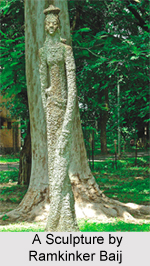 Contemporary Indian Sculpture is vocal about the Indian identity owing to the various forms and Modus Operandi about the visual art zone. Sculpture essentially being a public art lays bare the cudgels of modernity, avant-garde expressionistic modes and futuristic ways. Indian Contemporary Art in the break of 21st century is as varied as it had never been before. While the middle and pre independent era manifested the lack of independence on the part of Indian sculptors, as they were mostly commissioned for work and under quintessential patronage, post liberalization era witnessed the affluent emergence of new array of ideals which was a far cry from the stains of dogma or ideological shackles.
Developments of Contemporary Indian Sculpture
Contemporary painting and sculpture hardly bear the copious strings of inscrutability. They breathe the similar air, the similar mother body. Alienated from the Indian tradition they are bizarrely hinged to the modern eclectic notions of international space. From the elitist business houses and royal families, it has now entered the drawing rooms of the middle-class buyers and from domestic market it is now travelling offshore to fetch immense; often astronomical prices. To cater the demands of the newly emerging upper and middle social classes, intense and exaggerated realism during this period was introduced. The mid Victorian ideas on naturalism and smugness plated the colonial legacy of the British. However the British race instigated the sculptural zone with the fiery air of individualism. The iconographic, symbolical, religious ideals of Indian sculpture soon became a far cry of the past to invite the realist naturalist heights.
After being freed from the yoke towards forties, the sculptural institution started looking up to western world for dosages of inspiration. Phases of transition from the academism to well defined non objectivism with new and unconventional materials had been the watchword. The logical Cul-de sac with the perspectives of necessary height and measures indeed provides a meaningful introspection.
Full realisation of concepts had been the benchmark for the modern sculpture. The influence of the isms, concepts of desolation, semi surrealism, even got accentuated. Changes in the concept of colour, throws light on the paradoxical nature of modern and traditional dwellings. In case of sculpture, it is the material that is of fundamental importance determining the criticality of the concept. The sharp lines, the variegated textures, the incision the relief the excellence of etching all build up the manner and matter of the sculptural art.
Concepts in Contemporary Indian Sculpture
Expression wise deeper and newer forms of art evolved as India maintained her connections with the world beyond through both sea and land routes the influence of culture of other lands have always been felt in the art map of India. Stunningly intricate designs, sculptural artefacts, mark the archetypal feature of the lost history, of the quintessential Indian overtones. When it comes to Indian cultural abode, a major portion is indeed formulated by the sculptures. 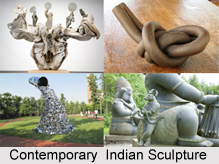
Indian sculptural abode has gone international with the unflinching traits of globalization and Cultural Revolution far across and far away, inland and outland. Beginning of modernism in Indian sculpture traced to its adaptation of western academic art traditions in the early 20th century. This is one of the reasons why one would still come across a statue of the Hindu gods amid hordes of Indian sculptures that represent the modern man and his environs. However, Post modern age compliments post modern patterns in Sculptural rendezvous with the nadirs of various influxes in the idealistic and social zone. The tumults of impressionism, cubism, Dadaism and Avant Garde trends and tendencies have silhouetted the artistic penumbra. They have coaxed and cajoled their ways into the spectrum, the confines of the sculptural artistry.
Three dominant features cloud the paramount sky of the Indian sculptures. They reiterate with time in the crescendos of art and sculpture. Unique indigenous language unconventional materials such as concrete gravel and cement looking to the rural landscape and tribal communities for subjects which reaffirm the unquenchable quest for identity. The second is the use of Computer Graphics, photography and modern techno buzz and an amalgamation of other media in the threshold of the creation of sculptural art amidst the Indian artistic canvas. Again last but not the least the exploration for individualist language of expression, the affirmation of Pseudo realism, an art genre, which solely originated in India. The stalwarts of Indian arts carried forward their nationalistic ideas which were born in British era.
Though modern Indian sculpture walks the journey of International vocabulary, yet the sources are ingrained in Indian history and Indian culture.
Contemporaneity of Contemporary Sculpture
Indian sculpture is pregnant with the streaks of contemporary flavours and the traditional hangovers. The concept of modernity in sculptural sky enamours the aforesaid conditional term. Tradition had been the key word to the body of Indian Sculpture however with the forward march of time the sculptural canvas had been silhouetted by the darkness of modernist impulses and the various isms. The quested query reverberates within the minds of chosen few: as to how much contemporary is the contemporary sculptural zone. The transitions, the ways, the attributes, the cyclical developments all are but the fall outs of the similar transgression. Contemporary vibes do not necessarily ascertain the features of the current age, the present genre, and it is for the sole reason as to why the medieval sculptures or the Indus ones are still contemporary. Ages would witness the dawn of revival times would stand before the sea of eternity yet the sculptures of the present ages, the meaningful ones would be immortal.
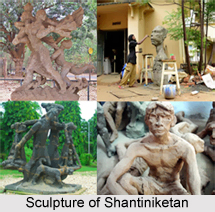 Sculptors of the Contemporary Age
Nandalal Bose, one of the distinguished pupils of Abanindranath Tagore had been influenced by the later. Quite naturally, the artistic trends, styles of the Tagore twilight had merged into the artistic shadows of the former. In the painting of a woman in the act of doing `Pranam` one sees both simplicity and directness of his pictorialism as also the significant impact on his work of the vitality of folk art. Jamini Roy`s works mainly show cased the in and outs of folk tradition. Singularly stylised, they are conceived in emphatic flat spaces and strong lines. Most of the important Indian artists of this time Abanindranath Tagore, Nandalal Bose and Jamini Roy stayed away from this genre of art and instead had established an alternative school of art called the Bengal School with its centre at Shantiniketan. It is only in late nineteenth century that some Indian artists had infused the techniques of realism to depict Indian subjects using Indian motifs and from Indian view points. The pioneer in the new school of Indian realism was Raja Ravi Verma. Raja Ravi Verma depicted scenes from Indian mythologies and presented them in a realist-romanticist format. A spirit of humanism is celebrated throughout which is infused with a sense of spiritual which is reminiscent of the classical sculptural styles. Search for pure form induced by European aesthetics added new and interesting dimensions. Experiments with unusual materials of classical traditions folk and tribal sources profound effect on the artistic imagination is widely observed.
Indian art has reached a terribly high degree of sophistication and abstraction at various times in Indian history. Amalgamation of European and Oriental styles is what Indian sculptural scenario consists of.
Famous Indian Sculptures
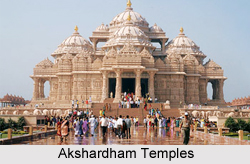 Often hailed as the land of diversity, India is speckled with numerous sculptures which highlight the rich culture and the peaceful co-existence of different communities in the sub-continent. There are certain famous Indian sculptures which have international fame. For instance the Taj Mahal is one of the Seven Wonders of the World. Besides the recipient of such a prestige and position in the arena of sculpture, Indian sculpture has successfully created its separate identity. The intricate works that adorn the colossal buildings is simply amazing.
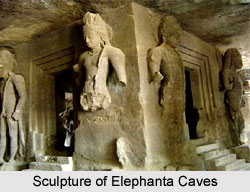
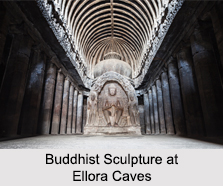
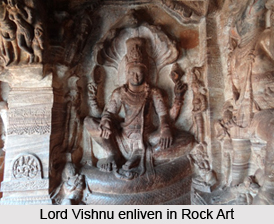
The famous Indian sculptures are incorporated in the Indian temple sculptures, Indian cave sculptures and Indian stupa sculptures. The religious places in India are the best sources for finding more about the remarkable sculptures of India. The Indian temples were once the centre of cultural activity. As a result it was here that the artisans and sculptors displayed their endowments. Sculpture, calligraphy and iconography, thus, blossomed within the temples. Both South and North India have been beautified with opulent Hindu, Buddhist and Jain shrines.
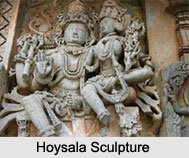
The recurring motifs used in these places of worship were foliage sculptures, animal motifs, kirtimukhas, perforated windows, lathe turned pillars and others. Temples like the Sun Temple (Konark), Meenaxi Temple (Madurai) and the Sculpture Of Veeranarayana Temple, Belavadi, Hoysala Sculpture sculpture of Veeranarayana Temple, Belavadi are some of the many specimens of sculptural acumen that existed in India. Amongst the new breed of temples it is the Akshardham Temple that stands out for its perfectionism.
An outstanding feature that makes Indian sculptures famous worldwide is the use of the erotic sculptures. Amorousness in these temples is synonymous to love. The aestheticism in these sculptures prevents them from being considered obscene. In fact it is amazing that temples which are more than 1000 years old have been adorned with such sculptures.
Some of the famous Indian sculptures are as follows:
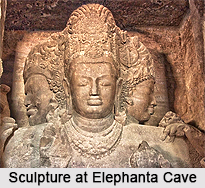
| Indian Temple Sculpture | Sculpture of Akshardham Temple | Elephanta Caves |
| Sculpture of Sun Temple, Konark | Khajuraho Sculptures | Indian Stupa Sculpture |
| Sculpture of Meenaxi Temple | Indian Cave Sculpture | Sculpture of Sanchi Stupa |
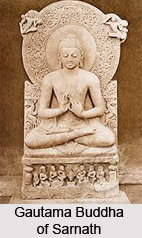
| Sculpture of Rameshwaram Temple | Ajanta Caves | Sculpture of Sarnath |
| Sculpture of Kamakhya Temple | Ellora Caves |