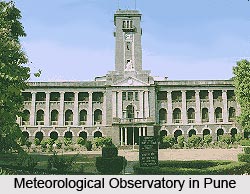
 Meteorological developments in British India gained momentum with the active participation of the British to enlighten countrymen to Indian atmospheric conditions. Ideally meteorological developments in British India happened for long span of time, with effort being out from every corner. Within the years of 1785-88, Colonel Thomas Deane Pearse (c. 1740-1789) maintained a meteorological journal in Calcutta.
In the period extending from 1792 to 1852, a series of meteorological observatories were established in country soil. The places consisted of Madras in 1792, Bombay in 1823, Calcutta in 1829, Trivandrum in 1836, Shimla in 1841, Ootacamund (Ooty) in 1847 and Karachi in 1852.
In the period of 1805-28, James Kydd compiled a register of tidal observations regarding the Hooghly River at Kidderpore. Meteorological developments under British India were being given a widespread status, just to make easier the mapping or charting of everyday weather conditions.
In the prolonged years of 1823-36, James Prinsep (1799-1840), Secretary of the Asiatic Society of Bengal, prepared a paper on his "Observations of the Transit of Mercury on the 5th of May 1832" for the Society. From 1822 onwards, he collected observations on wet-bulb indications which in 1836 he published in a paper entitled "Experimental Researches on the Depressions of the Wet-bulb Hygrometer".
Once again under the promise to develop India meteorologically, steps were being taken during the period of 1839-51. Henry Piddington (1797-1858) started to specialise in the study of storms. He prepared twenty-two memoirs for the Asiatic Society of Bengal regarding cyclones. From his investigations he published: The Horn-book of Storms for Indian and China Seas (1844), The Sailor`s Horn-book for the Law of Storms (1848) and Conversations about Hurricanes (1852).
In the time span of 1875-1888, the Meteorological Department was established under the direction of Henry Francis Bradford (1834-1893) who from 1875 to 1888 served as the first Imperial Meteorological Reporter. The Department prepared daily weather charts, issued weather summaries and conducted seismological and terrestrial magnetic studies. Throughout his life Bradford studied the impact of the sun`s heat on the earth, changes in atmospheric pressure associated with Indian monsoons and the oscillations of barometric pressure. From these observations he prepared several papers for the Asiatic Society of Bengal. Though still in the nascent stages of maturation, yet, meteorological developments under British India were truly the paving ways, the guiding star. These men and their machines brought the terms like weather, weather forecast, atmospheric pressure, charts, maps and layers of earth and crust home to native livings.