 Mauryan sculpture introduced new things in Indian sculpture. It includes the wooden sculptures were replaced by stone and brick ones. Most of the Mauryan sculptures are related to Buddhism. This was largely due to Emperor Ashoka. After converting to Buddhism, Emperor Ashoka had built several Buddhist buildings and sculptures.
The Mauryan era is marked by an extraordinary progress in the Indian sculpture. The pillars set up by Ashoka provide the finest remains of the Mauryan art. The pillars with Ashoka announcements engraved on them were placed each in sacred areas or in the locality of towns.
Features of Mauryan Sculptures
This era marked a creative and remarkable step familiar in Indian stone sculpture; much earlier sculpture was perhaps in wood and which has not survived. The Mauryan sculptures mainly comprise of the religious ones. The finest specimen of Mauryan sculpture was the pillars built by Ashoka. These monolithic pillars were carved out of single rocks. The well sculpted pillars bear Buddhist inscriptions. The pillars have supporting stones and had capitals on the top of them. The rocks are well polished and proportionately etched out. The pillars at Sarnath are the finest example of this kind of architecture.
One of the major features of Mauryan sculpture is the terracotta images. Hindu female deities made out of clay have been excavated from Mauryan sites. The forms of the mother goddesses are quite stylish. The sculpture of Sanchi Stupa and the sculpture of Dhameka Stupa in Sarnath are worth checking out for the sheer architectural brilliance.
The court art of Ashoka is best seen in the white-grey sandstone columns put up by him all over his kingdom also to mark a holy site associated with Buddha"s life or to honour a great event. Growing to a standard height of about 40 feet, the pillars are tall, pointed monoliths with sculptured capitals, incorporating a series of fluted petals in extended shape, overcome by a rounded abacus ornamented with animal and flower-patterned motifs in assistance.
Another feature of Mauryan sculpture is the rock-cut architecture. The series of rock-cut sanctuaries in the Barabar and Nagarjuni hills by Gaya in Bihar have a number of messages which show that they were donated for the occupation of certain Ajivika ascetics which are possibly the followers of the Jain religion.
The stupa was not famous in India before the time of Ashoka. It was first a simple funeral mound of earth and bricks stiffed by the Vedic Aryans. There is no proof of worship paid to relic-mounds in the pre-Maurya period. From the time Ashoka divided up the living body, historical objects of the Buddha and erected monuments to preserve them, the stupas became objects of religious group devotion.
A number of stone sculptures of human figures representative characteristics of the Maurya period have been found. Among them one is an exceptionally well-preserved statue of a female chowrie bearer. This type of feminine attire will be seen during the expansion of Indian art with some difference. The figure wears a hip-hugging garment over her lower body; its sheer folds are depicted by double-incised lines across her legs. Important ornaments, including a jewelled or beaded girdle, anklets, armbands, necklaces and earrings decorate the figure.
Works of Mauryan Sculptures
Mauryan period marked an imaginative and impressive move in Indian sculpting.
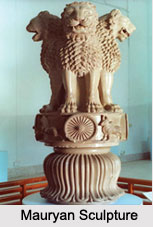
•Sarnath Pillar: The Sarnath lion capital pillar is the most extraordinary example of Mauryan court art. The representation and rendering of the 4 lions, the charisma of 4 animals below them and the fluted lotus below the abacus have been generally admired. The "Wheel of Law" surmounting the four lions suggests the superiority of dharma above royalty.
•Didarganj Yakshi: The life-size standing female figure variously described as a Yakshi, a queen or a symbol of feminine beauty. The female figure, shaped in the round, has full and rounded features with prominent breasts, broad hips, and a narrow waist. She wears a head crown, large triple-looped earrings, a pearl necklace, a double-stringed chain stanahara 5 stringed girdles, heavy anklets, and a waist garment with schematic pleats. In her right upraised hand, she holds a chamara.
•Lohanipur Torso: The torso of a Jina, standing in the kayotsarga or danda posture while performing penance, was recovered from Lohanipur near Patna and is now displayed in the State Museum at Patna. This figure in the round bears the Mauryan polish.
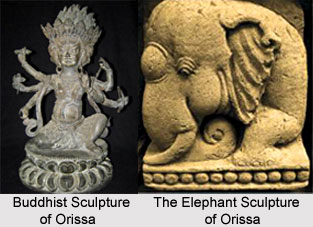
•The Stone Elephant at Dhauli: The stone elephant at Dhauli was also probably carved by local craftsmen. The majestic lions, grand horses and graceful sculpture on the Ashoka Pillars speak highly of the Mauryan sculpture. Baksha statues discovered at Dibarganj, Parkham, Patna and Besnagar and images of the Jain Tirthankaras reveal an indigenous technique in Mauryan sculpture. Usage of rocks as building material was the most important feature of the Mauryan sculpture.
•Ring Stones: Little round brown alabaster or soapstone rings, measuring between 3 and 7 inches with minute carvings are beautiful specimens of the Mauryan-Shungan period. These were found in India`s northern line from Taxila to Patna, counting Ropar, Mathura, Kaushambi and Rajghat. Specimens bearing a central gap are known as ring stones; those devoid of holes are termed disks.
•Caskets: Caskets are made of soapstone or crystal. The handling of the crystal, shaping it as a well pot with a top, demonstrates a high level of craftsmanship. These objects were excavated from the stupa of Piprawah on the India-Nepal border in the 19th and 20th century.
•Bharhut Stupa: A great stupa once stood in the locality of the village of Bharhut, near Satna in Madhya Pradesh. It was a contradicting clockwise cross with 4 gates; the space between each was covered by 16 monolithic pillars, which terminated in a return rail, allowing only an indirect entry into the sacred spot.
•Sanchi Stupas: The Sanchi area is full of stupas, which number 60 in all: 8 in Sonar; 5 in Satadhara; 3 in Andher; 37 in Bhojpur; and 7 in Sanchi. Most of these are small; only a few are large. The structure of stupas started in the 3rd century B.C.