





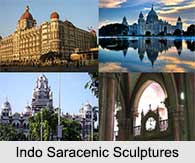
 Indo Saracenic style is an incorporation of Indian and Muslim styles by the British which led to the evolution of a new school of architecture and sculpture. This style came in to existence in the late 19th and early 20th centuries. The British architects combined the Indian and Persian styles with the Gothic sculptural and architectural attributes. Indo Saracenic style is an incorporation of Indian and Muslim styles by the British which led to the evolution of a new school of architecture and sculpture. This style came in to existence in the late 19th and early 20th centuries. The British architects combined the Indian and Persian styles with the Gothic sculptural and architectural attributes.
Features of Indo Saracenic Sculptures Indo-Saracenic designs were introduced by the British colonial government. The Indo-Saracenic sculptures were reminiscent of the Gothic era. Life size statues were sculpted in stiff and elongated styles. The figures had their individualized qualities. Attention was paid to drapes and facial expressions. Animal motifs were also widely used while depicting a king or a nobleman. These imposing sculpted figures were originally used in the West in religious buildings (churches). The Gothic sculptures were first carved on the walls. This style was a common feature in churches where episodes from Christian religious books were depicted on stone. Besides the Indo Saracenic sculptures various buildings came into being. The influence of this style is seen in several public building, for instance the Gateway of India in Mumbai, Victoria Memorial in Kolkata, Muir College at Allahabad, Lakshmi Vilas Palace at Baroda, the General Post Office in Kolkata, Napier Museum at Thiruvananthapuram, Rashtrapati Bhavan in New Delhi, Presidency College in Kolkata and others. In fact most of the courthouses, municipal buildings, clock towers and railway stations were built by following the Indo-Saracenic style of architecture. Apart from the features from the Gothic architecture the native features that were included within the Indo Saracenic form were the bulbous domes, vaulted roofs, chhatris with domes, pointed arches or scalloped arches, overhanging eaves, domed kiosks, pinnacles, open pavilions, towers or minarets, pavilion with Bangla roofs, pierced open arcading and harem windows. The Indo Saracenic sculptures, however, could not survive the test of time as India plunged back to its native forms of art as sign of protest against colonial suppression. |
| ||||||||||||||||||||||||||||

