





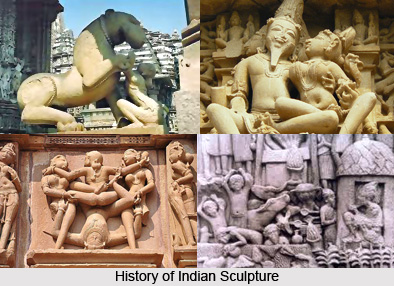
 India witnessed development in sculpture during the rule of the Mauryan Empire. Sculptors begin to carve characters and scenes from mythology. Brick constructions and the terracotta works were slowly replaced by the new found religious faith, Buddhism. Beautiful monuments dedicated to this faith came into existence. India witnessed development in sculpture during the rule of the Mauryan Empire. Sculptors begin to carve characters and scenes from mythology. Brick constructions and the terracotta works were slowly replaced by the new found religious faith, Buddhism. Beautiful monuments dedicated to this faith came into existence.
The presentation tends to be frontal. Among other themes, there are examples of Hindu art's most abiding image - magnificent young women, nude, full-breasted, and often some strikingly athletic pose. For example sculpture of Khajuraho temples of 11th century AD. Buddhist sculpture acquires a character of its own when the religion moves outwards from India to northwest. From the 1st century AD there is a strong school of Buddhist sculpture known by the ancient name of Gandhara. In Gandhara sculpture realism is subtly combined with the local traditions of India to produce Buddhist images. The sculptures of Buddhist structures were simple yet these appeal to the senses. Down south several kingdoms sprang up and with their emergence Hinduism was revived. In an attempt to bolster this faith the South kingdoms, such as, Cheras, Cholas, Chaulkyas, Pandyas, Nayakas, Pallavas and others provided royal patronage to the Indian temple sculpture. The scenario was similar in North India as well. However, there was a basic difference between the two styles. While the North Indian temples have bee-hive shaped towers, the South Indian temples follow the idioms of Dravidian art and sculpture. The ancient Indian sculptures, thus, primarily consisted of religious buildings. Another reason for this concentration was that temples in ancient India were the centre for art, culture and knowledge. Hence art and sculpture flourished here. Muslim rulers introduced India to an entirely different mode of sculpture and architecture. Medieval Indian sculpture, thus, witnessed the constructions of dome shaped buildings. Other architectural elements that enhanced the beauty of the religious places include the jharokhas, chajjas, chhatris and others. The modern Indian sculptures completely drifted away from the Muslim sculptures. The history of Indian sculpture has, thus, witnessed numerous changes over the ages. While some of the Indian sculpture has survived the test of time, others remain only in forms of ancient ruins. The contemporary Indian sculpture follows a more international vocabulary but its sources are deeply rooted in the history of Indian sculpture and art. |
| ||||||||||||||||||||||||||||

