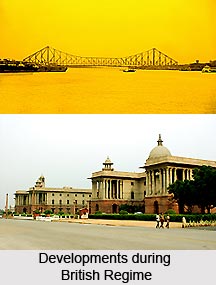
 Developments during British regime can be ideally personified as glorious. With detailed eye being kept on all subjects of educational and technical specifications the British teamed with the Indian intelligentsias offered diction to the then social scenario. Developments in technical fields like archaeology, agriculture or meteorology were the domains where the British thinkers delved their hands. Building of structured framework, buying of sophisticated tools, constructing of institutions for the concerned subject or publishing of thesis papers became a noble duty in developments during British regime. One of the significant developmental contributions of British to Indian infrastructure was the initiation of railways and travelling through trains.
Technological developments in British India started out in the mid-18th century, which would go on to become an eventful saga in the last years of British regime. At first facing much resistance from orthodox Indian population, technology did come out a winner gradually. With introduction of railways, telegraph lines, railway tracks and trains, technological development never seemed much promising ever before. With further journeys of steam ships, equipped with sophisticated implements British administration became a household name in rural areas too.
Meteorological developments in British India commenced from the late 18th century, trying to establish a complete new domain to Indians. Observatories were grounded first-hand, as a primary move. Astronomical phenomena, weather conditions and its effects on various parts of India could thus be splendidly observed for a methodical conclusion. And after an extensive period of research in the trial and error method, study papers would be published to educate the mass.
Developments in public works during British India began with a solemn promise in the early 19th century, a time which can already be considered late. Indian villages and cities were not much developed, with inadequacy speaking from every corner of the country. The unplanned conditions were hence taken into account, with irrigational standards and constructing of canals becoming the primary repair measure. A proper water channel would ensure a consequent betterment of public works in the upcoming years. The major river-sides were also ramped up in this context.
Developments in Archaeology under British Regime commenced pretty late, from the mid-19th century, with the government hurrying to establish the Archaeological Society of India to study ancient Indian culture and social life. Times prior to Christ were first taken into account. Thesis papers came into being by British scholars; surveys were conducted extensively for further knowledge of India`s primeval past.
Agricultural developments in British India can be traced from the early years of 20th century, with the government implementing every possible measure to enhance crops production and harvesting. Schools and institutions were established, head surveyors were created to look into matters, as well as creating a complete separate administration. Soil tests were conducted to make it rich for future use.
In all, developments during British regime with its stray hindrances, did happen to its fullest. A special mention needs to be made as a conclusion to developments programme. Science was the most interesting and innovative field that received a warm and full-hearted welcome form every class of society. Such were its reach that even lower stratum of natives became involved in the endeavour. As such, scientific developments during British regime contains a long list of progress, encompassing medicine, geography, forestry, astronomy, mathematics, botany, zoology and geology. These mentioned subjects outshone every possible development during English supremacy, augmented with an all-round development in science and sophistication.