


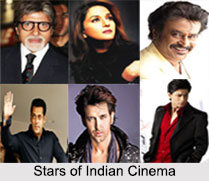
 Star system in Indian Cinema had gradually developed, as a result of changing tradition in Indian film industry. In a country, where majority of the population constitutes Hindus, religious tradition is based predominantly on the adoration of idols. Similar facet is seen with regard to Indian films, where the audience find their admiration, adoration, inspiration and imitation, in the actors and performers on celluloid and this very facet broaden their identity of these actors to Stars. What is true for the whole world as far as popular idols are concerned, takes on an infinitely deeper dimension with the heritage of "Hero Worship", very much alive and prevalent today. Star system in Indian Cinema had gradually developed, as a result of changing tradition in Indian film industry. In a country, where majority of the population constitutes Hindus, religious tradition is based predominantly on the adoration of idols. Similar facet is seen with regard to Indian films, where the audience find their admiration, adoration, inspiration and imitation, in the actors and performers on celluloid and this very facet broaden their identity of these actors to Stars. What is true for the whole world as far as popular idols are concerned, takes on an infinitely deeper dimension with the heritage of "Hero Worship", very much alive and prevalent today.
The phenomenon is perhaps not merely because of the desire of these actors to attain divine status but also because of a transposition to the screen of the secular tradition of the hero cult and the overriding importance of cinema in the lives of Indians. All these elements can be attributed as the driving force behind this system of stratification of the actors and actresses, as "stars", "superstars" and "megastars". In Indian Cinema, the star system has existed from the Silent Era and become even stronger when the studios were at their hilt. At Bombay Talkies, for instance, some remarkable actors and actresses grew into stars, but it was only in the post-studio phase that stars assumed enormous importance, both for the audience as much as for the cinema. Fundamentally, the main objective and conception of the "hero" is to make its audience dream and inspire them. The industry, realising that the star factor is what prominently drags its audience into the theatres for their movies, does not stop itself from going as far as possible to prop up the star system. With changing times, fan clubs have emerged and with the contemporary expansive reach of social media, the idolization of stars has touched incredibly greater heights. However, on the flip side of the coin are those producers and directors, of the period from the 1930s to the 1960s to that of the Golden Era of Indian cinema, as well as eminent filmmakers such as Satyajit Ray or those of the New Cinema from the 1970s onwards, and many artistic filmmakers of the time who have signed on talented actors of finesse and calibre in their films. These actors, committed professionally, are actors of parallel cinema, the films of which by these filmmakers have a place and space of their own today, unaffected by the "superstar syndrome" of commercial cinema. Raj Kapoor, Dilip Kumar and Dev Anand were the earliest stars of Indian cinema and the leading 3 actors of Hindi films in the 50s and 60s. Hindi Cinema later saw the emergence of a megastar, Rajesh Khanna. He is referred to as the "first superstar" and the "original superstar" of Indian cinema, who starred in 15 consecutive solo hit films between 1969 and 1971, a record unmatched till date. His era witnessed its closure with the evolution of the "Angry Young Man" at the forefront, Amitabh Bachchan. His dominance on Indian celluloid post films like ‘Zanjeer’ (1973) and ‘Deewar’ (1975) was so much that the French director Francois Truffaut called him a "one-man industry", in the 70s and 80s. Referred with tags like "Shahenshah of Bollywood", "Star of the Millennium" and "Big B", Bachchan has appeared in over 180 Indian films in a career spanning more than 4 decades, active prominently in films of today. He is regarded as one of the greatest and most influential actors in the history of Indian cinema. Indian Cinema down south observed this tradition first with N. T. Rama Rao and it was further ascended by the godly megastar Rajinikanth and the legendary actor Kamal Haasan. Sanjay Dutt and Mithun Chakraborty emerged as popularly followed stars of Hindi films during the 80s. The period of 90s in Bollywood witnessed the rise of 3 faces - Shah Rukh Khan, Salman Khan and Aamir Khan, the trio that continues to be indomitable and Hindi Cinema cannot do without. Actors Ajay Devgn, Akshay Kumar and Saif Ali Khan also emerged as stars of the period, and are today amongst the most established and bankable leading actors of Bollywood. The new millennium brought Hindi Cinema the contemporary superstar Hrithik Roshan, who catapulted to overnight nationwide fame with his debut in ‘Kaho Naa… Pyaar Hai’ which was one of the most successful debuts in Indian Cinema’s history. He has established a successful career in Bollywood and has been cited in the media as one of the most attractive male celebrities in India. The 21st century has also seen the emergence of Shahid Kapoor as a popular star and Ranbir Kapoor as a superstar who has continually proved his acting mettle through his performances. The most recent addition to the stars of Hindi Cinema is Ranveer Singh, who has broadened his stardom with a power-packed performance in ‘Bajirao Mastani’, one of the most commercially successful Hindi films of all time. Although the star system in Indian Cinema has always been more male-dominated, Indian actresses too have established themselves a distinct place of fame and acclaim. In Hindi Cinema, actresses who were regarded as stars and for their fine performances in films include Nargis, Madhubala, Meena Kumari, Sridevi, Madhuri Dixit, Kajol, Karisma Kapoor and Aishwarya Rai Bachchan and the contemporary actresses Kareena Kapoor Khan, Priyanka Chopra and Deepika Padukone, of whom, Chopra and Padukone have scaled their popularity and reach to a global level. Superstars of Indian regional cinemas are established actors like Chiranjeevi, Mahesh Babu and Nagarjuna of Telugu Cinema, Prosenjit Chatterjee of Bengali Cinema, Mammootty of Malayalam Cinema and Dhanush of Tamil Cinema. |
| |||



Home > Movies & Entertainment > Indian Movies > Movies in India > Indian Cinema > Star System in Indian Cinema
Star System in Indian Cinema
| Star System is an indispensable feature of Indian Cinema. |
| ||||||||||||||||||||||||||||

