 Sculpture during early British rule in India picturising the decline of Mughal and Rajputana art and the emergence of Graeco-Roman art that was dominant in 17th century Europe.
After a significant arrival to east by the British East India Company, India was given very much a colonial look in perhaps every sphere of existence. Besides education, architecture and paintings, early British rule in India had touched lives through its exquisite sculptural works. Sculpture was one of the several ways in which Englishmen tried to win over Indian population.
British Art in 18th Century
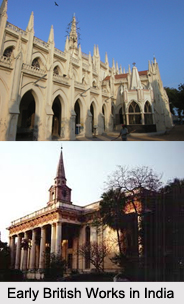
In 1835, Thomas Macaulay articulated the goals of British colonial imperialism most succinctly. In the late eighteenth century, precisely during the 1780s, the Bacons, father and son, developed the decorative allegorical style which characterised much of British sculpture executed in India. Some of the first church funerary monuments were sculpted in Madras. For example, the monument to Lieutenant-Colonel John Campbell, who died in 1784 in Mangalore during the Third Mysore War, was placed in St. Thomas`s Cathedral in Madras. The marble monument to Lieutenant-Colonel Joseph Moorhouse, who died in 1791 at the siege of Bangalore, is located at St. Mary`s Church, Madras.
Governmental Houses and Memorials of British
From the period of 1800s, the church memorials honouring civil officials of the Company projected a eulogistic theme toward the performance of duty. In the case of Sir William Jones (1746-1794) and James Kirkpatrick (1764-1805), sculpture denoted their interest in Oriental knowledge. Two monuments by James Flaxman of Jones are located in England. While John Bacon, Jr.`s work of Kirkpatrick resides at St. John`s Church, Kolkata, both sculptures possessed Eastern symbols and a sense of mysticism. It is evident from these works that sculpture during early British rule in India had started with a bang, which did not seem to stop some time soon. Sculptors were full of enthusiasm, gifted as they were with rare aesthetic vision.
Deathbed scenes and British Sculpture
Deathbed scenes constituted another leading theme of sculpture during early British rule in India. They were a common means for the representation of those associated with the Christian ministry. Sculptures by John Bacon, Jr. of the Danish missionary Christian Frederick Schwartz (d. 1798) are located at St. Mary`s Church, Madras and at Tanjore.
Sculpture showing Women in British Art
Few sculptures devoted to women were also accomplished in India. An exception is John Bacon, Jr.`s monument at St. Mary`s Church, Madras of Jane Amelia Russell who died in 1808. Her family connections, tragically brief life and recent marriage earned her this touching deathbed scene.
Imaging British Raj to the people of India
During the 1810s, John Bacon, Jr. initiated an altruistic theme in Indian sculptural works, depicting the philanthropic and Good Samaritan images. His monument of George Gilbert Keble (d.1811) at St. Mary`s Church, Madras, demonstrates this sense of charity. Likewise, Bacon`s relief of Charles Robert Ross (d.1816) in St. John`s Church, Kolkata, displays a philanthropic scene.