National Centre for the Performing Arts
|
National Centre for the Performing Arts is a cultural complex in Mumbai founded by J. R. D. Tata.
|
|
|
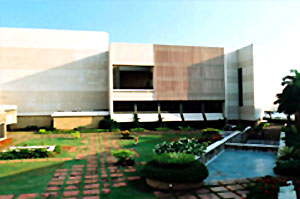 National Centre for the Performing Arts or NCPA is a cultural complex in Mumbai founded in June 1966 by the eminent industrialist J. R. D. Tata. This was founded with the objective of establishing a national centre for classical, traditional, and contemporary arts and sciences of performance and communication. In December 1969, it moved into its own premises on Bhulabhai Desai Road where its small theatre hosted a number of music and dance concerts. In May 1975, it relocated to its permanent building in South Mumbai which has five auditoria. The building had the 1000-seat Tata Theatre, the 350-seat non-proscenium Experimental Theatre, the intimate 100-seat Little Theatre, the 175 seat Godrej Theatre, and the latest, 1100-seat, Jamshed Bhabha Opera Theatre. The NCPA's Theatre Development Centre did some significant work largely on a Ford Foundation grant from 1986. Apart from collaborations with other groups and workshop presentations, its in-house productions featured Sameer Kulkarni's Kala vajir pandhra raja or 'Black Bishop, White King' in 1992 and Tempt Me Not in 1993. This was an adaptation by Rajendra Mehra and Ramesh Rajhans of Vasant Sabnis's well-known Tamasha Vichha majhi puri kara or 'Fulfil My Wish'. Both were directed by Waman Kendre. Goethe's Faust in 1994 was directed by Vijaya Mehta and Fritz Bennewitz. National Centre for the Performing Arts or NCPA is a cultural complex in Mumbai founded in June 1966 by the eminent industrialist J. R. D. Tata. This was founded with the objective of establishing a national centre for classical, traditional, and contemporary arts and sciences of performance and communication. In December 1969, it moved into its own premises on Bhulabhai Desai Road where its small theatre hosted a number of music and dance concerts. In May 1975, it relocated to its permanent building in South Mumbai which has five auditoria. The building had the 1000-seat Tata Theatre, the 350-seat non-proscenium Experimental Theatre, the intimate 100-seat Little Theatre, the 175 seat Godrej Theatre, and the latest, 1100-seat, Jamshed Bhabha Opera Theatre. The NCPA's Theatre Development Centre did some significant work largely on a Ford Foundation grant from 1986. Apart from collaborations with other groups and workshop presentations, its in-house productions featured Sameer Kulkarni's Kala vajir pandhra raja or 'Black Bishop, White King' in 1992 and Tempt Me Not in 1993. This was an adaptation by Rajendra Mehra and Ramesh Rajhans of Vasant Sabnis's well-known Tamasha Vichha majhi puri kara or 'Fulfil My Wish'. Both were directed by Waman Kendre. Goethe's Faust in 1994 was directed by Vijaya Mehta and Fritz Bennewitz.
The NCPA encourages research scholars, maintaining a library and archives to fulfill its goal of preservation and propagation of the arts. Its publications included the NCPA Quarterly Journal of the Arts during 1972-88 and the Theatre Development Centre's bimonthly Facts and News and annual Ranga-Antaranga. This stopped after the Ford Foundation grant ended. Theatre workshops and seminars constitute ongoing events. In order to decentralize its functioning, it also conducted workshops in small towns and rural areas in Maharashtra. Narayana Menon, Kumud Mehta, P L. Deshpande, Ashok Ranade, and the current director Vijaya Mehta have been largely responsible for the NCPA's development.
|
|
|
|