


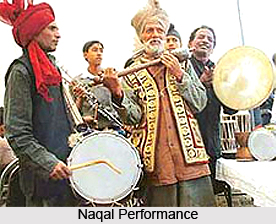
 Naqal is an Indian folk dance enacted by the Naqqals. The term naqal has been derived from a Persian word meaning 'to imitate'. This dance form is mostly popular in the villages of Punjab and Uttar Pradesh. Along with entertainment, Naqal provides a new aspect to deal with many issues. It presents subtly and sarcastically the seamy shadow spread on our life. Generally, Naqal is performed by the Mirasis, Naqaals and Bhands community people. Naqal is an Indian folk dance enacted by the Naqqals. The term naqal has been derived from a Persian word meaning 'to imitate'. This dance form is mostly popular in the villages of Punjab and Uttar Pradesh. Along with entertainment, Naqal provides a new aspect to deal with many issues. It presents subtly and sarcastically the seamy shadow spread on our life. Generally, Naqal is performed by the Mirasis, Naqaals and Bhands community people.
Origin of Naqqals Naqqals are also known as Bhands or 'clowns'. They are the rural itinerant actors in Punjab and Haryana, performing in Punjabi or Haryanvi Hindi. They originally came from the low bazigar or acrobat caste, patronized by local lords, to whom they ritually apologize before starting. Performance of Naqal Naqal is usually presented by two men who, through a series of jokes, improvisations, and horseplay, make sharp, satirical comments on society and politics. One carries a leather strap in his hand. The strap is generally seen in the size of a folded newspaper, which he wields as a weapon to hit his partner to underscore the witty punch lines. The performers wear a costume of tehemat i.e. a wraparound lower garment, short kurta, and dunce cap. As jesters, they are the symbols of the common man who relates to issues of tradition, progress, and modernity in a light hearted, frivolous, yet incisive manner through the power of their repartee. By exposing the hypocrisy of old and new alike they do their art. Naqqals function as both social critic and popular psychiatrist through their verbal gymnastics on such topics as dowry or usury. Themes of Naqal Their repertoire includes cliched relationships of mother-in-law and daughter-in-law, father and son, servant and master, law and citizenry, explored in ways that are hilarious, caustic, and close to the people's heart. These immediately communicate and create empathy through humour and laughter. The energy level is frenzied and combines dialogue with songs that tend to border on the risque. Innuendoes, double entendres, fantastically absurd remarks, and gags have spectators participating in ways that sometimes create the flow of the entertainment. The female impersonators' seductive wiles, accentuated by pelvic thrusts and provocative pouts, leave the crowd screaming for more. Other Functions of Naqal The Naqqal's other function is to provide the comic interludes offering counterpoint and softening the impact during serious moments in the performance of a full-length Swang. Larger bands of Naqqals, such as a family troupe comprising actors, clowns, singers, musicians, and dancers, often put on Swang. During the festival season or at weddings, the female impersonators, in loud costumes, can be seen gyrating furiously to the latest musical hits. At Ramlila time, they manage to earn a tidy packet, dancing to disco beats while the singers may soulfully render lyrics pertaining to the epic Ramayana. The ballads in their repertoire may belong to the narrative tradition or include popular film songs, depending upon the occasion. |
| |||



Home > Art & Culture > Indian Dances > Folk Dances of Indian States > Folk Dances of Punjab > Naqal Dance
Naqal Dance
| Naqal is an Indian folk dance which is usually presented by two men who, through a series of jokes, improvisations and horseplay make sharp, satirical comments on society and politics. |
| ||||||||||||||||||||||||||||

