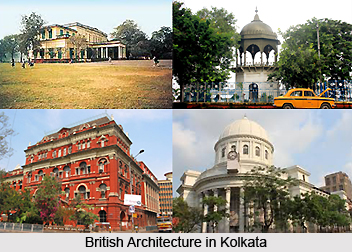
 Architectural developments of Calcutta under British rulers were given a regal look, when in January 1803 Lord Wellesley opened the new Government House with a great ball commemorating the Peace of Amiens. The structure consisted of a central block of three floors and four wings. It possessed considerable resemblance to Kedleston Hall in Derbyshire. As adapted by Lieutenant Charles Wyatt (1758-1819), Superintendent of Public Works of the Bengal Engineers, it took him six years to complete at a cost of 167,359 pounds. The renovated Government House possessed an Ionic facade. Grey marble from Italy was imported for the floors and teak wood from Burma for interior finishing. Only after 1870 did Lord Mayo (1822-1872) take an interest in landscaping the six-acre site surrounding Government House. Displaying a vigorous interest, he filled it with trees, flowerbeds and ornamental scrubs. Later still Lord Curzon (1859-1925) added electricity, modernised the plumbing and installed electric lifts and fans.
Esplanade
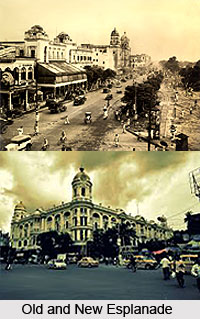
In 1813, placed on Calcutta`s Esplanade, a new Town Hall was constructed and placed in service. Colonel John Garstin (1756-1820). Chief Engineer of Bengal, designed a purely Palladian structure with no local features to moderate the severities of Bengal`s climate. In 1818, Esplanade underwent some significant overhaul.
St. Andrews Church
Within the period of 1815 to 1818, architectural developments of Calcutta under Britishers saw a sweeping escalation, overwhelming as they were in their work. The Presbyterian congregation of Calcutta constructed St. Andrews Church within this time. It possessed many resemblances with St. Martin`s-in-the-Fields, London. The structure proved to have a more coherent expression of classical details than Calcutta`s St. John`s Church.
Greek Temple Style In British Architecture
In the years of 1831 to 1837, the British East India Company builds a new mint in Calcutta for the storage of specie and the minting of new coins. It took the appearance of a classic Greek temple. The years of 1839 to 1847, witnessed Calcutta`s architectural developments create history, when St. Paul s Cathedral represented the first cathedral built in Britain`s overseas empire. Major-General William Forbes (1796-1855) of the Bengal Engineers provided its mixed Classical and Gothic design. Later the cathedral added some stained glass, executed by Edward Burne-Jones in memory of Lord Mayo (1822-1872), Viceroy of India, who was assassinated in the Andaman Islands and a statue by Francis Chantrey of Bishop Heber (1783-1826), the second Bishop of Calcutta.