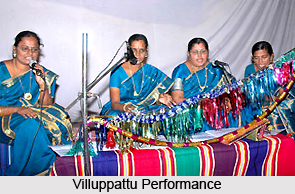
 Villuppattu is an ancient form of story-telling in which music and song provide the essential aspects. The term villuppattu comes from vil, which is a bow-shaped instrument, and pattu means `song`. Villuppattu is basically a Tamil form of narrative theatre. There is very little dialogue in this form of story narration. This form of theatre mainly found in the southern districts of Tamil Nadu.
Subjects of Villuppattu
It is about 150 years old. Stories associated with folk deities are sung. The form also encompasses ballads of local heroes who lost their lives in war or women who committed sati on their husbands` funeral pyres. Villuppattu is never treated as entertainment, but linked to values of love, heroism, and devotion. The seven-member groups performing all-night shows include many women.
Sudalai Madan, Muttu Pattan, Parvati kalyanam i.e. `Parvati`s wedding`, Minakshi kalyanam i.e. `Minakshi`s wedding`, Bharatam i.e. Mahabharata and Ramayana are in the repertoire. They have survived orally but incorporate a great deal of contemporary issues. In fact, Villuppattu took up new themes, sponsored by government and other organizations, to build new narratives. Therefore, it transcended the ritualistic balladeering traditions. Tamil cinema and television exploited it to the utmost.
Instruments of Villuppattu
Villuppattu is accompanied with a unique bow which is made in an interesting way to produce sound. The bow is made of palm, bamboo, or cane about 3 m long. The ends are strung with a thick rope, attached to a few brass bells. The bow is then tied to the neck of a clay pot, and beaten with two sticks called visu kol. This beating produces the music, which sounds like a primitive string instrument.
Other percussion includes the kudam i.e. a clay pot beaten with wide palm branches, udukkai drum, talam or cymbals, tabla, and kattai i.e. mridangam drum. The lead narrator is the annaviyar. The others repeat after him or her, with the person on kudam or tabla responding and dramatizing the story verbally. The annaviyar beats the bow only after the others repeat. Responses like amam, oho, ana, appadiya are the hallmark of this form. The narrative phase features a lot of variety as well.
People Popular for Villuppattu
In this trend, some popular names can be mentioned as N. S. Krishnan, N. S. Kolappan, Kothamangalam Subbu, and Subbu Arumugam.