Origin of Terukkuttu was in the Gingee area. The earliest references to Kuttu, involving the nominal forms kuttar or kuttan as "performer of Kuttu," are found in the Cankam poetry anthologies and the Tolkappiyam, the treatise on grammar and poetic conventions that was probably completed a few centuries after the anthologies. While the Sanskrit term nataka also came to be used in this period, defining in the Tolkappiyam the more technical sense of theatrical drama, kuttar referred to specialists in certain "ritual performing arts" , "professional actors who were also known for their nomadic character", "a particular group of bards" with a "knowledge of stories" that they enacted . The Cilappatikaram widens our scope on this early period in its depiction of various danced enactments of episodes from the mythologies of Murukan and Krishna, which can also be included under a broad but rather loose definition of Kuttu. But it is impossible to trace anything resembling the present Terukkuttu to this period, much less an epic-related dramatized mythology.
During the Chola period, inscriptions mention that plays glorifying the Chola kings were performed at temple festivals in
Thanjavur. But it is not until the Nayak period, in the sixteenth and seventeenth centuries, that one find reference to various forms of folk drama. Among these is the Kuravanchi, offshoots of which are included in the
Mahabharata repertoire of the Terukkuttu. It is possibly during this period that a repertoire of Mahabharata plays began to crystallize in the Gingee area for use at Draupadi festivals. It is estimated at around 1600 the beginnings of a Tamil ballad tradition that includes among its earliest productions a number of ballads on Mahabharata themes. As this repertoire of ballads grows, virtually all of its title episodes, including some drawn from folk Mahabharata traditions, come to have their counterparts in the Terukkuttu. Another clue that the Terukkuttu repertoire was shaped during this period is the fact that certain early Kuttus are called Yaksaganas. Indeed, though Yaksagana survives as a comparable drama form in the neighbouring Kannada-speaking state of
Karnataka, Yaksaganas were also composed in both Tamil and Telugu. The use of this term in all these languages suggests that the Tamil tradition could have adopted it as an equivalent to Kuttu during the Nayak period, when mutual influences between the three language areas were greatest.
The relation between Terakkuttu and other neighbouring regional drama forms not only the Yaksagana but the Kutiyattam and
Kathakali of Kerala, the Vithi Natakam of
Andhra Pradesh, and the Nattukkuttus of the Tamil speaking Batticaloa area of Sri Lanka has been noted by various scholars. The prominence of the two epics, and especially the Mahabharata, in these regional drama forms suggests that the epics had a sort of "prototypical" significance for them. Though generalizations on this point are risky, it would seem that at least three of them-the Kathakali, Yaksagana, and Terukkuttu drew on epic traditions that had developed in vernacular forms during the Vijayanagar and Nayak periods, with the first known dramas probably composed during the seventeenth century. There are, of course, certain themes that are distinctive to this South Indian epic mythology, most notably concerning Draupadi`s hair. But it is doubtful that there is a coherent folk epic prototype outside the Sanskrit epics themselves.
Against such a background of regional mythologies and vernacularizations of the epics, the Mahabharata repertoire of the Draupadi cult Terukkuttu is distinctive on two fronts. First, it is a specialization within the genre of Kuttu itself. Terukkuttu has this Mahabharata repertoire only in the Draupadi cult core area. In more southern parts of
Tamil Nadu excepting the very Deep South, a non-epic Terukkuttu repertoire has been shaped around other local deities and cults. In
Kerala the ritual possession dances of the Teyyam cult are also called Kuttu.
The most distinctive fact about the Draupadi cult Mahabharata of the Terukkuttu is that it seems to provide the only case where one of the epics is dramatized specifically in relation to an epic-defined cult. Kathakali is most often performed at temples of Bhagavati, in Kerala a name for Kali. Yaksagana performances are often held at various goddess temples. Terukkuttu plays on the
Ramayana are performed in the Draupadi cult core area at Mariyamman festivals. It is, of course, significant that the epics so often provide the primary material for dramatization at festivals for regional "folk goddesses." But again, it is in the Draupadi cult that this connection undergoes its most intense mythologization around the figure of the epic heroine as goddess.
The professional groups refer to Terukkuttu purely as kuttu, and regard the denotation of teru "street" kuttu as derogatory. They act and dance as they walk. The fact that they are part of a procession moving along a `street` or by way is what is truly designated by the prefix `teru`.

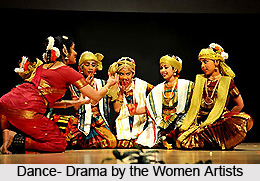
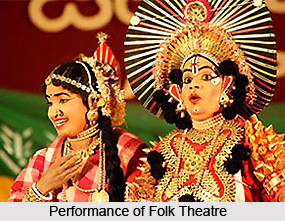
 Terukkuttu is a form of street theatre especially in Tamil language. Terukkuttu is a form of entertainment, ritual and social instruction. This form of street theatre mainly focuses on epics like Mahabharata. Terukkuttu when plays Mahabharata concentrates on the character of Draupadi.