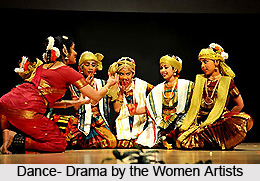
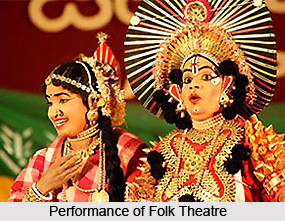
The main Swang play after the mandatory introductory Naqal is based on the legends that are part of Punjabi folklore. Some examples can be stated as Hir-Ranjha or `Hir and Ranjha`, Sassi-Punnu i.e. `Sassi and Punnu`, Sohni-Mahiwal i.e. `Sohni and Mahiwal`, Puran Bhagat, Raja Bharathari. Sometimes a troupe also stages works based on famous gathas or lyrical narratives like Prithviraj Chauhana, Puran Bhagat, or Guga Pir. The leader is director and playwright and actor all rolled into one. The texts that he evolves are totally uninhibited by any rules of syntax or dramatic structure. Mad mixtures of tragedy and comedy, they swing from the esoteric to the ridiculous.
The mesmerising performance uses a vast repertoire of songs and dances. This is based with musical patterns on classical ragas and movements that combine Kathak dance and folk forms. The style of presentation is totally non-realistic, as when the protagonist pats his horse and sings adieu to his mother but his charger, unsatisfied with the rendering, starts singing and repeats the lines in a more mellifluous voice. A character breaks into a dance measure set to a tune, even after receiving bad news. No scenery appears here. Men enact the female roles. In fact, all training of Swang and Naqal actors involves female impersonation. This is because of the fact that the entire process of transforming an actor to a character becomes more complex. With over-powdered faces, seductively-drawn eyes, blood-red lipstick, cascading wigs, and accentuated false breasts, performers with names like Miss Rosy and Miss Lilly are the real stars of the show. They serve an imperative function in a conservative society by depicting behavioural patterns that are more open and sexual. In this way their provocative pouts and pelvic thrusts feeding the fantasy of the male audience.
The actors have never heard of Brechtian alienation effects. But they continuously urge the audience away from being passive spectators to participating in the social activity. Their ability to detach themselves from the action of the play and comment on the situation creates immediate rapport with viewers. They are the total performers as they sing, dance, act, compose, and improvise in ways that always infuse new life and vigour in their art form. Tule Ram and Lakhmi Chand can be named as the most accomplished among all.