Sudraka
|
Sudraka was one of the famous dramatists of the post Gupta period. He is credited with writing the celebrated Sanskrit prakarana i.e. Mrichakatika
|
|
|
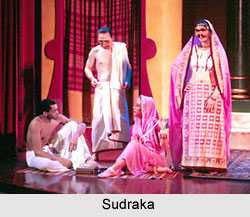 Sudraka was one of the celebrated dramatists of the post Gupta Empire. According to tradition Sudraka was known as the author of the celebrated Sanskrit prakarana or Mrichakatika. The prologue of the play contains a verse stating that he was a Kshatriya king, brave and handsome, who knew the Vedas, mathematics, the arts of courtesans, and the science of training elephants. He was a devotee of Lord Shivawho performed the military asvamedha yajnya , or horse sacrifice. He died aged 100 years and 10 days, voluntarily entering his own pyre. This account is apparently a later interpolation, but offers the only information about the dramatist. Scholars have attempted to identify him with the founder of the Andhrabhritya dynasty with Vikramaditya VI. Whatever the speculations, Sudraka cannot be placed later than the third century. Sudraka was one of the celebrated dramatists of the post Gupta Empire. According to tradition Sudraka was known as the author of the celebrated Sanskrit prakarana or Mrichakatika. The prologue of the play contains a verse stating that he was a Kshatriya king, brave and handsome, who knew the Vedas, mathematics, the arts of courtesans, and the science of training elephants. He was a devotee of Lord Shivawho performed the military asvamedha yajnya , or horse sacrifice. He died aged 100 years and 10 days, voluntarily entering his own pyre. This account is apparently a later interpolation, but offers the only information about the dramatist. Scholars have attempted to identify him with the founder of the Andhrabhritya dynasty with Vikramaditya VI. Whatever the speculations, Sudraka cannot be placed later than the third century.
Plays of Sudraka
Mrichakatika or 'The Little Clay Cart' is in ten acts, depicting the love between the Brahman Charudatta, a merchant impoverished by his generosities, and Vasantasena, a courtesan attracted to him because of his virtues. The title comes from a moving episode in which Charudatta's son cries for a toy made of gold instead of the clay cart with which he plays. In the unusual subplot, a successful uprising takes place against the reigning king of Ujjayini (Ujjain). The play is a unique comedy in Sanskrit Theatre. This is powerfully documenting the social and political conditions of the time as well as delicately delineating personal emotions. Another major feature is its use of several different Prakritdialects spoken by the minor characters, the women, and the vidushaka. It also contains much wit, humour, and satire. All these traits, and Sudraka's Mrichakatika in Bengali, directed by Kumar Roywas the staging of a revolution. It has given a wide appeal and appreciation among critics and directors not only in India but also the West.
Sudraka depicts the originality in this play of combining the political and love intrigue, which gives a special value to the play. Each of the minor characters in the drama has been given individuality that is rare in Indian theatre. Besides, the characterization of the court scene conforms duly to the requirements of the legal smritis of the sixth and seventh centuries A.D., but the conservatism of the law renders this no sign of date. The author can be regarded as the master of pathos and humour. The drama tries to reflect that an oppressive ruler can be dethroned and a Brahmin can marry a hataera, as Charudatta had married Vasantasena as his lawful wife. Charudatta held a high position in society. The drama reflects contemporary thinking on social and political problems. It is however difficult to assign any date to Sudraka, by whom the Charudatta was recast and made into one of the great plays of the Indian drama.
|
|
|
|





